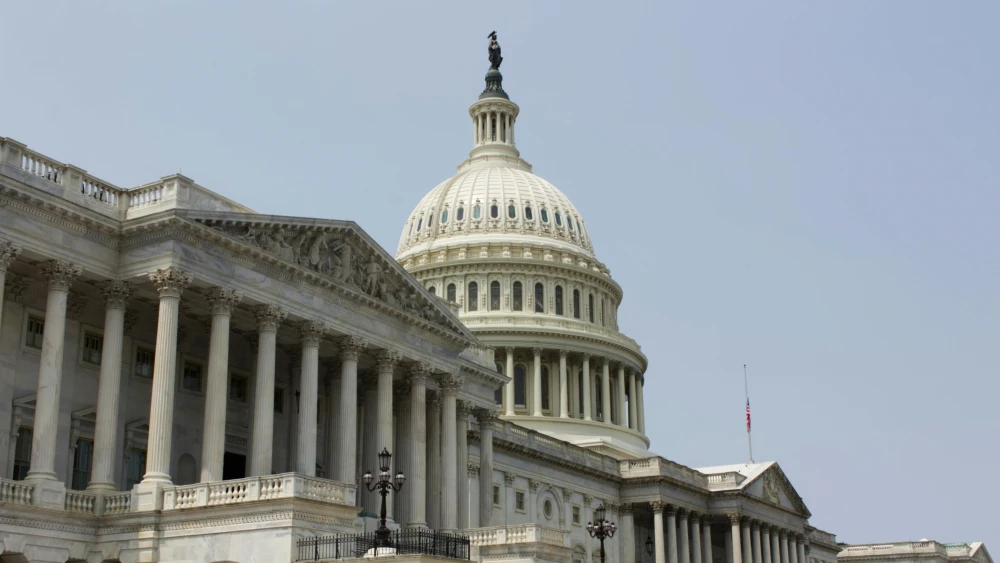

When 40 of 47 Senate Democrats vote to restrict key military support to Israel, the question is no longer whether policy is shifting, but why a party that once stood firmly with the Jewish state is now increasingly aligned with voices openly hostile to it.
This was not a vote to end all support: Defensive systems continue to receive broad backing. The distinction is narrower—and far more consequential.
Support remains for intercepting incoming attacks, but not for the means required (heavy aerial munitions) to eliminate those launching them and dismantle the infrastructure from which they originate. At a moment when Israel faces sustained threats from Iran and its network of proxy terrorist forces, that distinction reflects a deliberate choice by Senate Democrats to limit the tools available to Israel in a war it did not initiate.
There was a time when the Democratic Party was strongly pro-Israel. That support was most evident when Israel was widely perceived as vulnerable—during the wars of 1967 and 1973, when its survival appeared immediately at stake.
Today, a stronger, more capable Israel faces an arguably greater threat: Iran’s carefully constructed “ring of fire,” a network of proxy forces designed to encircle and pressure Israel from multiple fronts. This was most clearly demonstrated by the Hamas-led terrorist attacks in southern Israel on Oct. 7, 2023, which deliberately targeted civilians rather than military objectives. This is not conjecture.
Iranian leaders and their affiliated groups have repeatedly articulated their objective of eliminating the Jewish state. This is not a static threat environment; it is an actively coordinated strategy designed to pressure Israel simultaneously on multiple fronts.
Eighty-five years ago, Democrats, led by President Franklin D. Roosevelt, helped mobilize the United States to confront the global threat posed by Adolf Hitler and the Axis powers during World War II. There was broad recognition that defeating such a threat would require sustained force and significant sacrifice. More than 400,000 American soldiers died in that war, and Allied military losses reached into the many millions. Those numbers reflected an understanding that some threats cannot be contained through restraint or deterrence without credible force.
The parallels today, while not exact, are difficult to ignore. Iran’s regional ambitions, its ideological commitment to prolonged struggle, and its explicit hostility toward Israel echo earlier patterns in which expansionist goals and eliminationist rhetoric were dismissed until they could no longer be ignored. Yet Israel often appears to stand alone in treating these threats as strategically central.
What makes this vote significant is not only its outcome, but what it reveals about a broader shift already underway.
First, what can be seen is a growing moral inversion in which a democratic ally nation defending itself is treated with suspicion, while its adversaries are granted relative leniency. Second, a collapse in deterrence thinking, in which arming allies—once understood as a means of preventing wider conflict—is increasingly recast as escalation.
These shifts are reinforced by domestic political reflexes, where opposition to a policy may be shaped less by its strategic merits than by its political associations. The result is that decisions affecting a critical ally risk being filtered through internal partisan dynamics rather than external strategic reality.
When the forced transfer of children in one conflict produces relatively limited sustained political consequence, while another nation’s attempts—however imperfect—to limit civilian harm generate continuous outrage, the question is no longer simply about policy. It is about standards: how they are applied and to whom.
This disparity in standards is not merely rhetorical; it is reflected in concrete policy decisions.
That contrast becomes even more striking when it moves from moral framing into legislative behavior. In recent votes, Democrats have been overwhelmingly supportive of providing Ukraine with weapons and military assistance in its war against Russia.
Support for Israel, by contrast, has become markedly more divided—and in some cases, actively opposed—within the same party. One conflict is framed as a defense of democracy against aggression; the other is increasingly filtered through skepticism toward a key U.S. ally itself. The divergence is not in the recognition of aggression but in how consistently that recognition is applied.
At the same time, internal pressures within the Democratic Party have shifted. Elements of its left wing have embraced anti-Israel and anti-Zionist positions, at times overlapping with rhetoric that crosses into antisemitism. Whether or not this represents the majority of the party, it exerts influence on its direction and priorities. The result is a growing reluctance to extend to Israel the same strategic and moral clarity applied elsewhere.
One need not assume malign intent to recognize the moral asymmetry at work. But when policies that would predictably constrain the self-defense of the world’s only Jewish state gain overwhelming support within a major U.S. political party, it is neither unreasonable nor inflammatory to ask whether something deeper is at play, including the possibility that longstanding bigotry is being reframed in contemporary language.
The issue is not whether Israel deserves uncritical support. It is whether a democratic ally facing enemies that have explicitly declared genocidal intent—and repeatedly acted upon it—is still granted the legitimacy to defend itself.
When that recognition begins to erode, the consequences extend beyond any single vote. They signal that political accommodation has begun to outweigh strategic judgment. And in the realm of war, such signals are not debated—they are exploited by those who seek Israel’s destruction.