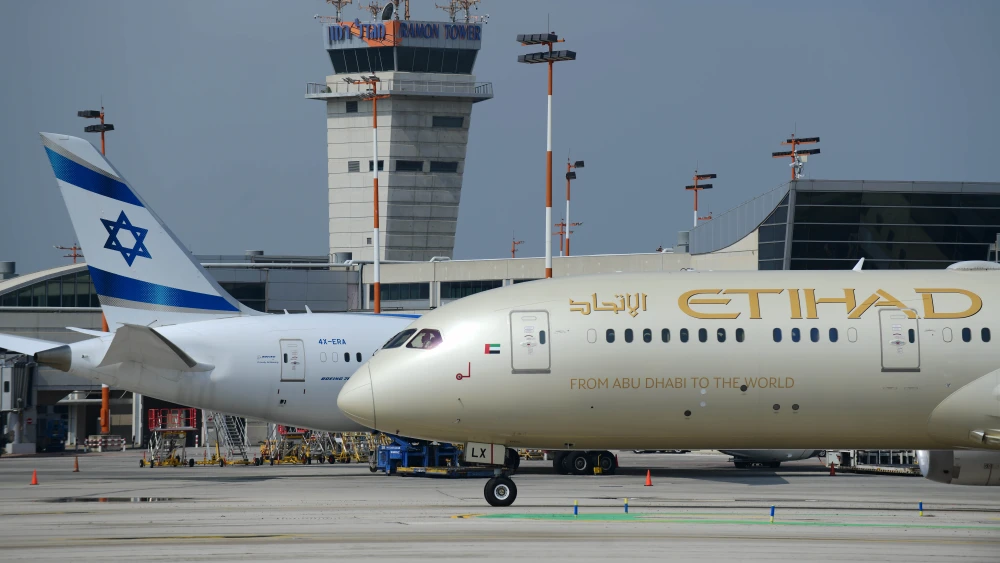
Two Emirati carriers are among the first international airlines to resume flying to Israel since the war against Iran began on Feb. 28, highlighting the close cooperation and burgeoning ties between the two countries forged by the landmark Abraham Accords.
The resumption of service by Abu Dhabi’s flag carrier, Etihad, and low-cost FlyDubai to Tel Aviv puts them ahead of all major European and American airlines, which have not yet resumed flights to Israel.
“The fact that FlyDubai and Etihad have returned to Tel Aviv as one of the first and few foreign carriers to come back is a testament to their belief in Israel’s economy, and the strong appeal both airlines hold with the Israeli public,” Mark Feldman, CEO of Jerusalem’s Ziontours, told JNS on Monday.
With limited service to and from Israel on international carriers and fares on the four Israeli carriers high due to demand, the two Emirati airlines are marketing their popular connecting flights to and from the Far East and the United States for travelers to and from Israel.
The United Arab Emirates was the first signatory of the landmark 2020 Abraham Accords, which saw four Arab countries make peace with Israel.
The close security cooperation between the two nations has only grown since the war began, when the two countries came under Iranian missile and drone attack, forcing the temporary closure of both nations’ airports.
“The Emirates were one of the leading destinations among Israelis even before the war, with strong demand that relied on a combination of tourism business and accessibility,” said Yoni Waksman, deputy chairman of Israel’s Ophir Tours. “The return of the routes is expected to quickly restore pent-up demand, especially for a route that has already proven its durability and attractiveness over time.”
“The gradual return of airlines from the Emirates is significant news for the Israeli market, because it is one of the most important air routes for passengers from Israel—both as a destination in itself and a central gateway for continuing to Asia, Africa and Australia,” said Shirley Cohen Orkaby, vice president of Israel’s Eshet Tours.
She told JNS that the loyalty of the Emirati carriers in servicing Tel Aviv has been “particularly strong” at a time when many other foreign carriers have repeatedly canceled or pushed back flights to the summer or fall. Both carriers were notably among the sole international airlines that flew to Israel throughout the two-year war with Hamas in Gaza, triggered by the Oct. 7, 2023, invasion of southern Israel.
“We see how much the Emirates are loved in Israel, and the summer season, which is usually not a high season for the Emirates, is recording good demand this year,” she said.
Amid the continuing regional instability, all three U.S. legacy carriers have pushed back service to Tel Aviv until September, effectively canceling summer travel to Israel.
Among the other foreign carriers currently flying to Tel Aviv are the Israeli-owned Greek airline Bluebird Airways, Cypriot Tus Airways, Ethiopian Airlines, Czech Smartwings, China-based Hainan Airlines, Russian carrier Red Wings, Georgian Airlines and Moldovan airline FlyOne.