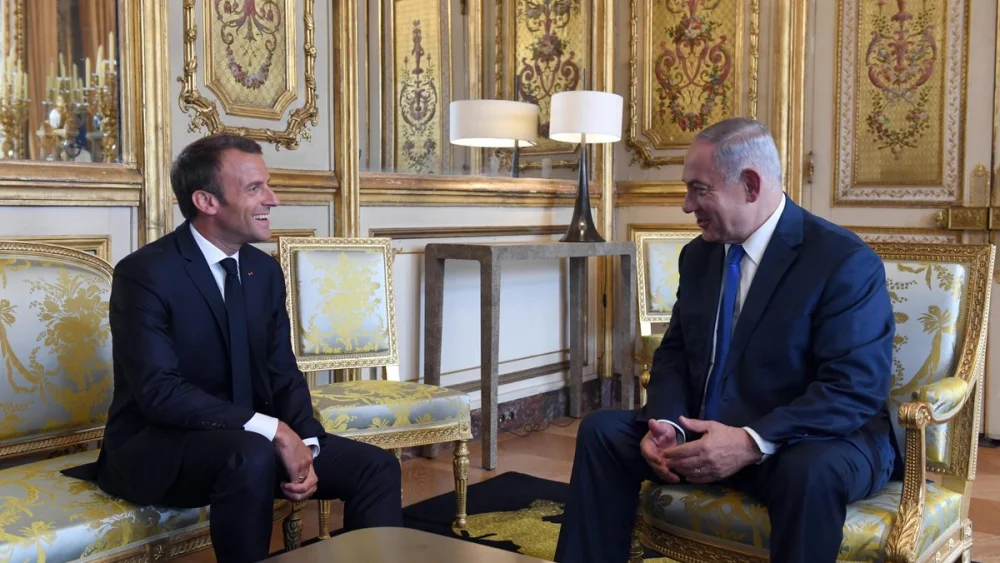
Israeli Prime Minister Benjamin Netanyahu reiterated that he considers a nuclear armed Iran the “greatest threat” to the world, while echoing his calls for Tehran to be ousted from Syria during his meeting with French President Emmanuel Macron on Tuesday.
“The greatest threat to the world today in my view is nuclear weapons in the hands of a radical Islamic regime like Tehran,” Netanyahu declared to the French leader in public remarks to reporters following their 90-minute private meeting. “The nuclear archive that we uncovered recently proved that Iran lied to the world about its nuclear weapons program, and I believe now is the time to apply maximum pressure on Iran to make sure that their nuclear program doesn’t go anywhere,” he said.
Netanyahu added that he did not ask Macron, a proponent of the Iran nuclear deal, to leave the nuclear accord, but that instead what the two leaders focused on is to “stop Iranian aggression in the region.”
“Israel’s goal, which I think should be shared by all those who seek peace and prosperity and stability in the Middle East—a reconstructed Syria which you seek. … I think that the precursor to that, the precondition to that is that Iran leaves Syria, all of Syria. It has no business being there,” said Netanyahu.
https://www.facebook.com/IsraeliPM/videos/2136562873025113/
On Tuesday, Iran informed the IAEA, the U.N.’s nuclear watchdog, that it would increase its nuclear-enrichment capacity.
Netanyahu is on a diplomatic tour this week with major European powers. On Monday, he met with German Chancellor Angela Merkel and is scheduled to visit with British Prime Minister Theresa May on Wednesday.
Macron also raised the issue of the ongoing violence in the Gaza Strip, expressing his “condemnation of any form of violence toward civilians and in particular, these past few weeks in Gaza.”
Nevertheless, the French leader said that moving the U.S. embassy to Jerusalem provoked further violence and did not promote peace.
“If this leads to people dying it’s not a celebration,” he said
Ahead of his meeting with Macron, Netanyahu also met with leaders of the French Jewish community, who have been struggling with increasing attacks amid rising anti-Semitism across Europe.
“We are preventing terrible attacks, including here, in France. Israel has stopped a great deal of attacks in Europe and will continue to do so,” Netanyahu told the Jewish leaders.