Newsletter
Newsletter Support JNS

Supreme Court rules religious group may keep its donor list private

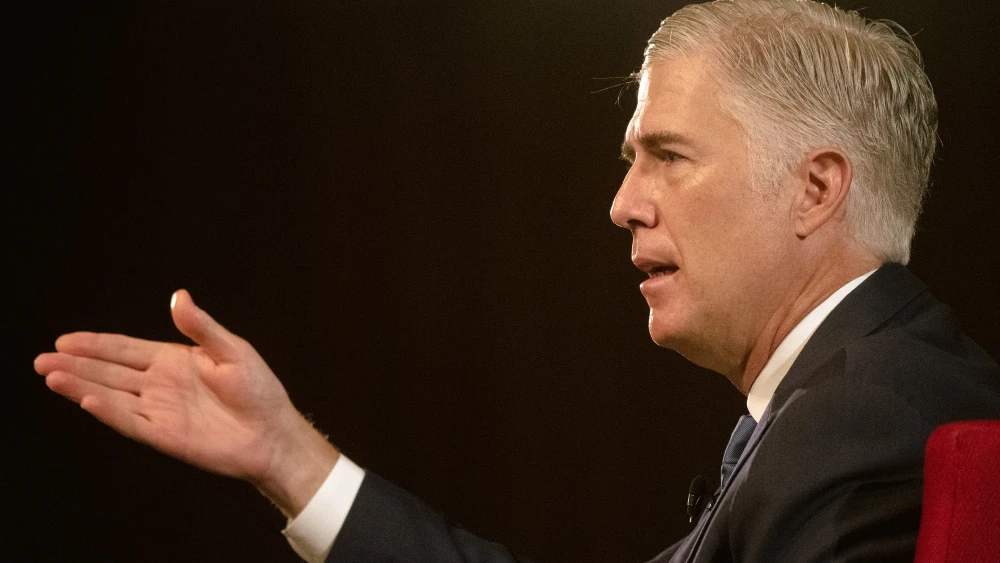
Justice Neil Gorsuch wrote that the New Jersey attorney general’s demand for donor information may deter donors from associating with First Choice, a Christian pregnancy resource center.

U.S. Supreme Court Justice Neil Gorsuch speaks at the LBJ Presidential Library in Austin, Texas, as the sixth annual Tom Johnson lecturer on Sept. 19, 2019. The lectureship was established in 2010 for Johnson’s 30 years of distinguished service as chairman of the Lyndon Baines Johnson Foundation Board of Trustees. He served as executive assistant to the president, and later, as president and chairman of CNN. Credit: Jay Godwin/Flickr/Public Domain via Wikimedia Commons.

The U.S. Supreme Court ruled unanimously on Wednesday that a religious nonprofit may challenge a state subpoena for donor information in federal court when the demand threatens its First Amendment rights.

In First Choice Women’s Resource Centers v. Davenport, New Jersey’s attorney general Michael Platkin accused First Choice, a Christian resource center for women with unplanned pregnancies, of “seeking to prevent people from accessing reproductive health care by providing false or misleading abortion information,” according to the ruling.

Platkin hoped to contact donors to determine if they had “been misled” into thinking First Choice “provides abortions.” He served a subpoena demanding that the group produce “documents reflecting the names, phone numbers, addresses and places of employment of all individuals who had made donations,” according to the ruling.

First Choice filed a suit in federal district court, arguing that revealing the names of anonymous donors would discourage them from associating with the group.

In the ruling, authored by Justice Neil Gorsuch (there are no concurring opinions and no dissents from other justices in the document), the court held that the subpoena seeking information about donors would cause injury to the group.

“An official demand for private donor information is enough to discourage reasonable individuals from associating with a group and to discourage groups from expressing dissident views,” he wrote.

William Haun, senior counsel at the Becket Fund for Religious Liberty, which had filed a friend-of-the-court brief in support of First Choice, called the decision “a triumph for every faith-based ministry in America.”

“The court made crystal clear that our First Amendment freedoms, including religious freedom, are ‘necessarily’ associative, and that keeps the federal courthouse doors open for religious groups to protect their governance from intrusive state bureaucrats,” he said.
“People shouldn’t think that, ‘Oh this is not going to happen to me,’” the 32-year-old Judaic studies teacher told JNS. “It can happen to anyone walking the streets, anyone with their groceries.”
The state must make changes “to clearly address content that is not permitted, while preserving the ability of candidates to present their qualifications to voters,” its secretary of state told JNS.
“It’s very important, not only for Israel, but also for the United States, that people will be more familiar with the real history,” Yigal Dilmoni, of American Friends of Judea and Samaria, told JNS.
“When influential voices spread conspiracy theories, promote terrorism or dehumanize Jewish people, it fuels real-world violence and intimidation,” Rep. Josh Gottheimer said.
The authority “continues to provide a system of compensation in support of terrorism through new mechanisms and under a different name,” the U.S. State Department informed Congress.
Shlomo Danzinger, an Orthodox Jew, narrowly defeated Vice Mayor Tina Paul with 50.4% of the vote after a court ruling extended the mail-in ballot deadline due to Passover.