
Antisemitism today is like an atomic bomb: anything can happen—anything at all—if institutions fail to take it in hand and act quickly, so that no one feels authorized to deal with it on their own.
This is a very delicate moment. All countries and states in Europe and across the world must act against antisemitism; otherwise, the consequences will be disastrous.
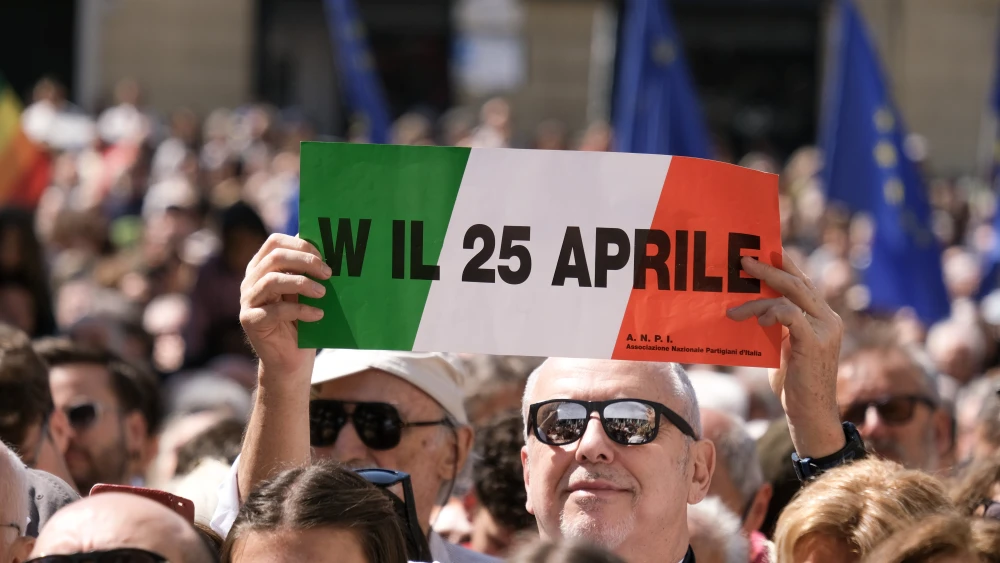
The young Jewish man who fired an air gun during an April 25 Liberation Day rally in Rome, targeting two representatives of the ANPI (National Association of Italian Partisans), acted with aggressive intent; an investigation will examine his motives. The facts are straightforward: he used a traceable scooter and a weapon that makes clear the act itself—violent and unacceptable, in violation of every moral and legal norm. Beyond that, little is yet known about him.
His action was clearly wrong; no one has the right to take the law into their own hands, under any circumstances. At the same time, this should be said without turning him into a symbol or subjecting him to disproportionate condemnation.
The demonstration itself included antisemitic elements, with Hamas flags and open hostility toward Jewish symbols such as the Star of David, rather than partisan symbols. The flags on display were deliberately chosen for a day meant to celebrate liberation from Nazi fascism, yet the Jewish Brigade’s flag was excluded. The world has been turned upside down. This does not justify what he did, but it helps explain the atmosphere in which he acted.
He acted foolishly, but also out of a sense of desperation and exasperation that many Jews are feeling today. That reality must be acknowledged, even as the rule of law remains absolute. This is the only judgment that should be made about the assailant. No one will boast about what he did, and Italian Jews are certainly harmed by his action.
It is, however, troubling that public figures, while not justifying the act, failed to say a word about the broader context—the humiliating, dangerous and aggressive antisemitism that Jews around the world are enduring today, and of which that very scene was clearly a part.
That young man, too—and this does not justify his action in any way—found himself caught in this storm, stunned and shaken by the antisemitic tsunami that began on Oct. 7, 2023. For the sake of analysis, for the sake of understanding events, this must be said, while leaving justice to do its work.
What, then, is to be done? This episode is a warning siren for democratic countries, after countless antisemitic incidents have gone unanswered. One can only imagine the anger and pain that may build in the heart of a young Jew facing hostility at school, at work, at university, in the media or even turning on the television to hear panels filled with falsehoods about Israel.
And let me repeat: this must never lead to violence, neither verbal nor physical. But it must also be understood that, even as this debate unfolded in Italy, two Jews were stabbed in North London near a synagogue in Golders Green, leaving them in serious condition. Such attacks now occur with alarming frequency. Italy—shockingly—is among the worst-affected countries.
In Rome just days ago, a man wearing a kippah was attacked. Months earlier, a father and his young son were assaulted at a highway cafe. Violence against Jews has spread worldwide. Last year saw 20 fatalities—a record. Since Oct. 7, the new norm has been a sharp rise in physical violence tied to verbal hatred.
Here lies an unavoidable point: It is futile to pretend that so-called “legitimate criticism” of Israel can be separated from the growing violence against Jews, even from murder. The claim that Israel can be labeled, without challenge, as “genocidal,” “colonial” or “apartheid”—and that this constitutes accepted “knowledge”—is deadly.
States must act accordingly. Governments must understand, urgently, that Jews must be defended in word and deed, and that their criminalization must be prohibited. The rule of law can prevent reckless reactions, but only if there is institutional and cultural courage.
At the same time, Jews know from experience that their greatest strength is defense. Never again will they accept the role of sheep led to slaughter—but neither will they embrace blind, uncontrolled rage.