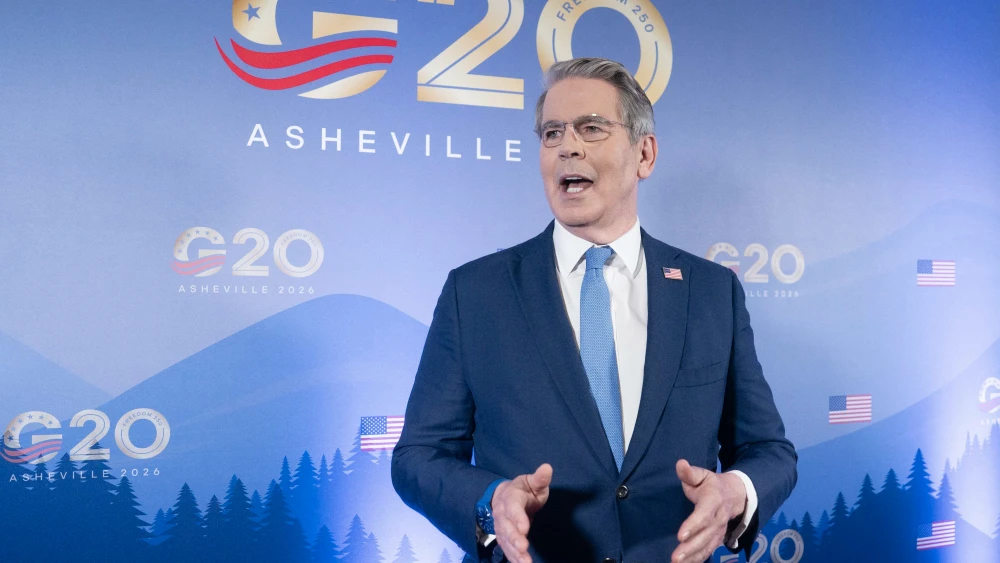
U.S. Treasury Secretary Scott Bessent said on Monday that Iran must dismantle its nuclear program, surrender its highly enriched uranium, halt support for regional proxies and reopen the Strait of Hormuz before Washington negotiates an end to its economic pressure campaign.
Speaking in an interview with CNBC on Monday, Bessent said U.S. sanctions under “Operation Economic Outcast,” alongside naval-blockade efforts, have effectively severed the Islamic Republic from global markets, severely accelerating economic distress inside the country.
“The goal here is to create the conditions that they will want to come to the table, and the president’s been very clear: They have to give up their nuclear program, they have to turn over the highly enriched uranium, they have to stop their support of proxies and the strait has to be open,” Bessent said.
.@SecScottBessent: "The President has been very clear — they have to give up their nuclear program, they have to turn over the highly-enriched uranium, they have to stop their support of proxies, and the Strait has to be open." https://t.co/KNtk5rkSTf pic.twitter.com/Xuc9kLABOD
— Rapid Response 47 (@RapidResponse47) August 31, 2026
Bessent pointed to soaring inflation, food shortages, gas lines and the collapse of the Iranian rial as drivers forcing Iranian officials to openly voice alarm over domestic instability. While President Donald Trump has assessed that Tehran is not yet ready to negotiate, Bessent noted that mounting pressure threatens the regime’s core survival and will ultimately compel leadership to seek an agreement.
“Look, my experience with people like this, the main thing they care about is their head staying attached to their neck,” Bessent said.
Trump calls Iran conflict ‘relatively little war’ for US
Trump on Monday characterized the conflict with Iran as “a relatively little war” for the United States, dismissing concerns that a prolonged Middle East operation could impair Washington’s ability to address threats elsewhere.
“This is a relatively little war for us. This is not a big war,” Trump said in response to a question from CBS News correspondent Weijia Jiang.
President Trump called the Iran conflict “a relatively little war” for the U.S. on Monday when asked by @weijia about U.S. military leaders reportedly warning Defense Secretary Hegseth that a prolonged operation in the Middle East weakens the U.S.’ ability to confront threats… pic.twitter.com/2heMtbI1St
— CBS News (@CBSNews) August 31, 2026
Jiang had asked Trump about reports that U.S. military leaders had warned Defense Secretary Pete Hegseth that an extended operation in the region could weaken the U.S. military’s readiness to confront other global challenges.
Trump said the U.S. could draw on weapons stocks worldwide if necessary, asserting that the military had “tremendous amounts” of older but “very powerful” munitions in addition to its more advanced systems. “Nobody is going to mess with us,” he said.
Waltz urges global enforcement of Iran sanctions
U.S. Ambassador to the United Nations Mike Waltz called on countries to enforce sanctions against Iran and target the banks and shell companies he said were helping sustain the Islamic Republic.
In comments aired on Fox News and posted on Monday, Waltz said the Islamic Revolutionary Guard Corps controls about half of Iran’s economy and that the regime prioritizes its own survival over the welfare of Iranians. He accused Tehran of killing protesters and continuing to execute young people who have challenged the government.
The Iranian regime doesn’t care about its people. It cares about money in order to keep the regime in control.
— Ambassador Mike Waltz (@USAmbUN) August 31, 2026
President Trump is going after it.
Now the world must do its part: enforce the sanctions, crack down on the banks and shell companies keeping the regime afloat, and… pic.twitter.com/3gQxf2GJnP
Waltz said the Trump administration’s economic-pressure campaign, led in part by Bessent, was aimed at Iran’s financial system. He cited the weakening Iranian currency, high inflation, depleted foreign-currency reserves and reported bank runs.
“The message that Secretary Bessent will send and that I will send here at the U.N. is, ‘You’re either against us or you’re with us, and you don’t want to be siding with Iran right now,’” Waltz said, urging a crackdown on institutions, banks and shell companies that evade sanctions.