


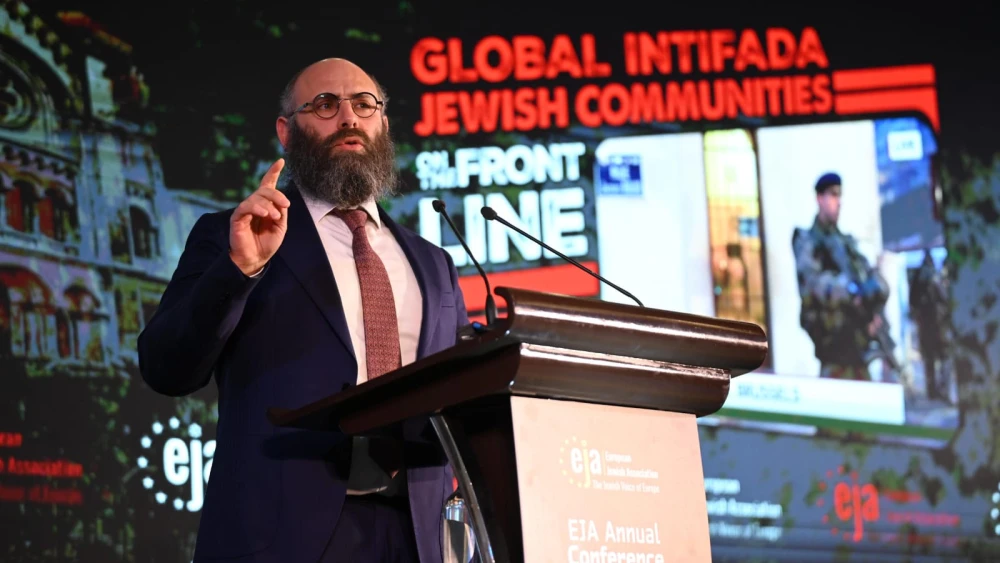
Two European-Jewish groups on Tuesday announced the opening of a certification program for performers of Jewish circumcision to address crackdowns on the custom, prompting a top E.U. official to laud the move as a “credible model” for cooperation.
According to a statement by the European Jewish Association (EJA) and the Rabbinical Centre of Europe (RCE), the new program, titled the Centre of Excellence for Religious Male Circumcision, will provide mohels, Jewish circumcisers, with “advanced medical and safety training, practical assessment and certification under the supervision of an international network of urologists, pediatricians, physicians and medical scientists.”
EJA said the new initiative comes “against the backdrop of growing legal and political challenges to Jewish religious circumcision in Belgium and other European countries.”
European Commissioner for Health and Animal Welfare, Oliver Várhelyi, said that “Jewish life and Jewish religious practice belong in Europe,” and must meet “European standards.” The new Brussels-based program “offers a constructive and credible model for doing exactly that,” the statement continued.
In May 2025, Belgian authorities searched the homes of three mohels in Antwerp, leading to their prosecution earlier this year for allegedly violating Belgium’s legal code on surgical procedures. Belgian law does not forbid circumcision explicitly but requires all surgeries be performed by trained medical personnel. Many mohels are not recognized as such by authorities in Belgium and other countries.
The prosecution, initiated by a Jewish man with a longstanding feud with the established Jewish community of Antwerp, led to a diplomatic crisis involving the United States and Israel. Diplomats from both countries said the legal case was a form of antisemitism. Jews circumcise male boys when they are eight days old in a ritual called brit milah. Muslims also circumcise their boys, though the timing varies from seven days after birth until age 7 or even later in some cases.
The program’s curriculum covers “the medical and safety framework surrounding the procedure, including newborn assessment, hygiene and infection prevention, infant welfare, bleeding and wound care, recognition of complications, emergency response and infant basic life support, medical referral and aftercare,” EJA said.
Rabbi Menachem Margolin, the chairman of both the EJA and the RCE, told JNS: “Faced with growing challenges to the practice and, in particular, to the ability of trained mohels to perform it in parts of Europe, we decided that our response must go beyond defending our religious freedom. We are creating the highest possible professional framework to support it.”
In 2013, another Jewish group, the Conference of European Rabbis (CER) announced the establishment of a union of mohels in an effort to standardize ritual circumcision and combat earlier attempts to ban the rite.
The Union of Mohalim in Europe seeks to “unite approved mohalim across Europe under a single banner, ensuring that all communities can be assured of the high level of training and regulation,” CER said.
The Union was established following a crisis around milah in Germany. In December 2012, German lawmakers passed a law that guarantees parents the right to circumcise boys for religious reasons. The vote followed a court ruling in Cologne that year that defined ritual circumcision as causing “bodily harm.” The ruling led to partial bans on circumcision in Germany, Austria and Switzerland, and intensified the heated debate over the issue in Scandinavian countries and beyond.



