Newsletter
Newsletter Support JNS

NSW government offers $1 million for info on 1982 bombings of Jewish institutions

The reward is being offered for information leading to criminal prosecutions, according to New South Wales Police counter-terrorism commander Mark Walton.

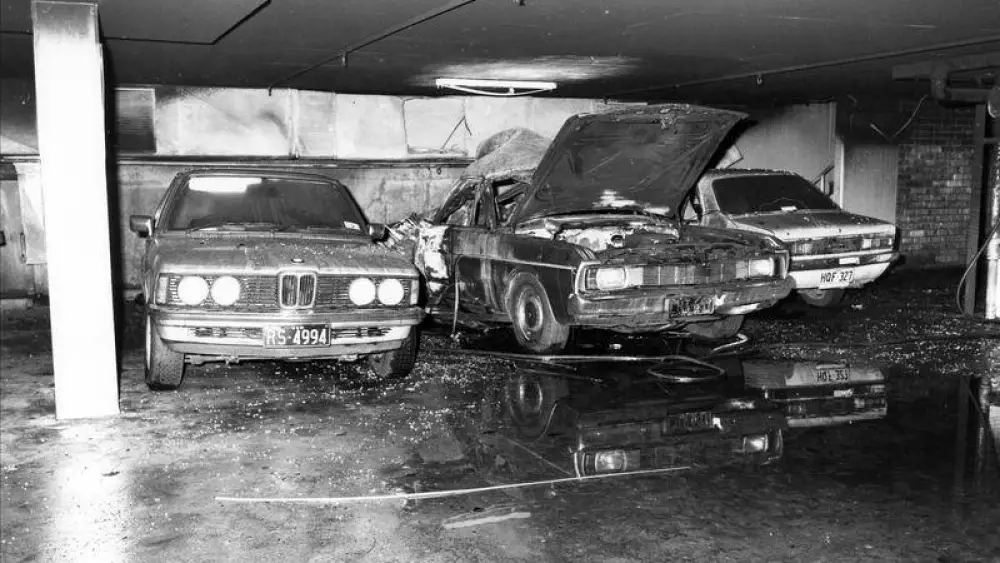
A $1 million reward has been posted by the New South Wales government for information leading to criminal convictions in connection with the bombings of Sydney's Israeli Consulate and the Hakoah Club in 1982. Credit: Courtesy.
A $1 million reward has been posted by the New South Wales government for information leading to criminal convictions in connection with the bombings of Sydney’s Israeli Consulate and the Hakoah Club in 1982. Credit: Courtesy.

The New South Wales government is offering a $1 million reward for information leading to criminal convictions in connection with the bombing of two Australian Jewish institutions in 1982.

The reward, originally set at $100,000 in 2012, was increased on Monday, the first day of the Coronial Inquiry into the bombings, Australia’s first terrorism “cold case.”

On December 23, 1982, an explosion damaged the Israeli embassy in Sydney, followed by a vehicle bomb in the basement of the Hakoah Club in adjacent Bondi four hours later.

Detectives have dedicated thousands of hours over the years, particularly in the last decade, to solving this case, said Deputy Premier and Minister for Police Paul Toole, according to an official statement.

“These two horrific targeted attacks were international acts of terrorism, and despite extensive damage caused to the Israeli Consulate and the Hakoah Club, we are extremely fortunate that no one was killed,” said Toole.

“I hope this increased reward of $1 million will be the final push members of the public need to offer up information – no matter how big or small it may seem – to help police in their unwavering quest for answers and provide closure for all those involved,” he added.

New South Wales Police counter-terrorism commander Mark Walton said, “These attacks have remained in the hearts and minds of Jewish, Israeli and Australian communities–and certainly never forgotten by investigators,” he added.

“Anti-Zionism can be a framework for justifying anti-Jewish hostility,” Rafaela Dancygier, of Princeton University, told the N.J. Advisory Committee to the U.S. Commission on Civil Rights.
A board member at the Orthodox synagogue told the FBI that members began attending services less frequently after Kevin Charles Pyles allegedly targeted the synagogue in separate July and August 2025 incidents.
The Senate rejected a resolution calling for the removal of U.S. forces from the war against Iran after U.S. President Donald Trump hammered Senate Republicans for approving a similar measure the day before.
“When someone uses the N-word on campus, no one thinks about free speech. No one talks about, ‘Let’s understand what they’re thinking. Let’s have a discussion,’” Rep. Randy Fine said. “But somehow when it came to Jews, everyone wanted to rediscover the idea of free speech.”
“Leadership should be responding with moral clarity, not suggesting that the act of teaching about the Holocaust has somehow ‘missed the mark,’” said Kurt Schwartz, CEO of CAMERA.
The judges said the sanctions, which the United States imposed in response to the Hague-based court’s targeting of Israel, are unlawful.
Benny Gantz, JNS editor-in-chief Jonathan S. Tobin, Gilad Erdan, Mosab Hassan Yousef, Nissim Black and leading voices in security, diplomacy, media, law and Jewish communal affairs headline the summit’s third day in Jerusalem.
