

One of the most significant steps taken in recent years to thwart the establishment of a Palestinian state in the Land of Israel has just been announced: the tentative approval of the E1 plan for the establishment of a new Jewish town between Jerusalem and Ma’ale Adumim.
It is to be called Mevaseret Adumim—"heralding” Jerusalem from the Adumim bloc to the east, just as Mevaseret Zion heralds the holy city from the west—and will see the construction of 3,400 housing units.
Nearly 150 recognized Jewish communities have been built in Judea and Samaria over the past several decades; what makes this one such a game-changer? For starters, the E1 plan was first initiated by the late prime minister, Yitzhak Rabin, back in 1994—and yet it has taken until now, 31 years later, to brave all the obstacles placed in its path by the Americans, Europeans, Arab interests and left-wing groups.
These entities object to the plan precisely because it separates the southern and northern parts of the Palestinian Authority-controlled areas (Judea and Samaria). As the United Nations’ criticism of the plan noted, it will break Judea and Samaria into isolated enclaves and prevent the development of a P.A. metropolis linking eastern Jerusalem to Bethlehem and Ramallah. “Practically,” a U.N. spokesperson said, “this will put an end to the two-state solution."Similarly, Peace Now declared with great alarm that it actually “prevents the possibility of an agreement” between Israel and the Palestinian Authority. Its opponents thus make quite clear the importance of the E1 plan.
E1 will prevent the establishment of a contiguous, pro-terror, antisemitic Palestinian state in the heart of the Land of Israel, one that many of its would-be leaders have vowed to render off-limits to Jews. As such, news of the new project is a boon for supporters of both genuine Middle East peace and the continuing survival and revival of the State of Israel.
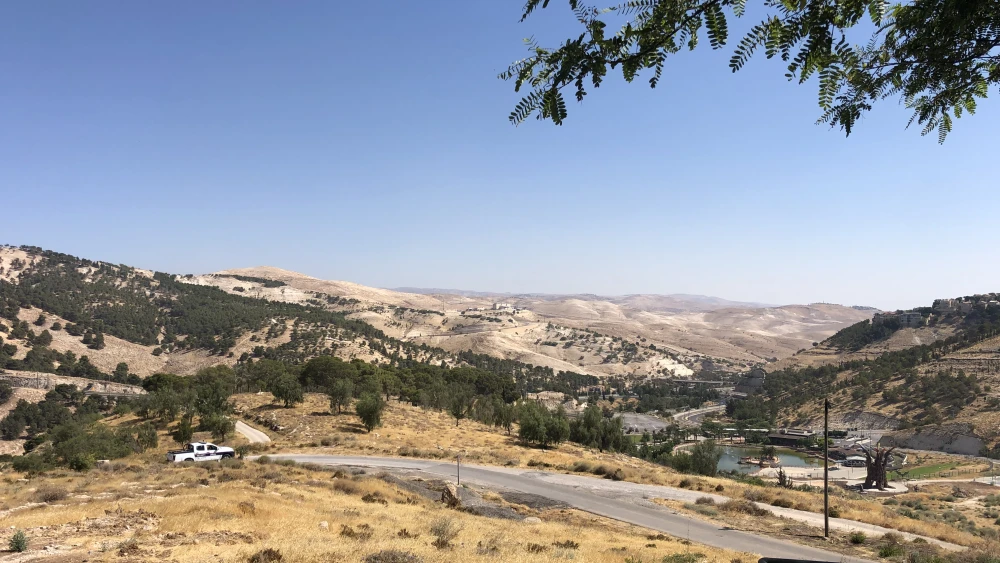
The new town will also essentially choke off the “creeping crescent” of largely illegal but somehow-tolerated Palestinian Arab construction and expansion, which is strangling the growth of Israel’s capital of Jerusalem. Travelers from Jerusalem to Ma’ale Adumim have long noted with alarm the large-scale illegal Palestinian construction along the highway, as well as in the E1 zone itself, all within what is known as Area C, under Israeli civil and security control. This growing Arab presence has already significantly narrowed the main traffic artery between Jerusalem and areas east, towards the Dead Sea.
Eastward is essentially the only direction left for Jerusalem to expand to. The north and south are blocked by large P.A. cities and an environmental ecosystem blocks westward growth.
It is important to note that the international community has been quite proactive not only in thwarting Israel’s measures to stop this illegal building, but also in actually encouraging and financing it. And with some of these important international players poised to actualize their efforts by declaring, even if only ceremoniously, their recognition of a Palestinian state that would threaten Israel in many ways, the E1 area is do-or-die.
Announcing the decision to approve the new development, Israeli Finance Minister Bezalel Smotrich said, “Whoever in the world tries to recognize a Palestinian state [a not-veiled reference to France, Canada, Britain and others that have announced intentions to do so], will receive our response on the ground, not with documents or declarations, but with facts in the form of houses, neighborhoods, roads, and Jewish families building life. They can speak about Palestinian dreams, and we’ll continue building Jewish reality, which as of now buries, once and for all, the idea of a Palestinian state.”
Given that all six Israeli prime ministers since Rabin have supported the plan, at least in principle, the question may well be asked: “Why now?” The answer is the critically necessary support of U.S. President Donald Trump, together with the increasing domestic Israeli clarity regarding its security needs in light of the Hamas massacre. As such, the Israeli government understands that it cannot fumble the present opportunity.
In actuality, the plan does not hermetically block the north from the south. Arabs seeking to travel between Ramallah and the Hebron/Bethlehem area will be able to avail themselves of an existing road linking these areas. Another proposed solution is a Highway 80 running east of Maaleh Adumim. The Arab side has not accepted these ideas, because it wants more than roads; it also demands continuous urban building (even though they agreed during the Oslo negotiations to a “safe passage” between Gaza and Judea/Samaria, with no urban building alongside it).
In any event, the new plan is an integral part of JCAP’s “Greater Jerusalem Metropolis” program. Its goal is to expand Jerusalem and make it the primary metropolis of Israel. The objectives are to preserve united Jerusalem under Israeli sovereignty, fortify its status as Israel’s capital, and deal with Jerusalem’s problematic urban and demographic challenges in the face of a shrinking Jewish majority.
Although the plan’s security importance for Israel has long been recognized, the Oct. 7, 2023, Hamas massacre has highlighted it several times over. As Jerusalem expert and JCAP consultant Nadav Shragai wrote several years ago, “In case of the reemergence of an eastern front that threatens Israel, the area between Ma’ale Adumim and Jerusalem—and further eastward, toward the Dead Sea—is essential for Israel’s strategic depth.”
A report by Shragai in 2009, as relevant now as it was then, concluded that the linking of Jerusalem to Ma’ale Adumim is an overriding Israeli interest for many of the above reasons - and also because Israel cannot allow Jerusalem to revert to a border-town status that would preclude the city’s eastward development. Nor can Israel tolerate a threat to the Jerusalem-Jericho road, where Palestinian construction is encroaching. This artery is of supreme security-strategic importance to Israel in case of a military threat from the east.
In conclusion, E1 provides an implementable solution to the necessary expansion of Jerusalem’s urban footprint, increases security by expanding strategic depth and corrects the demographic imbalance currently threatening our capital. But perhaps the most important justification for E1 is reflected in the ridiculous claim voiced by various Palestinian sources that it is just a Jewish plot to Judaize Jerusalem, which is akin to accusing the United States of scheming to “Americanize” Washington, D.C. Indeed, both are worthy goals.