


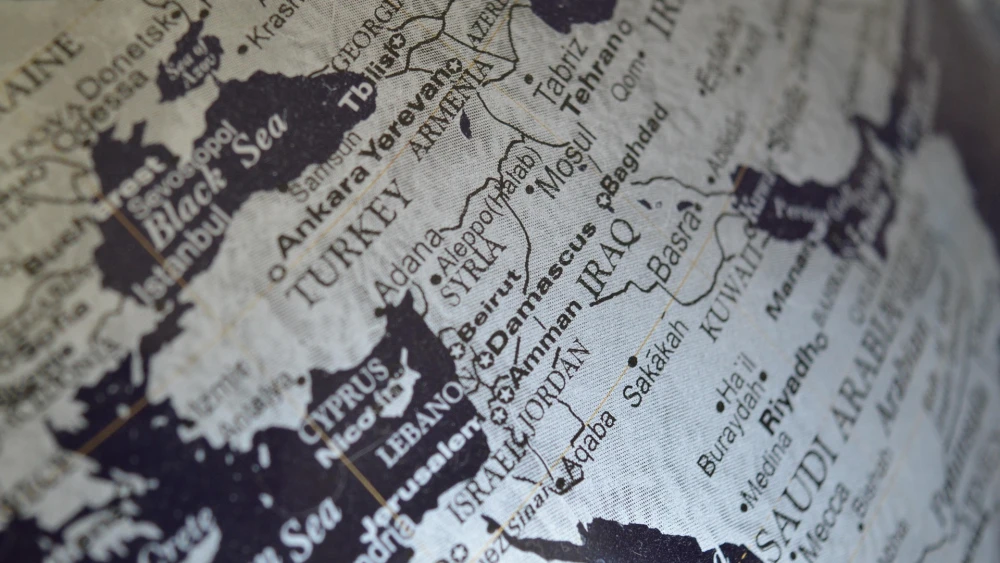

There is an old and uncomfortable habit in international politics: The grandest strategic arguments are often constructed far from the people expected to bear their consequences.
We speak confidently of deterrence, strategic equilibrium, regional order and spheres of influence. Nations become pieces on a geopolitical chessboard, governments become instruments of balance, and millions of ordinary people disappear beneath abstractions. Yet behind every theory of the balance of power lies a question that political realism too often avoids: Who is expected to pay for that balance and for how long?
In conversations with people from Iran’s neighboring countries, I have increasingly encountered an argument that deserves serious consideration. Many who make it neither admire the Islamic Republic nor approve of its ideology, proxies or regional behavior. Their concern is geopolitical.
Somebody, they argue, must counterbalance Israel. Without the Islamic Republic as a formidable adversary, Israel could emerge as the uncontested military power of the Middle East.
That concern cannot simply be dismissed. No sovereign state should welcome the emergence of an unchecked regional hegemon, and Arab governments have legitimate reasons to consider what a dramatic shift in the regional balance might mean for their security. But acknowledging that concern leads to a more difficult question: Why should the Iranian people be required to sacrifice their political future to preserve that balance?
What if regime change in Iran produces not a weak or fragmented country, but a powerful, secular, nationalist Iran that is friendly toward the Jewish state?
Imagine reversing the argument. Imagine telling the citizens of Saudi Arabia, Bahrain, Kuwait or the United Arab Emirates that whether they want their governments is ultimately irrelevant; that their freedoms and their right to determine their political future must be subordinated to the strategic interests of outsiders because their existing governments perform some useful function in the regional balance.
Few would accept such a principle when applied to themselves. Why, then, should Iranians accept it?
This is where geopolitics becomes an ethical question. The balance of power may be necessary to international order; however, no balance is morally neutral when preserving it requires one society to surrender its right to political self-determination indefinitely. A regional order sustained by the permanent coercion of one of its great peoples is not truly stable. It has merely transferred the cost of instability onto those who were never consulted about paying it.
The deeper conceptual error is the tendency to confuse Iran with the Islamic Republic. They are not the same. Iran is an ancient nation, civilization, society and historical identity. The Islamic Republic is a political regime established in 1979. Governments belong to chapters of history; nations survive them.
Nor is hostility between Iranians and Israelis an ancient or inevitable condition. Before 1979, Iran and Israel maintained extensive economic, strategic and security relations. Under the Pahlavi monarchy, the two countries discovered important common interests, despite the complexities of regional politics.
The revolutionary regime transformed hostility toward Israel into one of its ideological foundations. The conflict of the past several decades is therefore not evidence of an eternal antagonism between two peoples. It is largely the consequence of a political order born in 1979.
This distinction fundamentally changes the balance-of-power argument. If the Islamic Republic disappeared tomorrow, Iran would not disappear with it. Neither would Iranian power. Its population, geography, resources, strategic location, Persian Gulf coastline, cultural influence and thousands of years of history would remain. Iran would still occupy one of the world’s most consequential geopolitical crossroads and possess all the foundations of a major regional power.
The argument that Israel would dominate the Middle East without the Islamic Republic therefore contains a remarkable assumption: that only a revolutionary theocracy can embody Iranian strength. But why should Iranian power require revolutionary ideology? Why should Iranian influence depend upon proxy warfare? Why should a powerful Iran necessarily threaten Israel or its Arab neighbors?
There is no historical obligation to remain enemies
A post-Islamic Republic Iran could remain powerful while behaving very differently. It could defend its national interests without exporting revolution; compete economically and diplomatically rather than through militias; and regard neighboring Arab countries as sovereign partners rather than strategic depth. It could be strong enough to matter without requiring permanent confrontation to justify its strength.
The familiar choice between preserving the Islamic Republic and accepting Israeli domination is therefore false. Rejecting the Islamic Republic does not require accepting Israeli hegemony, just as concern about Israeli power does not justify preserving clerical rule in Tehran. The Middle East need not choose between two competing hegemonies. A more durable regional order would consist of strong sovereign states capable of balancing one another without demanding the subjugation of neighboring peoples.
There is also a profound contradiction in describing the Islamic Republic as a necessary shield for the region. Tehran has repeatedly demonstrated that when its own survival or security is threatened, it is prepared to widen the geography of confrontation. Its deterrence strategy has often depended upon the knowledge that a major conflict with Tehran could endanger neighboring infrastructure, energy networks, shipping routes, military facilities and civilian populations.
An Iran reconciled with Israel would transform the strategic architecture of the Middle East.
That is not collective security; it is the regionalization of risk. A shield protects its neighbors from danger; it does not make their vulnerability part of its own defense. Yet the Islamic Republic has helped create a strange regional psychology in which governments that distrust Tehran may simultaneously fear the consequences of its disappearance.
Beneath these calculations lies an even more uncomfortable reality. The Iranian people themselves frequently vanish from the discussion. We debate Israel, America, Saudi Arabia, nuclear programs, missiles, oil, military bases, shipping lanes and regional influence. Somewhere beneath those maps are millions of Iranians expected to endure repression because outsiders fear that political change in Iran might disturb the strategic equilibrium.
No people should be required to live indefinitely under an unwanted political system because foreign governments consider their rulers geopolitically useful. Security matters. Balance matters. But human beings matter, too. No legitimate regional order can be built upon denying one nation the right to determine its own government.
Perhaps this is also where we encounter one of the least discussed fears in parts of the Islamic world. The fear may not simply be that the Islamic Republic collapses. The deeper fear is what might replace it. What if regime change in Iran produces not a weak or fragmented country, but a powerful, secular, nationalist Iran that is friendly toward Israel? What if the hostility manufactured after 1979 gives way to the restoration of relations between two peoples that were never destined to remain enemies?
Consider what such a transformation would mean. A future Iranian government could restore diplomatic relations with Israel. The Israeli flag could once again fly over an embassy in Tehran. An Israeli ambassador could return to the Iranian capital. And if, for example, Crown Prince Reza Pahlavi were to return to Iran and play a role in the country’s political future, the symbolism would be impossible to ignore: the revolutionary order that made the destruction of Israel part of its ideological vocabulary would have been replaced by an Iran seeking friendship and cooperation with the Jewish state.
For some governments and ideological movements, that prospect may be more unsettling than the disappearance of the Islamic Republic itself. An Iran reconciled with Israel would transform the strategic architecture of the Middle East. One of the region’s largest, most populous, historically consequential nations would no longer serve as the ideological center of anti-Israel militancy. Instead, Iran could become a partner in a different regional order.
Security matters. Balance matters. But human beings matter, too.
And perhaps this is precisely the future that should be imagined, rather than feared. The fall of the Shi’ite clerical regime would not mean the disappearance of Iran, nor would friendship with Israel mean Iranian submission. It could mean the return of Iranian foreign policy to national interest and the reopening of a historical relationship violently interrupted by the revolution of 1979.
The people of Iran and Israel have no historical obligation to remain enemies. Once the Islamic Republic belongs to history, they may discover that they are not creating a friendship from nothing, but restoring one that politics interrupted. After the collapse of the Shi’ite mullahs’ regime, they can once again stand together—not to dominate the Middle East but to help build a new one.
That possibility offers a better answer to the balance-of-power dilemma than sacrificing Iranians to preserve the present order. The future need not belong to an Israeli-dominated Middle East or an Iranian-dominated Middle East. It can belong to strong sovereign nations whose security does not depend upon the oppression of another people.
Every theory of the balance of power must ultimately answer one simple question: Who is being asked to pay for it? If maintaining today’s equilibrium requires denying Iranians the right to choose their own government, then the problem is not merely the price. It is the balance itself.


