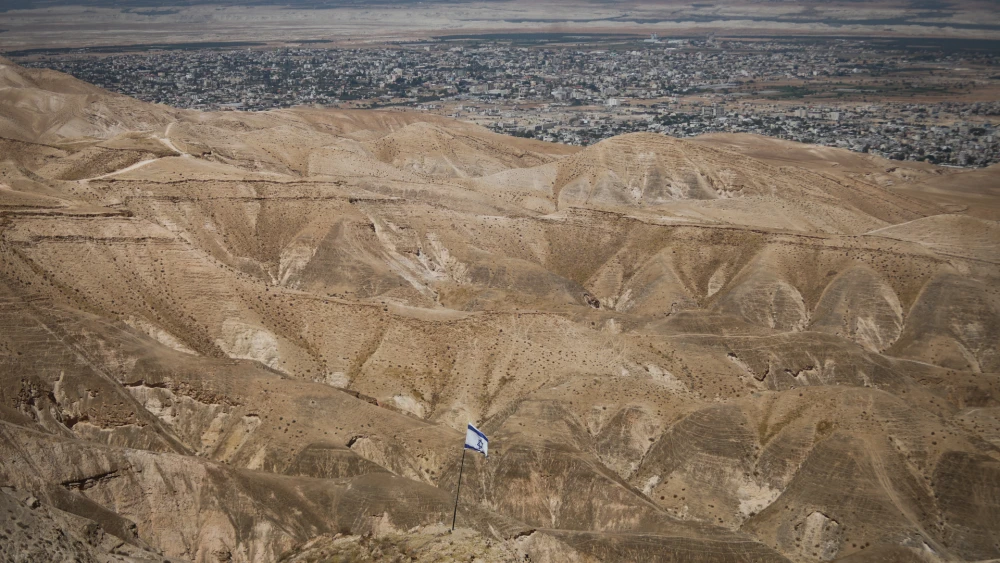
Whether Israel applies sovereignty to the Jordan Valley or not, the reality of Israel’s population there must be rectified, and urgently. The residents of the Jordan Valley, who have turned an arid, hot land into a modern agricultural powerhouse, planted with tens of thousands of acres of date groves, table grapes, vegetables, fruit and herbs that are exported as far abroad as Europe, will testify to that. But the enormous area of the Jordan Valley Regional Council—860,000 dunams (332 square miles)—is still sparsely populated, with just 6,000 people spread over the 21 communities established since 1967.
There is a big difference between the ever-so-lofty declarations made throughout the years about this strip of land’s importance to Israel’s national security and the minimal settlement there. Even a declaration of sovereignty, important as it would be, will have a hard time overcoming that discrepancy. When it comes to the Jordan Valley, Israel has emphasized open spaces and territory, but neglected mass settlement.
While regional councils in Judea and Samaria, some of which are 20 to 30 times smaller than the Jordan Valley, boast populations of over 50,000, the Jordan Valley is at a standstill. The dream of Ra’anan Weitz and Yigal Allon, who envisioned the area as home to 50 communities and a population of over 50,000, has never come to fruition.
Various Labor governments were satisfied with anchoring some 100,000 dunams (39 square miles) for farming, whereas the Likud failed to make the local council Ma’ale Efrayim into the capital of the valley. Instead of developing into a city of tens of thousands, only 1,400 people currently call Ma’ale Efrayim home. No cities like Ma’ale Adumim or Ariel, or even nearby Beit She’an—where 20,000 people live in a similar climate—have arisen in the valley.
All this has resulted in doubt and hesitation. Where there is no mass settlement, the future is uncertain. In contrast, it’s clear to everyone the settlement blocs in the greater Jerusalem area—Gush Etzion, western Samaria and Ariel—will sooner or later be under Israeli sovereignty and officially become part of the State of Israel.
The Jordan Valley is a matter of consensus when it comes to Israeli public opinion, but actually, until Trump became president of the United States, the various governments of Israel were willing to negotiate about its future. One U.S. secretary of state once told his Israeli counterpart that in theory, all the residents of the Jordan Valley could be relocated to a few dozen high-rises in central Israel.
In theory, he was right, and to change that theory we need to change course. If sovereignty is applied to the Jordan Valley, it can serve as an anchor for change, but it won’t happen on its own. The orchards of argan trees at Netiv HaGdud and Petza’el or the medicinal herbs grown by the wonderful people on Moshav Na’ama are not enough. Nothing has really changed since the beginning of the Jordan Valley settlement enterprise. The small communities are still hidden between the hills, the groves and a few nature preserves. Sovereignty must also be a time for change in the valley.
Nadav Shragai is a veteran Israeli journalist.
This article first appeared in Israel Hayom.