


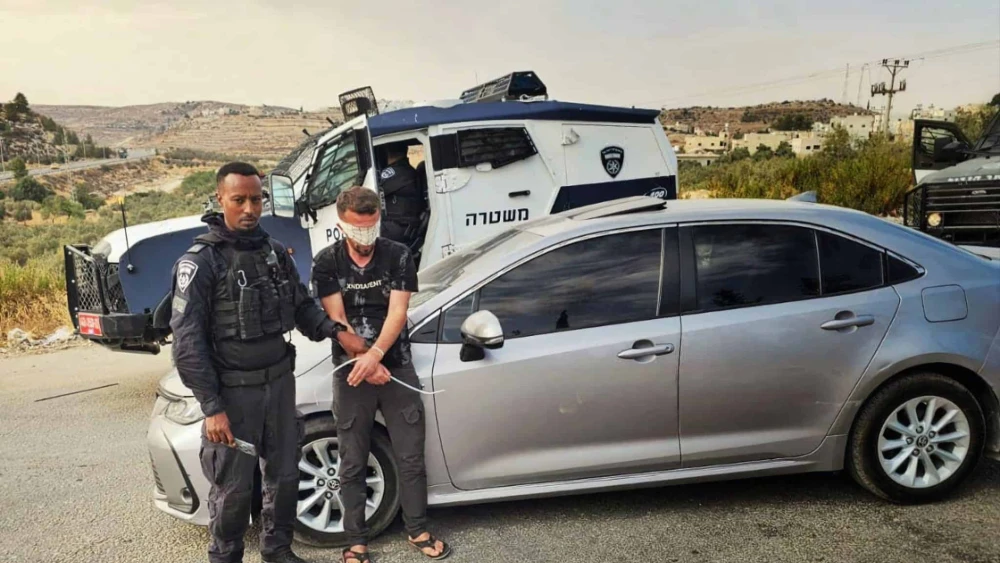

For many years now, international media and global organizations have pushed one narrative about Israel’s presence in Judea and Samaria, also known as the West Bank: the “settler violence” narrative.
This specific phrase is repeated so frequently that many don’t even think to question the term and simply accept as fact the vilification of our Jewish communities in Judea and Samaria. However, if history has taught us anything, it is that a lie repeated often enough can come to be accepted as truth—and that is precisely what is happening here.
Recent research by the Israeli NGO Regavim found that the apparent phenomenon of “settler violence” is in most cases simply false, and in many instances misleading or exaggerated.
The study confirms that while isolated cases of violence by Jewish residents do exist, they are rare, involve a tiny fraction of the population, and are dealt with by Israeli authorities according to the law. These incidents are not widespread, nor do they represent the broader Jewish communities in the region.
So where do the inflated numbers come from? The U.N.’s humanitarian office (OCHA) records the statistics. Between 2016 and 2023, they claimed there were 8,332 incidents involving Israeli “settlers.”
But when Regavim dug deeper, it found that many of these were not violence at all. In fact, many would not be classified as violence in any honest or accurate report. The OCHA list includes traffic accidents, school trips, infrastructure work, archaeological visits and even hikers simply walking in disputed areas.
Worse than this gross distortion, OCHA often counts Palestinian Arabs injured or killed while attacking Israelis as if they were victims of “settler violence” themselves. For example, when Muhammad Abd al-Karim Marshoud tried to stab Israelis, the U.N. logged his shooting as one incident and his death as another. Both instances were recorded as Jewish violence, even though he was the attacker.
Once the United Nations’ 8,332 incidents were systematically analysed, only about 833 real cases remained—less than ten per month over seven and a half years. This figure hardly supports the idea of a widespread problem.
If this deliberate perversion of the truth isn’t enough, OCHA’s “verification process” itself is deeply flawed. Many of the supposed independent sources are simply duplicate reports, often originating from Palestinian Authority offices, which is like using Hamas Health Ministry reports as “independent verification.”
It is a clear conflict of interest and clearly prejudiced. In other words, the same story is recycled under different names to make it look like multiple confirmations.
Official Israeli police data also disproves the global narrative of “settler violence.” From 2014 to 2024, the Samaria and Judea District of the Israel Police opened 1,356 files related to alleged Jewish nationalist violence. Only 537 were serious enough to investigate, and the majority of these were later closed due to lack of evidence or other reasons.
Likewise, IDF data shows that the number of incidents is low. In most reported cases, it isn’t even possible to determine who was at fault. And in the vast majority of the cases that do go further, what gets labeled as “settler violence” is in fact Israeli civilians defending themselves against Palestinian Arab terrorists and violent mobs.
In reality, only an estimated 0.2% of Jewish residents in Judea and Samaria have been linked to violent incidents. Yet the narrative of pervasive aggression persists, supported by foreign governments, NGOs, and international institutions, including the United Nations, for reasons of political motivation and the advancement of a foreign agenda.
At the same time, while incidents of violence attributed to Jewish residents are magnified and sensationalized, the far more prevalent and severe violence perpetrated by Palestinian Arabs is, for the most part, ignored or downplayed.
In fact, Palestinian Arab terrorism remains the primary source of instability in the region. Between 2019 and 2022, the Israel Security Agency (Shin Bet) recorded 25,257 Palestinian attacks on settlers. In 2024 alone, the number of attacks was recorded at 6,828, reflecting a scale of violence vastly disproportionate to the incidents attributed to Jewish residents—around 60 times more frequent than supposed “settler violence.”
After the Oct. 7, 2023, massacre, many in the media and international groups tried to draw a false moral equivalence between Palestinian Arab terrorists and Jewish civilians. They portrayed “settlers” and Hamas attackers as equally guilty. In reality, many of the incidents called “settler violence” were actually Jews defending themselves from attacks or provocation, but these important details were left out of the reporting.
For instance, Yotam Ovadia, 30, was fatally stabbed by a 17-year-old Palestinian terrorist. In U.N. records, the defensive response to the attacker is portrayed as settler violence. Similar distortions occurred in Hebron, Yitzhar and other locations in Judea and Samaria, where actions taken to protect Jewish communities or security personnel from Arab incitement were misrepresented as “settler violence.”
Even routine incidents, such as car accidents involving settlers and Palestinian Arabs, were included as violent acts by Israel’s residents.
Portraying isolated incidents by Jewish individuals as systemic, while ignoring the daily reality of Palestinian Arab aggression, is not only a brazen misrepresentation but profoundly unjust. Needless to say, at best, this narrative is deceptive; at worst, it is a deliberate attempt to criminalize innocent communities, when in reality, the overwhelming majority of violence in Judea and Samaria originates from Palestinian Arab sources.
The clear consensus of the Jews in Judea and Samaria live lawfully, peacefully, and contribute positively to their communities. They are not aggressors; they are families, children, and neighbors, often victims of terrorism themselves, facing constant threats to life and property.
The “two sides” argument, therefore, so often invoked by international observers, fails. Equating Jewish defensive actions with systematic Palestinian Arab terrorism is not merely false and inaccurate; it is dangerous. It ignores the realities of Jews who are often targets of violence and falsely suggests moral equivalence where none exists.
More than that, it distorts international understanding of the reality in the region, enables biased policies and undermines Israel’s legitimacy on the global stage.
False narratives targeting Jewish communities are nothing new. But we know better, and if we didn’t before, we certainly should during these challenging times when false anti-Jewish rhetoric is at its peak. At this moment, the stakes could not be higher.
I would, therefore, urge the Jewish community living in Israel and globally to resist repeating unverified slogans that mischaracterize our Jewish communities. To accept the fiction of “settler violence” is to reinforce dangerous stereotypes and feed a climate of already escalating misinformation about Jews and Israel.
As Rosh Hashanah approaches, we are reminded of our responsibility to safeguard the truth and to stand firm in defending our communities in Judea and Samaria, just as we defend the truth about Israel as a whole. Let us pray that this be a year of clarity, of safety, justice, and peace for all our Jewish communities in Judea and Samaria, across Israel, and throughout the world.




