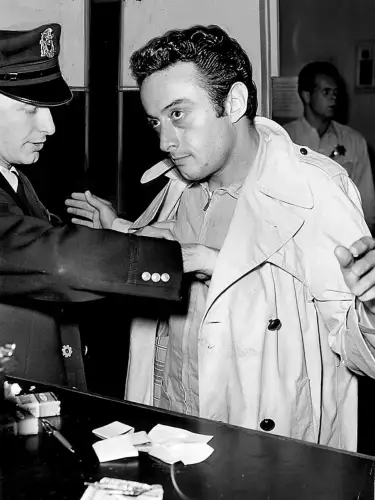
When I was growing up in the 1950s, Lenny Bruce (born Leonard Alfred Schneider) was a rising comedian. By the time I reached adolescence, he was as infamous as he was famous. Some remember him for his use of profanity on stage and his ultimately fatal addiction to drugs. Others choose to highlight his wit and biting social satire.
Several years ago, while teaching a class on Jewish identity, I was introduced to Bruce’s shtick titled “Jewish and Goyish,” described as a “humorous aim at the Jewish propensity to see the world as starkly divided,” often absurdly, between things that are “Jewish” and things that are “goyish.”
Part of the routine went:
Dig: I’m Jewish. Count Basie’s Jewish. Ray Charles is Jewish. Eddie Cantor’s goyish. … B’nai Brith is goyish; Hadassah, Jewish. … Kool-Aid is goyish. All Drake’s cakes are goyish. Pumpernickel is Jewish, and, as you know, white bread is very goyish. … Fruit salad is Jewish. Lime Jell-O is goyish. … Trailer parks are so goyish that Jews won’t go near them. Jack Paar Show is very goyish.
Given the longstanding negative feelings among Jews when it comes to guns, I can imagine his having added a line like: Playing pinochle and mahjong is Jewish. Shooting guns very goyish.
Bruce has been dead for almost 50 years, and Count Basie, Eddie Cantor and Jack Paar are only remembered by senior citizens. Among many younger Jews today, the adjective goyish is considered a politically incorrect slur.
However, among most American Jews of all ages, the conventional wisdom still seems to be that guns—and anything having to do with them—remains what once was called goyishe naches, that which gives non-Jews pride and pleasure and therefore is automatically considered to be anathema to Jews. In addition to pinochle and mahjong, American Jews participate in many other hobbies and pastimes. Spending time on a shooting range, however, isn’t one of them. Even after the gun violence at the Tree of Life synagogue in Pittsburgh in 2018, Chabad of Poway in 2019, the protests as a result of the Hamas-led massacre in southern Israel on Oct. 7, 2023, and the numerous acts of violence against Jews and Judaism committed in sympathy with those atrocities, American Jews continue to feel reticent about learning how to use firearms, even for purely defensive purposes.
It’s not that they are against armed force per se in defense of Jews and Jewish institutions. Indeed, armed security personnel (almost always non-Jews) are now regularly on the premises of synagogues and Jewish institutions. For generations, American Jews have shepped naches seeing young Israeli men and women—some in uniform, some even dressed in evening clothes—schlepping their M-16 rifles. It’s just that they can’t imagine nice Jewish people like themselves “packing heat,” even to reinforce their own synagogue’s security measures.
What is the cause of this disconnect? Why do American Jews honor the likes of King David, Judah Maccabee, Simon Bar Kokhba and the Israel Defense Forces, but still believe that touching or handling firearms will make them morally shmutzig (“dirty”)? From my perspective, two reasons may be at the heart of this hoplophobia, or “fear of firearms and weapons.”
Curiously, they seem to contradict each other.
The first is that the reluctance to integrate responsible firearm use (and, for that matter, personal self-defense in general) into Jewish life and learning is a “holdover” from living as victims in the Diaspora for two millennia. For 2,000 years, suffering and dying were part of a Jew’s fate. It was our particular “cross to bear.” Throughout the history of the Diaspora, “sanctifying God’s Name” through suffering and martyrdom was understood as the reason for our plight, even as it conferred a certain nobility on us.
The second reason American Jews have not embraced a more robust approach to learning how to defend themselves is because the U.S. experience has largely not been one of suffering and martyrdom. That is not to say that antisemitism hasn’t always existed. But until recently, violence against Jews—threatened or real—has been relatively rare. Consequently, it has been suggested that American Jewry has been “on a vacation,” as it were, from the vicissitudes of Jewish history.
Up until now.
Recent events strongly suggest that the vacation may well be coming to an end, and therefore, we Jews need to prepare for what may be coming. Fortunately, pockets of focused preparation are appearing in Jewish communities around the country. Jews who would never think of laying hands on another person are learning martial arts, especially the Israeli version, Krav Maga. And there are some who are finally “biting the bullet” and learning how to be more comfortable around and responsibly use firearms.
With more Jews needing to wake up to what’s going on, Adam Fuller’s recent book, The Armed Jew: The Case for Jewish Gun Ownership, is a reasonable nudge. For those who have supported this attitude change, at least since Pittsburgh, Fuller has provided a solid resource to help other Jews, especially those who are passionately “anti-gun,” to begin to change their minds.
The author is the Clayman Professor of Jewish Studies and Associate Professor of Political Science at Youngstown State University in Ohio. Fuller has done extensive research on his work, making his case with the support of 28 pages of endnotes. That said, the book is in no way high-brow or overly philosophical. It weaves together Jewish teachings and rabbinical responsa dealing with the subject of self-defense, a look at Israel’s growing weapons industry, and includes interviews of individual Jews who have prior experience with firearms, or who, because of a growing concern for self-protection, have become new converts. Adding legitimacy, the author shares the story of his own journey of how and why he became an “armed Jew,” and why others should do likewise.
The most recent battle between Israel and Hamas in Gaza may have ended, but it is by no means certain that the war is over. Our enemies have not had a change of heart, nor should we expect that they will. Jews there and here are as vulnerable to attacks as ever.
American Jews need to jettison the mindset of noble victimhood and the belief that we are immune to the vicissitudes of Jewish history. We also need to remember that we have what our ancestors in ages past didn’t have—the freedom and ability to defend ourselves with every means legally available to other citizens of this country. To help fully embrace this opportunity, The Armed Jew should be required reading for every serious Jew in America, as well as included in the curriculum of Jewish high schools and adult-education classes.
As a rabbi, I would even humbly suggest that before beginning this book, one might recite these words from Psalm 144: Blessed is the Lord who teaches my hands to do battle and my fingers for war.