Politics and Knesset

Foreign victims of human-rights abuses and terror attacks cannot sue foreign businesses in American courts, ruled the U.S. Supreme Court.

Israeli Supreme Court President Esther Hayut convinced Prime Minister Benjamin Netanyahu to postpone a vote on a controversial Knesset bill that would enable legislators to override Supreme Court rulings on Knesset laws.

In a wide-ranging interview, former British Prime Minister Tony Blair says that anti-Semitism in the Labour Party “is a real problem”; the world must learn history’s lessons on allowing dictators to remain in power; and sees U.S. embassy move to Jerusalem as part of “bigger strategy.”

Consortium of four leading Indian companies awarded three-year license with option for extension • Energy Minister Yuval Steinitz plans to step up efforts to attract international investors.

In wake of deadly border clashes between Gazans and Israeli forces, Israeli Arab protesters wave Palestinian flags, say they will “continue the martyrs’ struggle.” • Joint Arab List lawmakers, left-wing activists and Arab public officials in attendance.
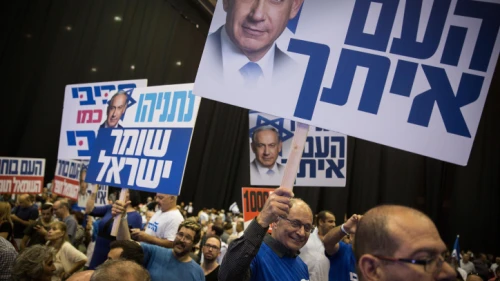
A Channel 10 News poll projects a strong showing for Netanyahu’s Likud Party if general elections were held today, with Yesh Atid coming in No. 2 with 21 Knesset seats. The same poll predicts 13 seats for Joint Arab List, compared to 12 for the Zionist Union.

Jeremy Corbyn, leader of the British Labour Party, said it was “very interesting talking to a lot of young people about their experiences of modern Britain, and I learned a lot. Isn’t that a good thing?”

The construction of permanent homes will begin in the coming months and is slated to reach 102 houses. Yet roughly a third of them will have to pass legal hurdles, as new petitions have been filed by Palestinians who claim the land demarcated for the homes belongs to them.

“I spoke the truth, and I would be happy to hold a discussions on the matter,” insisted Hanin Zoabi of Joint Arab List.

New statistics show that the number of women Knesset members in Israel increased from nine to 34 in the last 20 years.

One allows the state to revoke the permanent residence status of convicted terrorists. The other allows Israeli police to retain possession of terrorists’ bodies in order to prevent mass politicized processions.