Newsletter
Newsletter Support JNS

Likud, climbing in polls, is projected to win 32 seats

A Channel 10 News poll projects a strong showing for Netanyahu’s Likud Party if general elections were held today, with Yesh Atid coming in No. 2 with 21 Knesset seats. The same poll predicts 13 seats for Joint Arab List, compared to 12 for the Zionist Union.

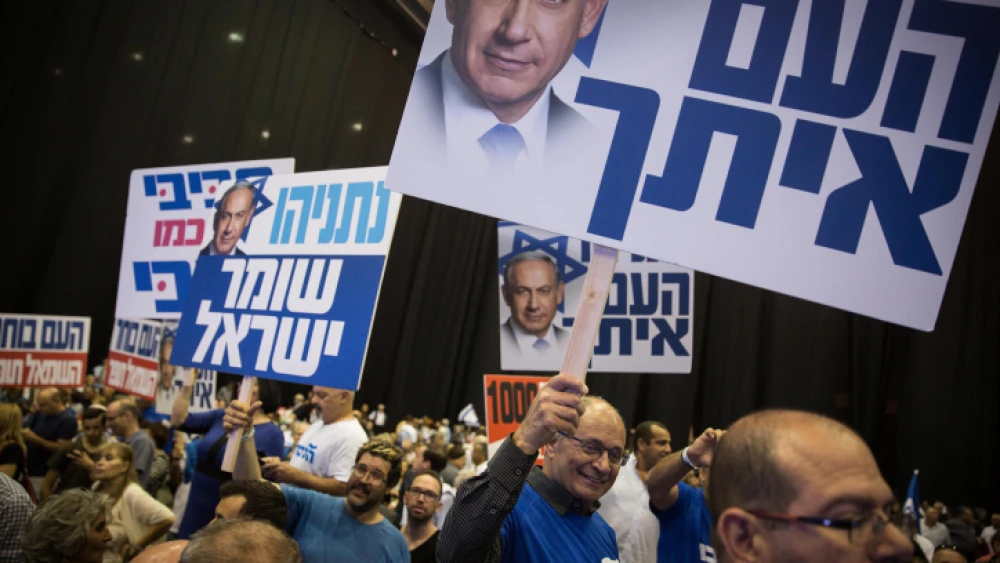
Israeli supporters at a Likud Party rally. Photo by Hadas Parush/Flash90.

Israeli Prime Minister Benjamin Netanyahu’s decision on Tuesday to revoke a compromise that would have prevented the mass deportation of illegal African migrants in Israel appears to have benefited his Likud Party.

According to a poll conducted by Channel 10 News, if a general election were held now, Likud would win 32 Knesset seats—far more than any other party.

The poll predicted 21 seats for the Yesh Atid Party, 13 for the Joint Arab List and only 12 for the Zionist Union.

Habayit Hayehudi was projected to secure 10 seats. Meretz, which just elected Knesset member Tamar Zandberg as party chairwoman, and Finance Minister Moshe Kahlon’s Kulanu Party were predicted to win seven seats each.

The poll showed Yisrael Beytenu, under Defense Minister Avigdor Lieberman, collecting five seats, which is the same number projected for United Torah Judaism.

MK Orly Levy-Abekasis’s as-yet unnamed new party and Shas would win four seats a piece.

“These attacks come amid a broader rise in violent extremism across Canada and other Western democracies—a toxic brew of anti-Zionist rhetoric, local criminal elements, Iranian-backed proxies and ISIS-inspired terrorism,” CIJA stated.
“Iran and Israel are the only two countries on this planet that have a biblical relationship,” the exiled Iranian Crown Prince Reza Pahlavi said.
“We discussed the friendship and relations between Israel and Bahrain, as well as the importance of the U.S.-led Abraham Accords,” Isaac Herzog said.
The cause of the blaze near the grave of Rabbi Shneur Zalman of Liadi was not immediately clear.
The Japanese Red Army member, who helped kill 26 people, lived in Lebanon since his release in a 1985 prisoner exchange.
The suspect’s writing about the deadly Samaria shooting prompted an investigation and the seizure of ammunition, cash and fireworks.