


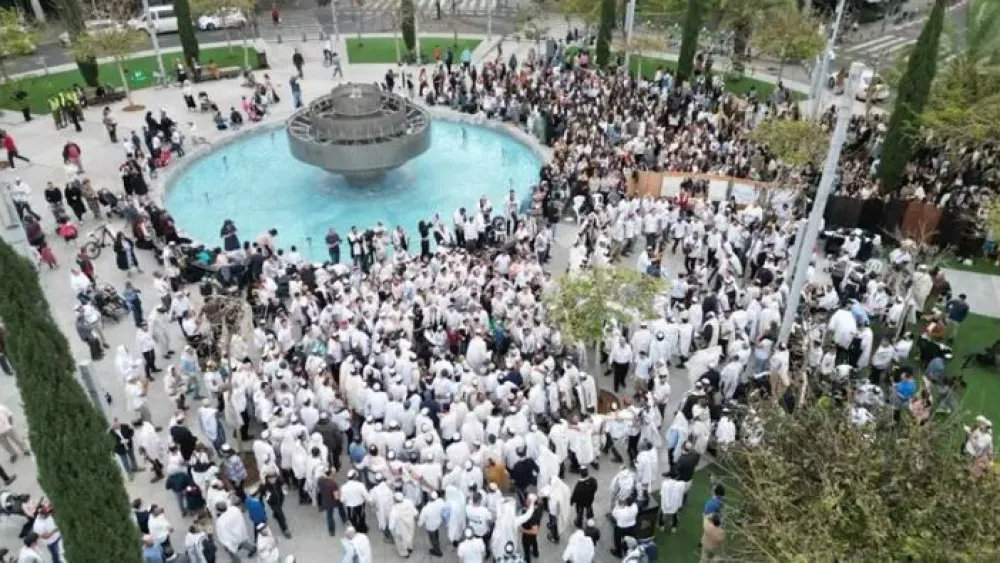
The Tel Aviv District Court ruled on Sunday in favor of the municipality’s ban on sex-separated prayer on public grounds.
The ruling was on a petition asking the court to order the municipality to allow sex-separated prayers on Yom Kippur on Dizengoff Square.
“On separation, I found no grounds to substitute the municipality’s discretion with my own as I was not convinced that the [municipality’s] decision diverges in the extreme from the realm of what is reasonable administratively. It relies on clear reasoning and I found in it no elements of authoritarianism, discrimination, unfairness or irrelevant considerations,” Judge Erez Yakuel wrote in his 24-page ruling.
In the petition filed last month by 14 residents along with the Rosh Yehudi nonprofit, one of the arguments was that the city’s refusal to allow sex-separated prayer on public grounds was discriminatory in light of its non-interference during multiple Muslim sex-separated religious events on public grounds.
The municipality last month declined to approve Rosh Yehudi’s request to hold its annual Yom Kippur event, which features the separation of the sexes, on Dizengoff Square. The holy day begins this year at sunset on Oct. 11.
Despite stating that the municipality’s refusal was non-discriminatory, Yakuel acknowledged in the same ruling that the municipality failed to treat Jews and Muslims equally. “The municipality clearly did not make the necessary effort to enforce its policy on all residents. It should do so in the future in real time whenever a violation becomes known—including vis-à-vis the Muslim population,” he wrote.
The events of last year’s Yom Kippur prayer at Dizengoff Square, which Rosh Yehudi held with a permit, shocked Jews and others across the world. Secular activists interrupted the event, tearing down Rosh Yehudi’s dividers—frames made of flexible materials to symbolically separate the sexes while respecting the municipality’s ban on physical barriers. Some activists threw prayer books into the square’s fountain as they harassed and chased away Jews trying to pray on Judaism’s holiest day.
The municipality has insisted it could not allow sex-separated prayer on public grounds because this would discriminate against women, despite arguments to the contrary by multiple religious women, including feminist ones.
Yakuel said the municipality should allow Rosh Yehudi, whose mission statement is to strengthen Jewish identity, to hold the event if it is done without separating the sexes. Yet the subject of the petition and the main bone of contention was that separation.
In a statement, Rosh Yehudi, headed by Israel Zeira, noted that the Orthodox interpretation of Halacha, Jewish law, requires separating the sexes during prayer.
The court “failed to address the central issue,” Rosh Yehudi wrote. “In practice, it delivered an absurd and offensive outcome. It’s difficult to accept that in the Jewish state, Halakhic prayer on Yom Kippur is banned for those who wish to engage in it, even for just a few hours. Painful and regretful.”
Zeira told JNS that Rosh Yehudi is considering appealing to the Supreme Court.


