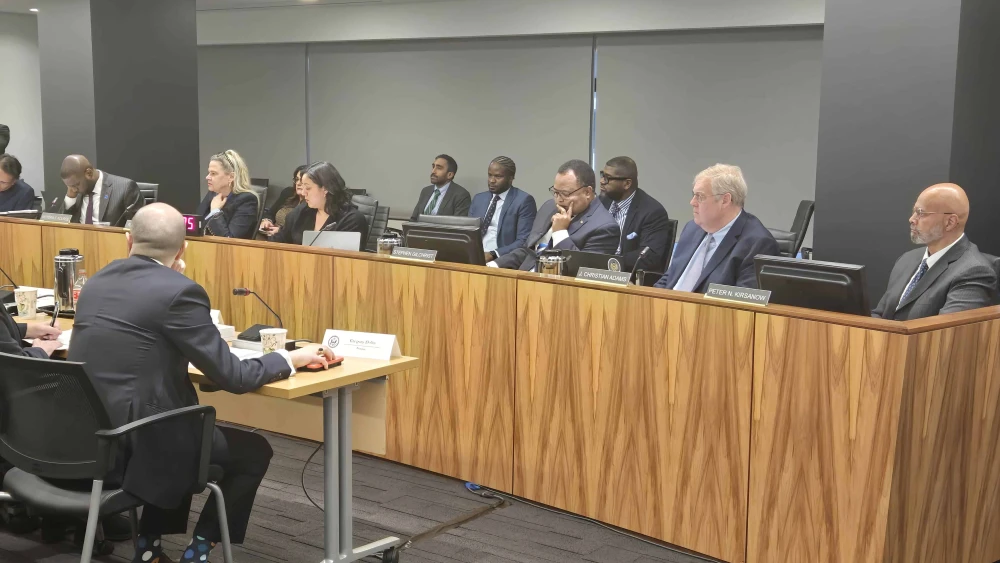
Witnesses before the U.S. Commission on Civil Rights on Thursday sharply disagreed over where First Amendment protections end and unlawful discrimination based on race, color or national origin begins, as the panel examined rising antisemitism on college campuses.
The session heard testimony from law professors, students, current and former federal officials, and representatives of groups such as the Jewish Council for Public Affairs and J Street U.
“There is no First Amendment exception for ‘hate speech,’ advocacy or defense of genocide, or other such views,” Eugene Volokh, a senior fellow at the Hoover Institution, said, arguing that the absence of such an exception protects speakers across the political spectrum.
“For instance, the lack of any exception for speech that supposedly promotes ‘genocide’ protects pro-Hamas speakers—but it also protects pro-Israel speakers who seek to defend Israeli actions in Gaza, despite claims that those actions themselves constitute ‘genocide’ of Palestinians,” he said.
Carly Gammill, director of legal policy for StandWithUs Law, countered that Zionism is not a political idea but rather refers to the connection between the Jewish people and their ancestral homeland.
“The failure to credit the repeated refrain of the Jewish community—that Zionism is a component of their Jewish religious, ethnic, racial and shared-ancestry identity, not politics—has blinded administrators and other decision-makers,” she said.
Gammill argued that campus chants calling for Israel’s elimination, violence against Jews or support for terrorist groups such as Hamas—including terminology that attacks Zionism—cannot be dismissed as simple political expression.
At issue throughout the hearing was when protected speech crosses into a Title VI violation requiring universities to act.
“If 100 students walked into a library holding nooses and sat down, I think we would all immediately understand this as a hostile environment for Black students,” said Mark Goldfeder, CEO of the National Jewish Advocacy Center and a professor at Touro Law School.
“When Jews on campus see the inverted red triangle of Hamas, which says they want to kill Jews everywhere in the world, that is what they see, and that is what they experience,” he said.
“We are not talking about slogans,” he added. “We are talking about symbols that mean something to people, and the same way that other recognized symbols have meant something to protected minorities.”
Benjamin Eidelson, a law professor and affiliate philosophy professor at Harvard University, said that speaking out against Israel is not a violation of Title VI of the 1964 Civil Rights Act.
“To state the obvious. There is no Zionist gene that I have or that Jews have,” Eidelson said. “Zionism is an ‘ism.’ It is not a fact about your birth in the way that being Italian, or being Irish or being black or being Jewish, in the sense that it is protected under Title VI, is.”
Eidelson also addressed the argument that anti-Israel protests are offensive and hostile.
“I have real sympathy for those feelings of estrangement and alienation on all sides of this conflict, and I want universities to be thoughtful about how to manage that,” he said. “But again, not everything that’s bad is a violation of Title VI.”
Gregory Dolin, senior counsel in the U.S. Department of Justice Civil Rights Division, testified that the administration proceeds “with a clear understanding that the First Amendment protects speech.”
The division focuses on antisemitic conduct that rises to actionable harassment or unequal treatment of Jewish students, he said.
The hearing marked the first time in at least 20 years that the civil rights panel addressed antisemitism. The review comes amid a surge in reported antisemitic incidents following the Hamas-led terrorist attacks in southern Israel on Oct. 7, 2023.
Democratic commissioner Mondaire Jones, who is leading the investigation with Republican commissioner Peter Kirsanow,
said the decision to examine antisemitism was bipartisan and unanimous.
“Antisemitism is the oldest bigotry in the world, and it has not gone away,” said Jones, a former U.S. congressman from New York, adding that Jew-hatred has “reached a fever pitch” since Oct. 7.
The commission expects to issue a report in September.