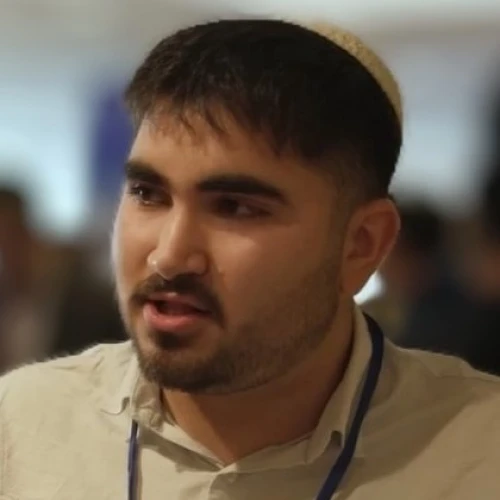
Yitzy Spinner, 41, remembers dropping his phone on the floor when he learned in October that he was a kidney match.
Spinner, the chazzan (“cantor”) at the Orthodox congregation Great Neck Synagogue on Long Island, N.Y., had gotten swabbed at a Renewal event the prior February.
Renewal is a Jewish nonprofit that aids those suffering from renal disease, including helping match donors with those who need a new kidney.
“I remember the exact spot in my basement of where I was when I got the call in October,” Spinner told JNS. “I picked up my phone and said I was sorry. I said that I didn’t know how to respond.”
“The woman from Renewal said this is not the first time this has happened,” he said. “‘I’m just going to send you an email, take your time.’”
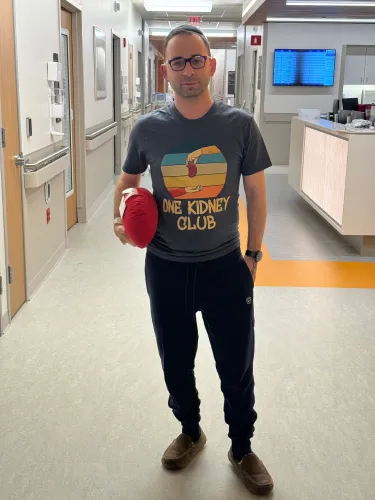
The married father of three decided to go forward with the surgery, which took place at Hackensack University Medical Center in New Jersey. The surgery to remove his left kidney took four hours, and Spinner felt fine with no pain nine days later, he told JNS.
The cantor learned about Renewal on a trip to Panama.
“I ended up sitting on a boat next to a very nice couple, and I was talking with the man who introduced himself as the president of Renewal,” Spinner said. “We were in a canoe. That was when I first learned about it.” The man was Sendy Ornstein.
The Brooklyn-based nonprofit performs 2,000 annual cheek swabs and has more than 300 patients on its waiting list, per its website. The average male donor is 38 and the female donor is 45.
Renewal helps facilitate about 135 transplants a year, according to Rabbi Chaim Steinmetz, its executive vice president.
“We are excited to see people become involved to save lives,” he told JNS.
Recipient driven
Spinner donated to Renewal at a fundraiser in Great Neck a year ago. He got his cheek swabbed and didn’t think much of it.
He knows that he donated his kidney to a man, but has yet to meet the person who received it.
“That’s recipient-driven, and it’s up to them if they want to meet,” he said.
Some research suggests that it can be very difficult for recipients to handle the fact that they owe their lives to someone else.
“Renewal tells you that you might find out and you might not,” Spinner said. “There is also a possibility the transplant doesn’t take. So, it’s not so simple that they put you in a room to have coffee together.”
As a child, Spinner was a star soloist in the Miami Boys Choir. He went on to study at the Belz School of Jewish Music at Yeshiva University.
JNS asked if anyone had jokingly suggested that giving up a kidney might impact his voice.
“The joke was that maybe the guy who got my kidney would become a good singer,” Spinner responded.
Spinner, a former cantor at the Hebrew Institute of White Plains, in New York, told JNS that his family was completely behind his decision. An avid runner and cyclist, Spinner is making his story public, hoping to inspire others, he said.
“People have the misconception that once you donate your kidney, your life is over,” he said. “Mine was right back to normal. Everyone makes their own choices in life.”
“For me, if there is someone on the fence and is thinking about doing it, if they see my story and it makes them want to do it, I think that’s a good thing,” he said.