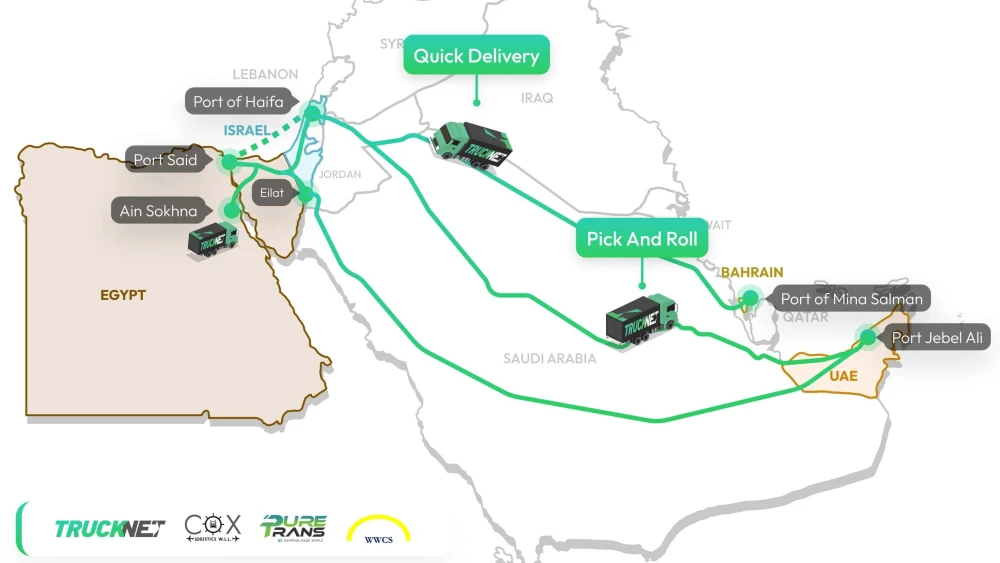
A land corridor for the delivery of cargo between the Gulf states and Israel through Saudi Arabia and Jordan is being extended to Egypt, as alternate sea routes have come under attack during the war with Hamas in Gaza, Israeli officials said Sunday.
Operation of the ground route, which quietly got underway earlier this year amid U.S.-brokered Saudi-Israel normalization talks, has gathered steam as Iranian-backed Houthi rebels from Yemen have stepped up assaults on commercial vessels in the Red Sea, a critical corridor for global shipping.
The U.S.-backed transportation project is a testament to the strength of the 2020 Abraham Accords, which saw Israel make peace with four Arab countries, led by the United Arab Emirates and Bahrain.
“This is an economic and historic breakthrough which gives expression to the economic and trade cooperation between Arab countries and Israel who have joined together to combat the ‘axis of evil,’” said Hanan Fridman, founder and president of Trucknet Enterprise, an Eilat-based startup that provides logistics technology for Arab companies that make the journey.
He said that the latest accord expanding the corridor, which was signed on Sunday, was not intended to replace the sea route through the Suez Canal, but to offer an alternate route at a time of attacks on the international waterway, and to complement it during times of peace with expedited delivery.
The maritime route provides Egypt with sizable revenue.
But with the war with Hamas raging, use of the land route grew exponentially in the wake of the Houthi attacks over the past two months.
Time and expense
Even before the war ignited by Hamas’s Oct. 7 attack on Israel, the “Land Connectivity by Trucks” project enabled the transport of cargo between the Gulf of Dubai and Israel’s Haifa Port while significantly cutting costs and time, Fridman said. A 14-day journey by sea was reduced to just four days by land, he added.
The transportation project was launched without publicity even as U.S.-brokered talks were underway with Saudi Arabia towards the normalization of relations between Riyadh and Jerusalem.
The prospect of a landmark peace accord between Israel and Saudi Arabia, which was widely expected to occur early next year, is believed to have been one of the major reasons for the Hamas attack.
A month before Oct. 7, Trucknet Enterprise, which serves as a matchmaker between cargo companies and carrier companies, signed an agreement with the UAE and Bahrain in Manama. An agreement has now been reached with the Egyptians that will allow goods reaching Israel from the Far East through the Gulf to be transported onwards to Egypt via land or sea.
“The high level of cooperation and readiness which we found among shipping and logistics companies both in the Arab world and around the globe prove that the contacts that are being developed are of mutual interests to all sides which can turn Israel into a [transport] traffic hub on an international scale,” he said.
Breakout
After the war broke out, the land option suddenly became even more useful as the Houthis began attacking the sea route, forcing Israeli vessels to reroute via South Africa, resulting in delays and higher transportation costs.
The overland route can accommodate a total of 350 trucks a day.
A ‘new Middle East’
“The Abraham Accords really created a new Middle East,” said Fridman. “Turning Haifa Port into a gateway of connectivity for goods to and from the East is a major boon for the Israeli economy.”
A separate long-term plan discussed before the war and still under consideration would see the creation of a rail link between Israel and the Gulf states through Saudi Arabia that would be part of a train project linking Israel, the Gulf, Europe and the East.