Newsletter
Newsletter Support JNS

US sanctions men, companies accused of laundering money for Hezbollah

“This administration will continue to take action against Hezbollah financiers ... who have used money-laundering and tax-evasion schemes to fund terrorist plots and finance their own lavish lifestyles as the Lebanese people suffer,” according to the U.S. Treasury Secretary.

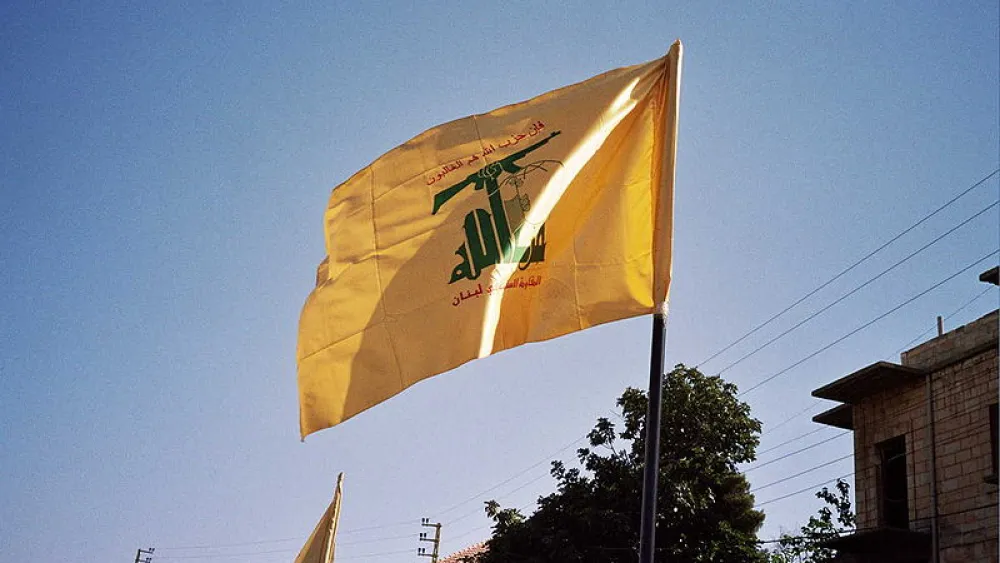
The Hezbollah flag. Credit: Wikimedia Commons.

The United States sanctioned two top Hezbollah money-launderers on Friday—one in Lebanon and the other in the Democratic Republic of the Congo—and their companies.

“Hezbollah continues to use seemingly legitimate businesses as front companies to raise and launder funds in countries like the DRC, where it can use bribery and political connections to secure unfair market access and evade taxes,” said U.S. Treasury Secretary Steven Mnuchin. “This administration will continue to take action against Hezbollah financiers like Nazem Said Ahmad and Saleh Assi, who have used money-laundering and tax-evasion schemes to fund terrorist plots and finance their own lavish lifestyles as the Lebanese people suffer.”

Ahmad, who has a vast art collection, is reportedly one of Hezbollah’s top donors, generating funds through his longstanding ties to the “blood diamond” trade.

Assi reportedly provided financial support to Hezbollah financier Adham Husayn Tabaja, who has direct ties to senior Hezbollah officials and Hezbollah’s operational component, the Islamic Jihad, which is responsible for executing Hezbollah’s terrorist attacks globally, according to the U.S. Treasury Department.

Tabaja has already been sanctioned by the United States.

The United States also sanctioned Tony Saab on Friday for allegedly providing support to Assi.

Since withdrawing in May 2018 from the 2015 Iran nuclear deal, the United States reimposed sanctions lifted under it, along with enacting new financial penalties against Tehran.

In a draft report delivered to the U.S. president, the commission also called for improved religious accommodations for U.S. service members.
Salah Salem Sarsour, accused of concealing Israeli military court convictions on immigration forms, argued his detention was part of a Trump admin effort to target the pro-Palestinian movement.
CENTCOM stated that the strikes targeted missile, drone and radar facilities after the Islamic Republic attacked a cargo ship in the Strait of Hormuz, calling the assault a violation of the ceasefire.
Now that the primaries are over, “we hope that everyone will come together and be united,” Christine Quinn, chair of the executive committee of the New York State Democratic Party, told JNS.
An Iranian official warned on Friday that the safety of ships passing through the Strait of Hormuz without Iran’s permission “cannot be guaranteed.”
“We have put the train back on the tracks and going in the right direction,” said Yechiel Leiter, Israeli ambassador in Washington. “Final destination? Peace between our two countries.”
Benny Gantz, JNS editor-in-chief Jonathan S. Tobin, Gilad Erdan, Mosab Hassan Yousef, Nissim Black and leading voices in security, diplomacy, media, law and Jewish communal affairs headline the summit’s third day in Jerusalem.