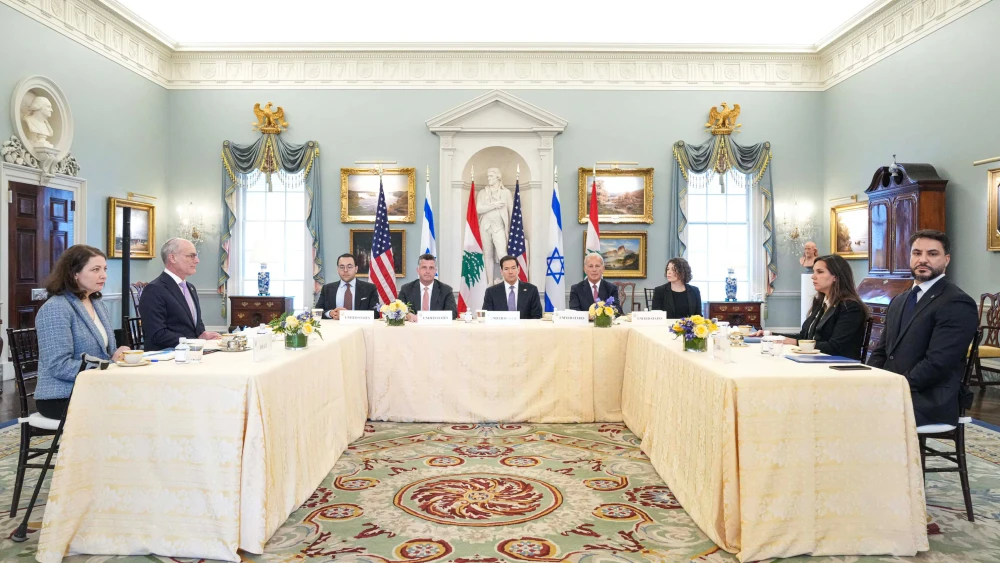
Israel and Lebanon agreed to a 10-day ceasefire on Thursday following calls between U.S. president Donald Trump and the leaders of each country.
After Trump announced the truce on social media, the State Department released a statement with details of the agreement between the two sides.
“Israel and Lebanon will implement a cessation of hostilities” that will start at 5 p.m. Eastern on April 16 for “an initial period of 10 days, as a gesture of goodwill by the government of Israel, intended to enable good-faith negotiations toward a permanent security and peace agreement between Israel and Lebanon,” the agreement says.
The agreement adds that Israel will retain a right to self-defense “at any time, against planned, imminent or ongoing attacks” but will otherwise cease offensive military operations in Lebanon.
The agreement does not call for a withdrawal of Israeli ground forces from Lebanon and says that the initial ceasefire may be extended “as Lebanon effectively demonstrates its ability to assert its sovereignty.”
That condition appears to be tied to Lebanon’s ability to disarm Hezbollah, as the agreement requires the Lebanese government to take “meaningful steps” from the time the ceasefire begins to prevent Hezbollah and other terrorist groups from attacking Israel from Lebanese territory.
Trump wrote in a followup post to the truce announcement that he would invite Lebanese President Joseph Aoun and Israeli Prime Minister Benjamin Netanyahu to the White House for “meaningful talks.”
The agreement released by the State Department says that those negotiations would be designed to resolve “all remaining issues” and reach a comprehensive peace agreement between Israel and Lebanon, which do not have diplomatic relations and have technically been in a state of war since Israel’s founding in 1948.
An open question about any ceasefire in Lebanon is whether Israel can prevent Hezbollah from carrying out attacks on Israeli border communities.
In a statement confirming the ceasefire, Netanyahu said that the agreement allowed for Israeli troops to maintain a “reinforced security buffer zone” inside Lebanon.
“This allows us, first and foremost, to block the danger of an invasion into our communities, and secondly, it allows us to prevent direct anti-tank fire into the communities,” Netanyahu said. “The residents are now protected from these two dangers.”
Netanyahu added that he had received assurances from Trump that the U.S. president intends to continue the naval blockade of Iran and dismantle the regime’s remaining nuclear capabilities.