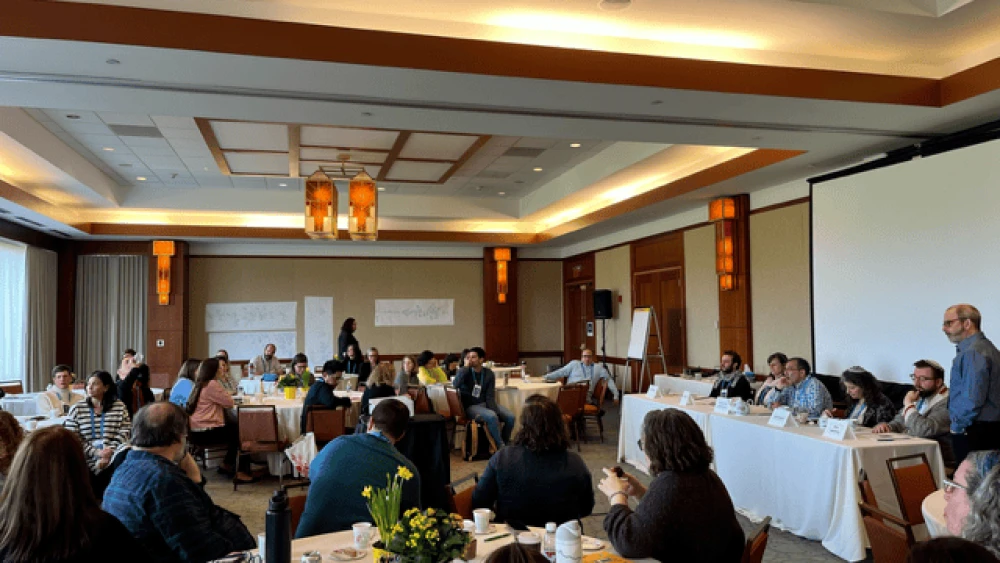
A new training program is helping Jewish educators address some of the most complex and difficult challenges in Israel education. Run by The iCenter, Conflicts of Interest addresses key issues in the Israeli-Palestinian conflict, increasing educators’ confidence, competence and capabilities to hold nuanced perspectives and engage learners with different narratives.
Conflicts of Interests draws from the best resources and pedagogies from leading organizations in the fields of conflict education, peace education, political education, civic education and more. The learning is organized around a set of values and core pedagogic approaches, content areas, and historical and contemporary points of contention. Central to any iCenter experience is its approach that places the learners’ relationship with Israel at the center of the learning experience.
“By far, my biggest takeaway is becoming more comfortable with holding multiple narratives as truths even if they go against my internalized biases,” said a participant from the pilot cohort of the Conflicts of Interest program. “COI helped me grapple with the difference between understanding or sympathizing and fully agreeing. That has helped me with feeling comfortable exploring narratives surrounding the conflict that contradict beliefs I hold deep in my heart.”
Over about four weeks, both virtually and in person, participants developed skills, open-mindedness, courage and resilience to approach conflicts in their work and everyday lives. Throughout the program, educators engaged with core content related to conflicts and Israel, learned and practiced protocols for facilitating conversations around controversial issues, examined primary sources and received practical tools for engaging with these topics.
“Especially after Oct. 7, Jewish educators are also Israel educators,” said Anne Lanski, CEO of The iCenter. “Educators must be ready to engage with Israel and the conflict in nuanced ways that respect each learner. We support and train educators in ways that reflect what we call ‘the art of turning conflict into growth.’ ”
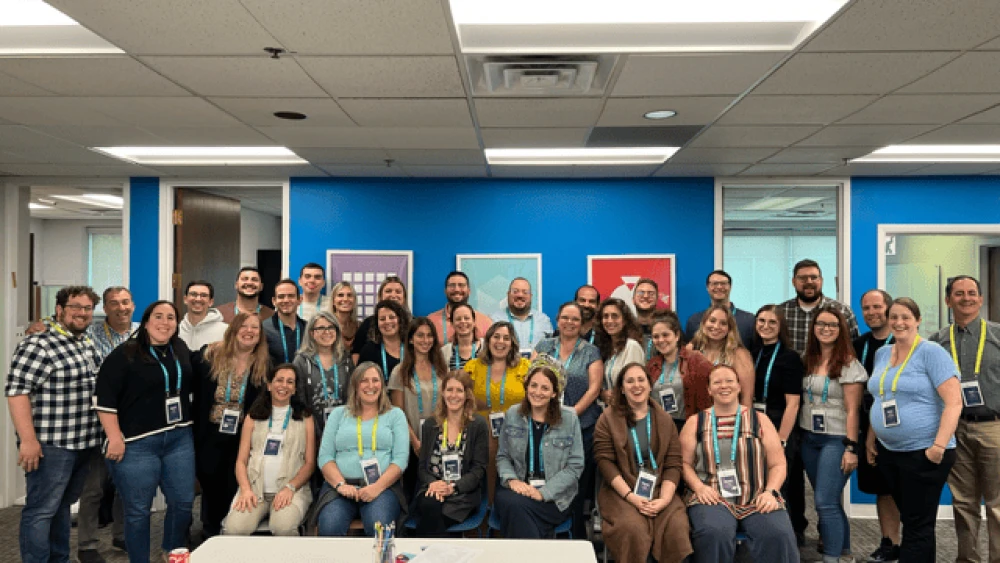
Independent evaluation of Conflicts of Interest captures the educators’ experience from the four cohorts during the pilot implementation year. The program proved to be extremely effective, as participants gained more confidence and skills in engaging learners in conversations about the conflict, and increased their ability to hold multiple perspectives when discussing the conflict. Key findings include:
● Receptiveness Is Crucial for Engaging in Contentious Conversations. There was impressive growth in receptiveness—the willingness and ability to engage with perspectives that differ from one’s own—when discussing the conflict, with participants’ self-ratings moving from moderate to high across all cohorts. According to the evaluator, “While some participants found [receptiveness] to be the hardest skill for them to acquire, most said they believed it was crucial in being able to converse about conflict.”
● Curating Multiple Perspectives Is Critical for Unpacking Complexities. The most frequently mentioned takeaway for participants was the value of learning multiple perspectives of historical and current events. The evaluation showed impressive growth (from moderate to high) across all cohorts on participants’ ability to hold multiple perspectives when discussing the conflict. Many respondents mentioned that they appreciated the value of exploring Arab and other narratives, which they felt enhanced their understanding of the complexities of the current conflict.
● The Learners’ Relationships to Israel Must Be at the Center of the Experience. Nearly 85% of respondents found the program’s approach that centers their relationship with Israel and engages them as learners to be very or extremely valuable. They appreciated the time they got to be nurtured as learners.
● For Educator Training, the Balance Between Being a Learner and Practitioner Is Key. The “pulling back the curtain” strategy was rated as one of the most effective parts of the program, enabling participants to translate their own learnings into practical applications. One respondent even remarked that, “pulling back the curtain to explain pedagogies felt useful, largely as a constant reminder that we were learning these things not just to gain content knowledge, but to find ways to teach it.”
“The program challenged me to think outside the box to find new ways to think and new ways to teach,” said a participant. “It makes me want to be more experiential with how I teach and the importance of not only the topic but connecting to the learner through lived experience.”
Another participant reflected, “We must teach with nuance and complexity, recognizing different narratives and perspectives. Anything else a) feels like it lacks integrity; b) risks losing learners who are skeptical that Jewish institutions can hold space for more than one perspective (e.g., teens, young adults, etc.), and c) risks creating resentment in learners down the road who could feel like they’d been ‘lied to’ through their Jewish-educational experiences when they were younger.”
About the Conflicts of Interest Certificate Program: In August 2023, The iCenter provided a pilot certificate program on the Israeli-Palestinian conflict to interested Israel educators and others working in the field of Israel education. Since then, three other cohorts completed the program, totaling 196 educators from across the United States and Canada.
The certificate program was offered as an intensive and immersive experience to help participants gain competence and confidence to educate their learners about conflicts in general and the Israeli-Palestinian conflict in particular.
Applications for Conflicts of Interest cohorts in August 2024, November 2024 and January 2025 are now open. To learn more and to apply, visit theicenter.org/conflictsofinterest.