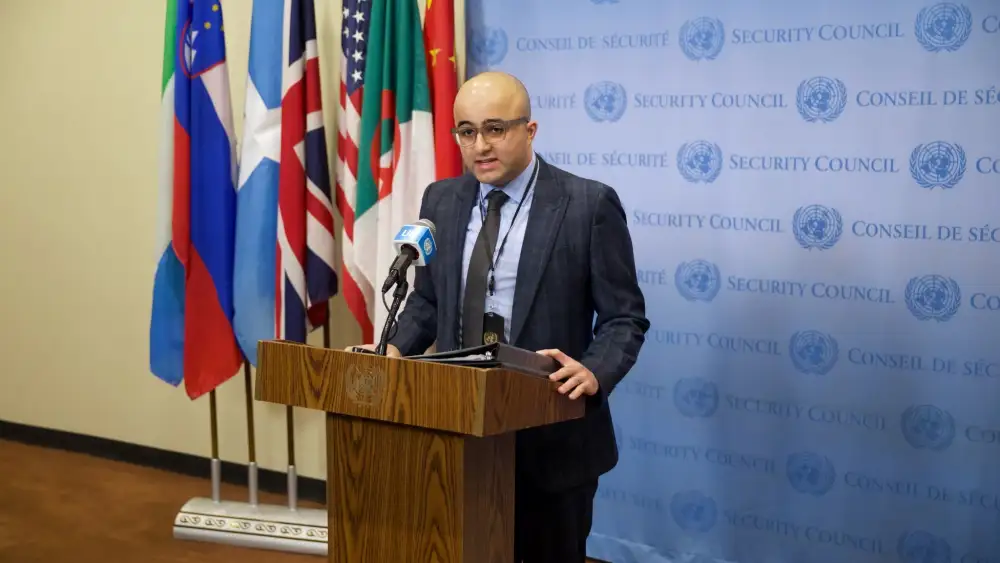
As world leaders arrive in New York City for the 80th session of the United Nations General Assembly this week, much of the talk is expected to focus on Iran’s nuclear program and the sanctions meant to squeeze its economy. Jonathan Harounoff, Israel’s spokesman at the United Nations, hopes the spotlight also lands on everyday Iranians who live under the regime.
His book, Unveiled: Inside Iran’s #WomanLifeFreedom Revolt, which he spent three years researching and penning, is slated to publish on Thursday.
“Whenever you’re reading about Iran in the news, all you hear about is the nuclear program, proxies, instability,” he told JNS at a café near U.N. headquarters in Turtle Bay, where he has spent the last year as Israel’s international spokesman.
“You don’t read about what’s going on on the ground, with the people,” said Harounoff, a British journalist who is Jewish and of Persian descent. “I wanted to spotlight them, not the regime.”
The discussions at the global body, particularly the Security Council, tend to center on Israel and Iran. The council recently decided to reimpose “snapback sanctions” on the Islamic Republic—a decision designed to further isolate the regime and deepen its economic crisis.
“There is history behind all of this,” Harounoff told JNS. “Having that historical foundation that I’ve written about really informs what’s playing out live at the United Nations.”
His forthcoming book centers on the death of Mahsa Amini, the 22-year-old Kurdish woman whom Iran’s so-called morality police detained for what it said was improperly wearing her hijab. After she was killed in captivity in September 2022, Amini’s case gained global attention and sparked the Woman, Life, Freedom revolt, Iran’s largest wave of anti-regime protests in more than a decade, according to Harounoff.

Amini being “an ordinary person” was the driving force behind the movement’s rise, he told JNS.
“She wasn’t an activist or seeking fame. She was minding her own business, visiting Tehran with her relatives, when she was stopped by the morality police,” Harounoff said. “That kind of encounter resonated with thousands of Iranian women who had similar experiences. It could have happened to anyone.”
‘News happens quickly’
Harounoff told JNS that the title of his book is a play on words. The “unveiled” reference refers to “unmasking the Islamic Republic,” he said, as well as the physical act of women defying state law and removing their headscarves.
“After Amini died, we saw women inside Iran and in the West, Iranian and non-Iranian, taking off their veils and cutting their hair in protest,” he said. “Even members of European parliaments cut their hair on live television.”
The hashtag before “#WomanLifeFreedom Revolt” highlights the role social media played in “amplifying and metastasizing the protests,” Harounoff told JNS.
Despite the Iranian regime’s efforts to censor, so-called “citizen journalists” drove the news cycle, and Harounoff thinks they will continue to do so.
That was evident during the recent wave of water protests across Iran’s 31 provinces and again on the third anniversary of Amini’s death, when most news coverage relied on footage from everyday citizens, he said.
Iranian authorities responded to the Woman, Life, Freedom protests with a series of brutal crackdowns and killed hundreds of protesters and arrested thousands more, according to Harounoff. That violence, coupled with what he describes as a lack of international follow-through, prevented the movement from achieving its goals.
“News happens quickly. People move on,” he said. “There wasn’t sustained pressure.”
Harounoff also cited what he sees as a pattern of half-measures at the United Nations.

“At the United Nations, there was a resolution in December 2022 to remove Iran from the Economic and Social Council, and there were promises of sanctions,” he said. “Not enough followed through.”
The failure, as he sees it, came ultimately from “not enough international action, brutal repression inside Iran and a lack of unified opposition in exile,” according to Harounoff.
“Some leaders coalesced, but most fought about what a post-Islamic Republic Iran should look like,” he told JNS.
The future
A new wave of protests is inevitable as conditions inside Iran worsen, according to Harounoff, who told JNS that he sees no sign that Tehran will change its tactics.
“It’s always a combination,” he said. “You see brutal crackdowns: arrests, disappearances, executions. People who protested in 2022 are still being sentenced today, and the morality police are still active.”
Iran’s “supreme leader” Ali Khamenei and the Islamic Revolutionary Guard Corps, which Washington designated a terror organization in 2019, “call the shots, and they continue the repression,” Harounoff said. “As long as that structure exists, the brutality will continue.”
Renewed collaboration between Israel and Iran may sound far-fetched today, but Harounoff notes it was once routine and could again reshape the Middle East.
“Before 1979, there was all of this collaboration, all of this trade that really doesn’t get spoken about,” he said.
At the request of Mohammad Reza Pahlavi, then the shah of Iran, Israel dispatched a team of water-engineers to help rebuild infrastructure in the center of the northern part of Iran after the 1962 earthquake in Qazvin that killed about 12,000 Iranians.
“Imagine that level of collaboration now,” Harounoff told JNS. “The entire Middle East would be more prosperous.”
That idea resonates with those who remember what life was like in the country before 1979 or who have relatives that remember, according to Harounoff, whose family lived in Iran prior to the revolution.
Harounoff told JNS that the collapsing economy in Iran poses a greater threat to the regime than does politics and ideology.
“Like anywhere, people care first about living in prosperity, health and safety,” he said. “Right now, inflation is sky-high, unemployment is rampant and electricity and gas shortages are constant. Meanwhile, the government diverts resources to proxies, nuclear programs and weapons development—all extremely expensive.”
“Ordinary people see that money being wasted while they suffer,” he said. “That kind of economic instability is more dangerous to the regime than demands for political change.”
Harounoff’s book also highlights the shared pain that Israelis and Iranians have endured under the regime.
“Both have suffered directly and indirectly at the hands of the Islamic Republic,” he told JNS. “Israel has suffered a lot. But, of course, nobody has suffered more at the hands of the Islamic Republic than the people of Iran.”