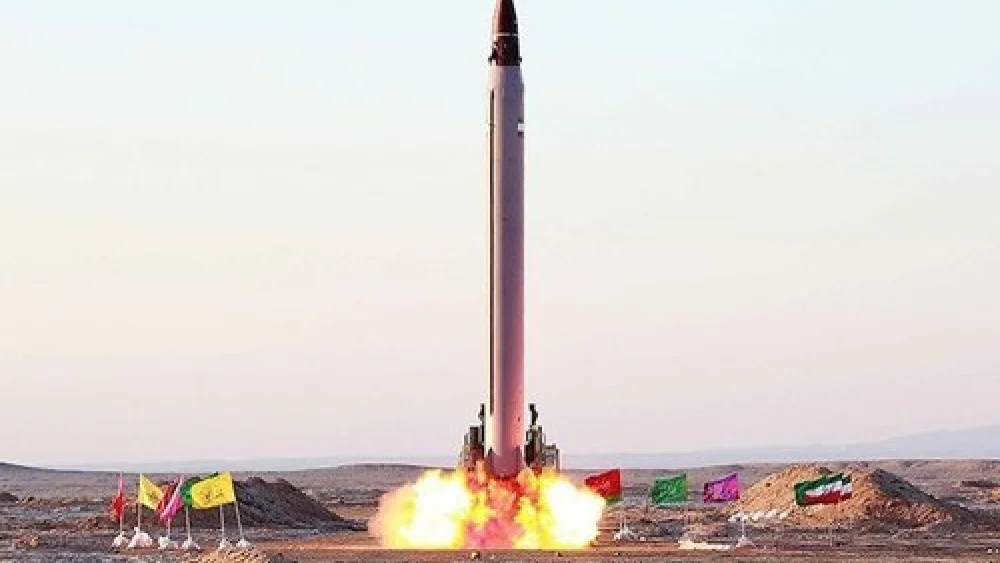
Iran may be conducting long-range ballistic-missile testing at a secret facility in a remote desert hundreds of miles east of Tehran, The New York Times revealed on Wednesday.
“An analysis of structures and ground markings at the facility strongly suggests, though does not prove, that it is developing the technology for long-range missiles, the researchers say,” the newspaper reported.
While the existence of a long-range ballistic-missile program would not violate the Iranian nuclear deal or other formal agreements, it would likely ratchet up tensions with the United States and even Europe, where a long-range missile could hit.
According to the report, researchers from the Middlebury Institute of International Studies, who were looking at a recent flurry of state media material on Gen. Hassan Tehrani Moghaddam—the lead scientist on Iran’s long-range missile program, who died in a 2011 explosion while testing them—discovered purported evidence that long-range missile development and testing was being carried out at a secretive military facility in Shahrud in a remote Iranian desert about 220 miles east of Tehran.
Moghaddam “oversaw the development of a secret, second facility in the remote Iranian desert that, they say, is operating to this day,” the report said, quoting the researchers.
While many believed that missile testing at Shahrud had ceased in 2013, satellite images of the site showed a steady increase in the number of buildings there in the last few years.
Additionally, large marks on the desert floor appeared to be the result of rocket engine test-firings, while an analysis of the concrete stands that would hold the missile engines during the test-firings indicate that they held engines between 62 and 93 tons of thrust, consistent with long-range missiles.
The report noted that the five experts who reviewed the research material all agree that it likely indicated such work. But it also pointed out that “it is possible that the facility is developing only medium-range missiles, which Iran already possesses, or perhaps an unusually sophisticated space program.”
According to the report, “the country does not appear to be sprinting toward a long-range missile, but preparing the ground in case Iranian leaders should one day deem that necessary.”