Newsletter
Newsletter Support JNS

US anti-Semitism envoy warns of continued online hatred after COVID subsides

“Periods of economic pain have almost always seen Jew-hatred increase and not just in words, but in violent acts,” noted Elan Carr.

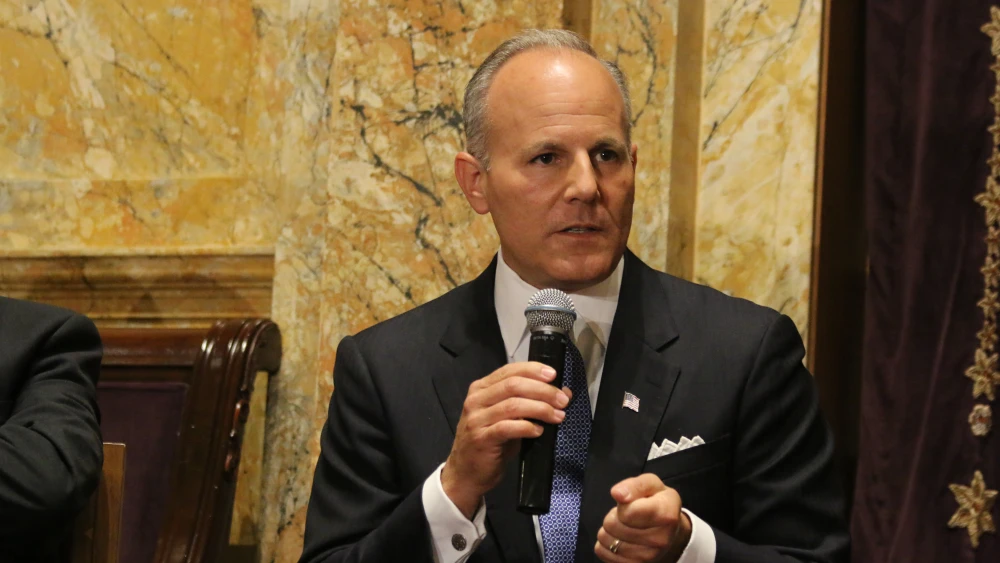
Special Envoy for Monitoring and Combating Anti-Semitism Elan Carr at a panel discussion on anti-Semitism in New York City on Sept. 10, 2019. Photo by Rhonda Hodas Hack.

As anti-Semitism has fomented during the coronavirus pandemic, hatred towards Jews as it pertains to the outbreak won’t go away once it ends, warned U.S. Special Envoy for Monitoring and Combating Anti-Semitism Elan Carr.

“We’ve seen a tsunami of anti-Semitic hatred on the Internet and social media that baselessly blames Jews for … having invented the coronavirus, for intentionally spreading from it, profiting from it or using it as a tool for global control,” said Carr on Monday at the virtual summit hosted by Christians United for Israel (CUFI) in lieu of the organization’s annual summit in Washington, D.C.

“The only thing new or novel about this absurd allegation is the coronavirus itself,” continued Carr. “Blaming Jews for the world’s maladies has been a standard feature of anti-Semitism for centuries.”

Carr also cautioned that even when the pandemic subsides, anti-Semitism related to it won’t disappear.

“When COVID-19 is behind us—G-d willing, may that be soon—we will be forced to confront the anti-Semitism that feeds off of the economic downturn resulting from this global shutdown,” he said. “Throughout history, periods of economic pain have almost always seen Jew-hatred increase and not just in words, but in violent acts.”

Panelists at the JNS Summit argued that Israel must expand its domestic military capabilities while continuing strategic cooperation with the United States.
“Anti-Zionism can be a framework for justifying anti-Jewish hostility,” Rafaela Dancygier, of Princeton University, told the N.J. Advisory Committee to the U.S. Commission on Civil Rights.
A board member at the Orthodox synagogue told the FBI that members began attending services less frequently after Kevin Charles Pyles allegedly targeted the synagogue in separate July and August 2025 incidents.
The Senate rejected a resolution calling for the removal of U.S. forces from the war against Iran after U.S. President Donald Trump hammered Senate Republicans for approving a similar measure the day before.
“When someone uses the N-word on campus, no one thinks about free speech. No one talks about, ‘Let’s understand what they’re thinking. Let’s have a discussion,’” Rep. Randy Fine said. “But somehow when it came to Jews, everyone wanted to rediscover the idea of free speech.”
“Leadership should be responding with moral clarity, not suggesting that the act of teaching about the Holocaust has somehow ‘missed the mark,’” said Kurt Schwartz, CEO of CAMERA.
Benny Gantz, JNS editor-in-chief Jonathan S. Tobin, Gilad Erdan, Mosab Hassan Yousef, Nissim Black and leading voices in security, diplomacy, media, law and Jewish communal affairs headline the summit’s third day in Jerusalem.
