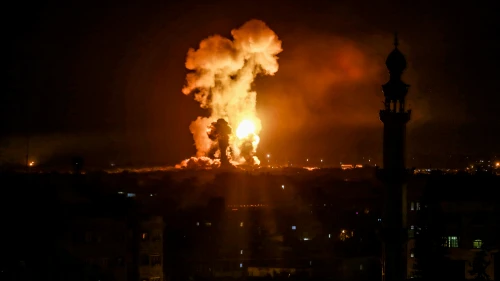
Israeli troops completed a two-month operation in northern Gaza.
 Trump says U.S. will guide neutral ships out of Strait of Hormuz in humanitarian move, warns any interference will be met with force.
 Four of the most devastated communities during the Oct. 7, 2023, attacks are in advanced stages of reconstruction.
 If Iran decides to fight over passage through the Strait of Hormuz, “it will mean a return to hostilities,” a security source said.
 A deadline in the law has yet to pass, but Rabbi Josh Joseph, of the Orthodox Union, told JNS that “we expect the mayor and the NYPD to work in close coordination with the community to ensure that the intent of this legislation is fully upheld.”
 Online critics accused the bestselling author, who is a supporter of the BDS movement, of “normalizing” Israelis over a brief reference in her book, Taipei Story.
 The president’s call for a national Shabbat “celebrates our religion and it refocuses on our job to become a light unto the nations,” Rabbi Steven Burg of Aish told JNS.
 “Doris Fisher leaves behind a legacy of deep commitment to her family and our city,” San Francisco Mayor Daniel Lurie said.
 Nearly four of five French Jews feel unsafe, according to a recent survey.
Trump says U.S. will guide neutral ships out of Strait of Hormuz in humanitarian move, warns any interference will be met with force.
Nearly four of five French Jews feel unsafe, according to a recent survey.
Trump says U.S. will guide neutral ships out of Strait of Hormuz in humanitarian move, warns any interference will be met with force. The formal public hearings in the probe into the Bondi Beach massacre reveal Australian Jewry’s fear and anxiety.
 The murderer, who converted to Islam in 2007, held “antisemitic, florid and ideologically disturbing” views, according to the judge.
 “We’re not seeing any indication that a large part of the Jewish community supports anti-Zionism,” Jonathan Schulman, of Jewish Majority, which conducted the survey, told JNS.
Nearly four of five French Jews feel unsafe, according to a recent survey.
“We’re not seeing any indication that a large part of the Jewish community supports anti-Zionism,” Jonathan Schulman, of Jewish Majority, which conducted the survey, told JNS.
Nearly four of five French Jews feel unsafe, according to a recent survey. “People shouldn’t think that, ‘Oh this is not going to happen to me,’” the 32-year-old Judaic studies teacher told JNS. “It can happen to anyone walking the streets, anyone with their groceries.”
 “Those responsible must be found and investigated before words turn into action,” the Combat Antisemitism Movement said.
 Its contemporary manifestation almost always centers on the charge that Jews are more beholden to Israel than their own nation.
 The trip underscores Israel’s growing diplomatic outreach in Latin America, the President’s Office said.
 The director of the Jewish school said that the speed with which his staff guided the children to the bomb shelter saved their lives.
 “He informed and entertained generations of fans with a theatrical and unapologetic style that was uniquely his own,” the New York Yankees stated.
 “There isn’t a moment that I don’t think of what could have been,” her mother told JNS.
 Rare documents, letters and photos on display at the President’s Residence trace a century of engagement between the Chief Rabbinate and American presidents.
 From Miami suites to Mexico City kitchens, a new generation of Jewish food influencers is using cuisine as a powerful form of cultural diplomacy.
 An exhibition in Tel Aviv supports thousands of IDF troops from abroad serving in Israel.
 Attempts to separate the movement to accomplish the genocide of half the world’s Jews in Israel from attacks on them elsewhere have zero credibility.
 What was once dismissed as a fringe campus problem is no longer staying on the fringe.
 Restraint against Hamas may be strategically necessary, even if operationally frustrating.
 Israelis want to get rid of Hezbollah terrorists once and for all, the Iranian terrorist proxy that has prevented them from living normal lives for decades.


-
Israeli troops completed a two-month operation in northern Gaza.
Trump says U.S. will guide neutral ships out of Strait of Hormuz in humanitarian move, warns any interference will be met with force.
Four of the most devastated communities during the Oct. 7, 2023, attacks are in advanced stages of reconstruction.
If Iran decides to fight over passage through the Strait of Hormuz, “it will mean a return to hostilities,” a security source said.
-
A deadline in the law has yet to pass, but Rabbi Josh Joseph, of the Orthodox Union, told JNS that “we expect the mayor and the NYPD to work in close coordination with the community to ensure that the intent of this legislation is fully upheld.”
Online critics accused the bestselling author, who is a supporter of the BDS movement, of “normalizing” Israelis over a brief reference in her book, Taipei Story.
The president’s call for a national Shabbat “celebrates our religion and it refocuses on our job to become a light unto the nations,” Rabbi Steven Burg of Aish told JNS.
“Doris Fisher leaves behind a legacy of deep commitment to her family and our city,” San Francisco Mayor Daniel Lurie said.
-
Nearly four of five French Jews feel unsafe, according to a recent survey.
Trump says U.S. will guide neutral ships out of Strait of Hormuz in humanitarian move, warns any interference will be met with force.
The formal public hearings in the probe into the Bondi Beach massacre reveal Australian Jewry’s fear and anxiety.
The murderer, who converted to Islam in 2007, held “antisemitic, florid and ideologically disturbing” views, according to the judge.
-
“We’re not seeing any indication that a large part of the Jewish community supports anti-Zionism,” Jonathan Schulman, of Jewish Majority, which conducted the survey, told JNS.
Nearly four of five French Jews feel unsafe, according to a recent survey.
“People shouldn’t think that, ‘Oh this is not going to happen to me,’” the 32-year-old Judaic studies teacher told JNS. “It can happen to anyone walking the streets, anyone with their groceries.”
“Those responsible must be found and investigated before words turn into action,” the Combat Antisemitism Movement said.
-
Its contemporary manifestation almost always centers on the charge that Jews are more beholden to Israel than their own nation.
The trip underscores Israel’s growing diplomatic outreach in Latin America, the President’s Office said.
The director of the Jewish school said that the speed with which his staff guided the children to the bomb shelter saved their lives.
“He informed and entertained generations of fans with a theatrical and unapologetic style that was uniquely his own,” the New York Yankees stated.
-
“There isn’t a moment that I don’t think of what could have been,” her mother told JNS.
Rare documents, letters and photos on display at the President’s Residence trace a century of engagement between the Chief Rabbinate and American presidents.
From Miami suites to Mexico City kitchens, a new generation of Jewish food influencers is using cuisine as a powerful form of cultural diplomacy.
An exhibition in Tel Aviv supports thousands of IDF troops from abroad serving in Israel.
-
Attempts to separate the movement to accomplish the genocide of half the world’s Jews in Israel from attacks on them elsewhere have zero credibility.
What was once dismissed as a fringe campus problem is no longer staying on the fringe.
Restraint against Hamas may be strategically necessary, even if operationally frustrating.
Israelis want to get rid of Hezbollah terrorists once and for all, the Iranian terrorist proxy that has prevented them from living normal lives for decades.