
Watching the Academy Awards used to be a simple pleasure. Movie stars received statues, thanked their agents, thanked God, and occasionally, remembered to thank their parents.
Now the Oscars have become something else: an improvised foreign-policy seminar conducted by people whose professional expertise lies in pretending to be someone else.
This year’s ceremony followed the now familiar script. Comedian Conan O’Brien, this year’s host, reminded viewers that these are “very chaotic, frightening times.” Later, comedian and TV show host Jimmy Kimmel appeared to introduce the documentary category and offered a joke about courage and free speech, quipping that some countries don’t allow it: “North Korea and CBS.”
The audience chuckled. Social media approved. Another evening of Hollywood moral commentary was underway.
The question is why the Academy Awards have become a stage for geopolitical pronouncements at all.
War. Elections. Climate change. Israel. Gaza. Iran.
Every year the subjects change slightly, but the tone remains the same: a mixture of moral certainty and remarkable lack of depth. The most complicated conflicts on earth are reduced to applause lines that last about as long as a movie trailer.
Hollywood has always believed in the power of storytelling. Stories require heroes, villains and satisfying conclusions.
Real life rarely cooperates. War is not a screenplay. It does not resolve itself in two hours with a swelling musical score and a closing montage. It involves decisions where the stakes are measured in lives lost and families shattered.
That reality is rarely acknowledged from the Oscar stage. In Hollywood, courage is often defined as delivering a politically fashionable line in front of an approving audience dressed in tuxedos and designer gowns.
But real courage looks very different. Sometimes, it is a journalist reporting from a battlefield. Sometimes, it is a soldier defending his country. Sometimes, it is a parent who lost a child to terrorism and still insists that justice matters.
Thirty-one years ago, my daughter Alisa was murdered in a terrorist attack sponsored by the Islamic Republic of Iran. There was no red carpet that day, no applause lines, no clever monologue about “chaotic times.” There was simply the brutal reality of terrorism and its lifelong consequences for the families left behind.
Those experiences rarely translate into award-show humor. Nor do they fit neatly into the narratives many celebrities prefer when discussing Israel and the Middle East.
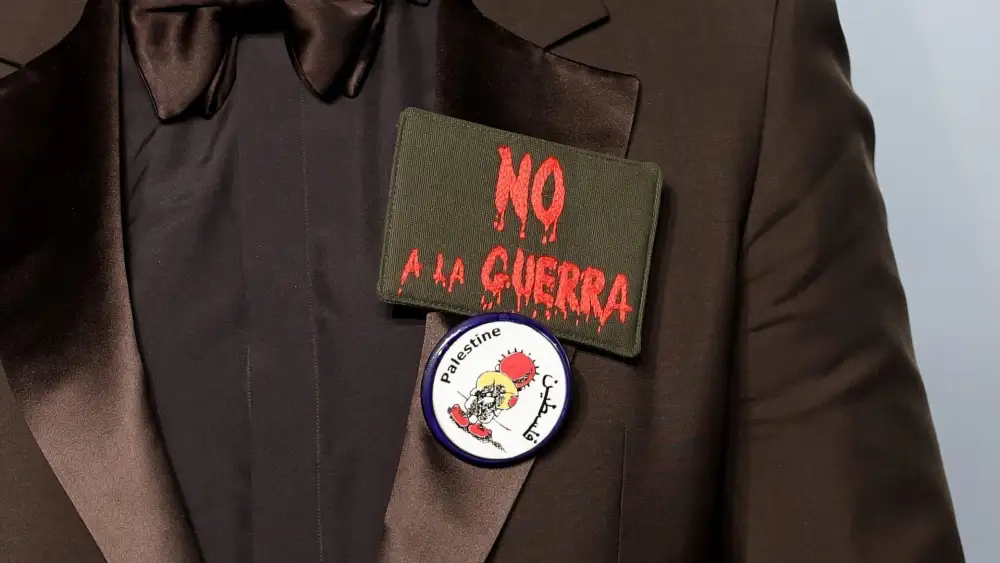
Later in the evening, actor Javier Bardem of the current “F1, the Movie” fame about race-car driving, presenting the award for Best International Feature Film, stepped to the microphone and declared: “No to war—and free Palestine.” He was wearing a pin that read: No a la guerra.” (I doubt he ever wore a yellow ribbon one.)
The line drew applause, as such lines usually do in Hollywood. But it also revealed the deeper problem. War was invoked—but not the war that Hamas began on Oct. 7, 2023. Bardem spoke as a celebrity, but also as a Spaniard at a moment when Spain’s government has been among the loudest European critics of Israel, while giving comparatively little attention to the terrorism that triggered the current conflict.
In a few seconds on stage, one of the most complicated conflicts on earth was flattened into a slogan.
For years now, the entertainment industry has shown a remarkable willingness to pronounce on the Israeli-Palestinian conflict with great confidence and very little understanding. The slogans change depending on the moment, but the pattern is familiar: complex history reduced to a simple morality play.
The irony is that many of the people delivering these lines live in a profession built on scripts written by others. Yet on Oscar night, they suddenly become authorities on the world’s most difficult geopolitical questions.
Movies, at their best, can illuminate the human condition. They can help audiences understand moral complexity and the consequences of human choices. But when the Academy Awards turn into a forum for celebrity geopolitics, something else happens.
Serious issues become props in a performance. The applause is real. The insight is often not.
And somewhere far from Hollywood—in places where wars are actually fought and terrorism actually takes lives—the people living with those realities know the difference.