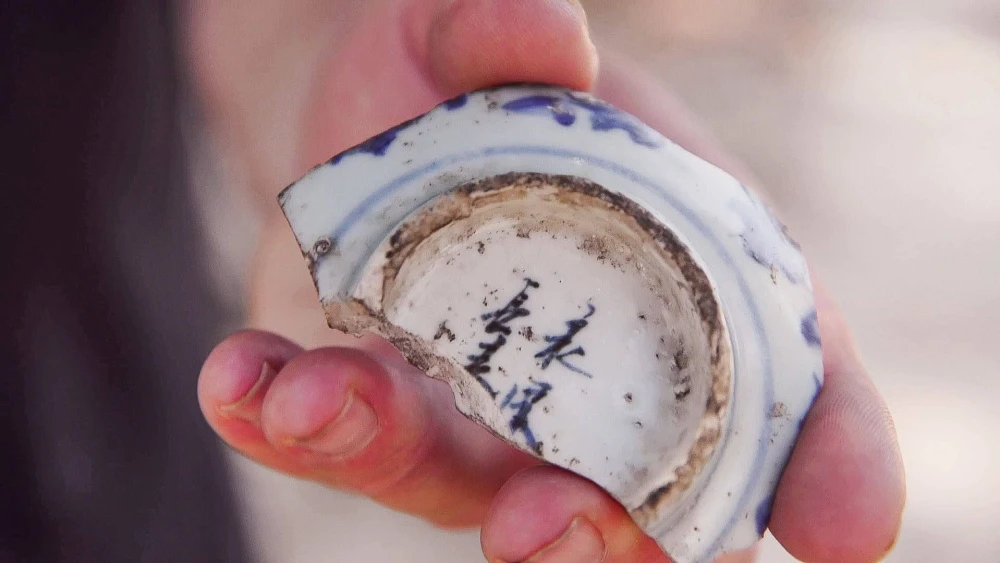
The earliest known Chinese inscription in Israel from about 500 years ago has been uncovered in Jerusalem, the Israel Antiquities Authority announced on Tuesday.
The rare 16th century CE Chinese inscription, unearthed in a dig on Mount Zion and discovered on a porcelain bowl fragment, reads: “Forever we will guard the eternal spring,” the state-archaeological body said.
Ancient Chinese porcelain vessels were previously found in Israel, but this is the first to bear an inscription.
Most of the findings from the excavation date from the Byzantine period and earlier to the Second Temple period, well over 1,500 years ago. As a result, according to the IAA, when the archaeologists stumbled upon the more recent colorful object during this summer’s dig, they were surprised.
The bowl was subsequently dated to 1520-1570, and originated in the Ming Dynasty, the IAA said.
The 16th century saw close trade relations between the Chinese Empire and the Ottoman Empire which ruled the Holy Land at the time explaining how a dish from China ended up in Jerusalem. During that period, there were colonies of Chinese merchants in Beirut and Tripoli who likely had trade interests in Jerusalem, Cairo and Aleppo.
“In archaeological research, evidence of trade relations between merchants in the Land of Israel and the Far East is known even from earlier periods – for example, of various spices,” said Israel Antiquities Authority Director Eli Escusido. “But it is fascinating to meet evidence of these relations also in the form of an actual inscription, written in the Chinese language, and in an unexpected place – on Mount Zion in Jerusalem.”
The multi-year dig underway at the site is being carried out together with the German Protestant Institute of Archaeology.