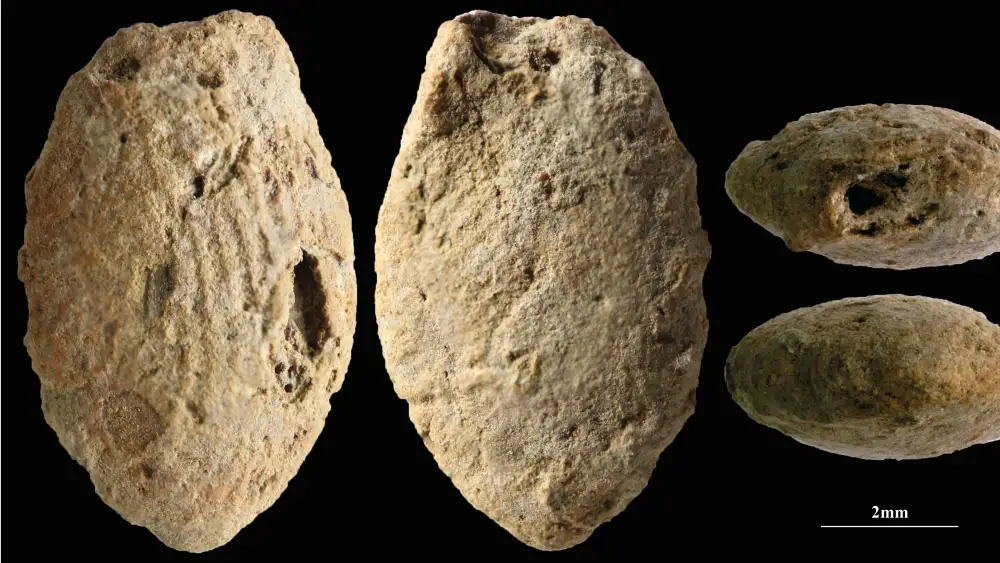
An Israeli university announced on Wednesday that archaeologists have uncovered the earliest known clay ornaments in Southwest Asia, dating back 15,000 years in modern-day Israel.
The Hebrew University of Jerusalem said that 142 beads and pendants were created by Natufian hunter-gatherers. These ancient people lived by gathering wild food and hunting, rather than through agriculture or farming.
The ornaments were found at four Natufian sites: el-Wad, Nahal Oren, Hayonim and Eynan-Mallaha, spanning more than three millennia of occupation. These communities were the first in the world to settle permanently in one place, millennia before the rise of agriculture.
Small enough to fit in the palm of a hand, the beads were carefully shaped from unbaked clay into cylinders, discs and ellipses.
“This discovery completely changes how we understand the relationship between clay, symbolism and the emergence of settled life,” said Laurent Davin, a postdoctoral researcher at the Institute of Archaeology at Hebrew University of Jerusalem who led the archaeological team.
Fifty reserved fingerprints were identified as those of individuals of different ages, including children, adolescents and adults.
Until now, clay in this period was thought to play little or no ornamental role, with only five clay beads from this era being previously known worldwide.
Many were coated in red ochre, using a technique known as engobe, a thin layer of liquid clay smoothed onto the surface. This is the earliest known use of this coloring technique anywhere in the world, the university said in a press release.
“By documenting one of the world’s oldest traditions of clay adornment, the study reframes the Natufians not just as forerunners of agriculture, but as innovators of symbolic culture—people who used clay to say something about who they were and who they were becoming,” it added.
“These objects show that profound social and cognitive changes were already underway,” said Prof. Leore Grosman. “The roots of the Neolithic lie deeper than we once thought.”
The findings were published this week in Science Advances, a peer-reviewed American journal.