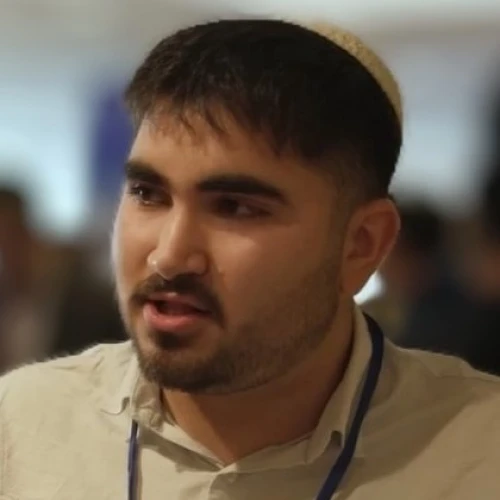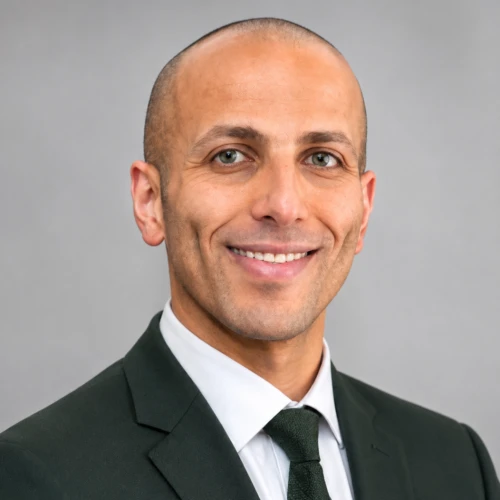
During a 70-minute conversation with U.S. journalists and a social-media influencer in a conference room at the Nefesh B’Nefesh headquarters in Jerusalem, the nonprofit’s leaders presented as Jack Lemmon and Walter Matthau of “The Odd Couple.”
Businessman Tony Gelbart, chairman and co-founder of Nefesh, and Rabbi Yehoshua Fass, a co-founder of the nonprofit and, for nearly 25 years, its executive director, appeared to really enjoy each other’s company on Nefesh’s first charter flight since Oct. 7, which landed in Tel Aviv on Aug. 20.
At 30,000 feet, they laughed frequently at each other’s jokes and huddled to talk often. In the Nefesh conference room, where Gelbart wore a suit jacket and Fass was in shirtsleeves, rolled up, the two often finished each other’s sentences and joked about how much they disagree on things—though such differences of opinion could be whether one of the two put 200% of himself into his work, or just 110%.
“We are not very good actors,” Fass told JNS, of his relationship with Gelbart.

Gelbart, who came into the meeting as Fass was answering the question, told his co-founder that he missed JNS’s question. “About why we hate each other,” Fass told him.
Fass, whose ordination comes from Yeshiva University, where he also earned degrees in biology and education, was associate rabbi at the Boca Raton Synagogue in Florida, where Gelbart was a congregant. And here they claim to have different versions of the origin story of Nefesh B’Nefesh.
“I’ll give my side of the story, and then Tony can give his side,” Fass told those assembled.
As Fass tells it, he wanted to bounce his idea off Gelbart and went to the latter’s house. “I said, ‘I need to pick your brain. There’s a challenge, and I think we can do something, or I can do something about it. I want to know if you think it’s a waste of time,’” Fass said. “Not asking Tony to jump in. And at the end of a very long conversation, and our wives very upset with us, because I think we missed Shabbos lunch. Tony called me after Shabbos and said, ‘I’m in, 200%, let’s do this together.’”
“There’s a deep—” Fass continued, as Gelbart cut in. “Actually, I think it was 110%,” the latter said.
“There’s a tremendous mutual respect between the two of us. There’s mutual love between the two of us,” Fass told JNS. “We, for the last 23 years, have only missed speaking to each other on Shabbat or yuntif.” (The latter word is Yiddish for holiday.)

“We talk at least once every day—about the organization, about Israel, about politics, just bouncing ideas that might not have anything to do with the organization, somehow it somehow gets back to the organization,” he said. “Also, to have a chairman who is so passionately involved in the work, so it’s not like one founder goes one way and the other founder is sitting in the ivory tower not being involved.”
The two are “daily involved in this,” Fass said. “There’s kinship. There’s brotherhood. We bring different talents to the table, and we know how we complement each other. With an ‘e,’ complement. You can count on one hand, I think, when we really had moments of not tension, just disagreements. We usually see eye to eye. We feel the same way.”
Sometimes one is more worked up. Other times, the other is. “Rare when we’re both worked up at the same time,” Fass said.
“I think why it works so well here between Rabbi Fass and I is you can’t imagine how much good a person can do without ego. There’s no ego here, there’s no ego there,” Gelbart said, motioning to himself and then to his cofounder. “And that’s how come this works.”
Ego drives an agenda, which is dangerous, he said in response to JNS’s question. “This organization is definitely not about me or about Rabbi Fass,” he said. “The idea is to focus on the olim that are coming.”
Fass said that it’s important to focus on the “product,” though he was loath to use that word. “The product comes before us,” he said. Organizations that are based mainly on leaders can fall apart, whereas the focus on a product is “pure,” Fass added, noting that he saw it as a good thing that some people didn’t recognize him the prior day, when the charter flight landed.

“You can be insulted at first, but you’re like, oh, that’s great,” he said. “You take pride that the organism exists on its own.”
‘We run it like a business but with a heart’
Though convincing other leaders to abandon ego is perhaps like convincing a camel to go through the eye of a needle, the Nefesh co-founders said they think they do have a recipe for success in response to a JNS question.
That’s where Gelbart jumped in with his origin story. “When Rabbi Fass approached me, and we talked about this and had a long conversation,” he said. “The stories are a little bit different. He came to my house. I mean, he’s brilliant. Very learned guy, and I always could use more learning, so I said, ‘I’d love to learn with him. Even an hour.’”
“Finally, a knock on the door. It was Shabbat,” Gelbart said. “And I’m screaming, ‘My God. We’re going to learn. This is really remarkable.’ He goes, ‘Can we go for a walk? I want to talk to you about something.’”
The partnership that emerged from those conversations comes down to “we run it like a business but with a heart,” Gelbart said.
“We built a roadmap. We have a vision for 10 years from now. You want to build physical communities; if you don’t have a road to get to those communities, you have a community that nobody can get to,” he said. “We look at the long term. We want a computer system that’s good not for 1,000 people but for 10,000 people, for 20,000 for 100,000 people. We want infrastructure for that, and we will build to that.”
“So you run like a business. CFO. CEO CMO. Everything you would imagine how a business is run. The transparency. All the workings of a really good business,” he said. “But you run with a heart, because we’re not selling a pen. We’re not selling a glass. We’re dealing with people and their lives, and that’s the most important thing you can deal with.”
The nonprofit, which has brought some 90,000 immigrants from North America to Israel, has gone through some admitted early mistakes, including being too trustworthy, according to its leaders. But it now has proprietary technology that draws interest and queries for advice from a wide range of parties, including foreign governments. (The co-founders wouldn’t say which governments, although at least one of the foreign governments met with Nefesh staff using a translator.)
‘A lot of eggs in very few baskets’
The co-founders are thinking ahead about the next generation of Nefesh leadership and say that they are building redundancy into the nonprofit, including in talent.
“Our budget and our programming and our staffing are exploding exponentially. Two years ago, our budget was 50% where our budget is today,” Fass said. “That’s maybe, I’m not saying ‘unhealthy,’ but it’s an accelerated growth spurt in any business model.”
Nefesh has 156 staff members around the world. “There’s not one day that our staff is located in an office,” Fass said. “There’s always a team some place on a plane or traveling some place.”
“For me, the challenge is just bandwidth,” he said. “It’s just our ability to catch up to so many of the projects and the dreams that we have. It’s a humbling but beautiful position to be, like we’re the girl that everyone wants to go to the ball with.”
Nefesh has to turn down a lot of projects that others bring to it. “It’s constant, every few days there’s another project that comes to the table,” Fass said. “That means more staffing. More budgeting. More infrastructure. More planning.”
Nefesh has tried bringing in external fundraisers and it has never worked, according to the co-founders, who say everything they do is fundraising. Some 13 years ago, the nonprofit took the advice of philanthropist Angelica Berrie—whose late husband Russ Berrie sold plush “Russ Bears” toys—who said that “aliyah isn’t digestible.”
“It’s too historic, too big for a donor to feel that their dollar is going to be impacting aliyah,” Fass said. “She said, ‘You have to compartmentalize it into projects and start looking at it as a project focus.’”
That mindset was “transformative” for the organization and allowed it to look at different projects, according to Fass. “The danger of that is that it’s not grassroots small donations. You have a lot of eggs in very few baskets,” he said. “That’s the danger with this kind of mode. It’s higher yield but higher risk.”
Organizations that partner with Nefesh think they’re going to gain access to a Rolodex with thousands of names only to find it’s a very small network of donors, according to Fass.
“Most organizations that we all know, sitting around this table, are out there trying to collect $18 from the same universe,” Gelbart said. “Or have a dinner,” Fass cut in.
“Or have a dinner,” Gelbart said. “But they’re all trying to go collect for the same universe. I know what I’m about to say is a bit—I don’t care. People who donate money want to feel that their money is making a difference. They want to be part of it. So if I’m sending out a dozen or two dozen $18 checks a year, do I really feel I’m making a difference for that?”
“But if I’m going to write one check for $1,800, then I can see one oleh—that’s the cost, moving from here to here—maybe I feel that I’m a part of that organization,” he said. On a major scale, giving $2 million really makes a donor really feel like a part of the group, he said.
“I’m not saying the other place is wrong,” Gelbart said.

‘We can’t compare ourselves with ourselves’
Fass said that Nefesh doesn’t want to “cannibalize” other Jewish organizations that need the smaller donations. “We say it all the time. We’re leaving money on the table,” he said. “For others to have. It’s not altruism, it’s also balancing your time.”
JNS asked the Nefesh co-founders which organizations they see as a peer group, against which they benchmark their success.
“We built something here that people would love to copy. It’s copyable in some ways and some ways it’s not, but you could take portions and fit it into the model that you need,” Gelbart said. “The technology that we have here. That’s pretty interesting because organizations within Israel, agencies, organizations love what we do here and how we do it.”
Nefesh has a lot of technology—“unique, we built it ourselves, it’s quite amazing,” Gelbart told JNS.
JNS asked again what Nefesh B’Nefesh sees as a peer entity, and the “odd couple” routine commenced again.
“An entity?” Gelbart said. “I don’t think. Look—”
“I’m going to answer,” Fass said.
“OK, because I,” Gelbart started.
“Go. You go ahead,” Fass said.
“No, no,” Gelbart said. “It’s fine with me. We’re going to have the same answer.”
“If you pigeonhole yourself looking at what other immigration entity or institution there is, you’re not going to find it, because this is very rare. It’s a unicorn,” Fass said. “Other countries that come to us, and it’s very hard to find that base. You’re looking for other comparable institutions or enterprises that have some kind of public-private relationship that’s responsible for something and also is growing in branched-out ways.”
“So you can either model yourself after a Brown University, looking at a university that had one degree and now over the years has multiple disciplines,” he said. “That’s the mode of where we are at. What industries are doing research for government?”
Though Gelbart isn’t the rabbinic half of the “odd couple,” he turned to an almost Talmudic explanation.
“Even within ourselves, we can’t compare ourselves with ourselves,” he said.
JNS submitted that the Nefesh co-founders sounded like they were running a technology company.
“Well, look around,” Gelbart said. “It is technology merging with the heart.”
He turned to Fass. “Notice he’s been saying ‘investors,’ not donors, and ‘partners,’” Gelbart said.