At a time of prolonged war and deep societal polarization, a cross-sector Israeli leadership network has put one of the country’s most contentious issues back on the table: how different parts of Israeli society understand the Israeli-Palestinian conflict.
More than 150 public figures and opinion-makers gathered on Tuesday at the Council for a Beautiful Israel in Tel Aviv for a conference organized by TEMA, a grassroots initiative that brings together people from across Israeli society “to foster an inclusive and meaningful dialogue about the future of Israel’s relations with the Palestinians, while developing new language, shared understanding, and practical initiatives rooted in the diverse values, identities and aspirations of Israel’s communities.”
The event, which took place 1,000 days after the Hamas massacre on Oct. 7, 2023, featured the presentation of a year-long study titled “Spectrum of Worldviews,” mapping how different groups in Israeli society understand the conflict across a range of dimensions, including the Israeli-Palestinian conflict, the broader Middle East conflict, Jewish-Arab relations and Jewish-Muslim relations.
TEMA’s leadership network includes participants from the Religious Zionist and Haredi communities, traditional Mizrahi Jews, secular Israelis, Israeli Arabs, immigrants from the former Soviet Union and young leaders.
The organization says its goal is not to erase disagreement but to create a new public discourse that allows Israelis from different backgrounds to confront the conflict honestly while developing practical initiatives from the ground up.
Leading participants in the network include Rabbi Yitzhak Ben David, Rabbi Dov Zinger, Ofir Toubul, Hadass Fruman, Eli Bar-On, Tzipi Diskind, Dr. Aharon Ariel, Khulud Abu Ahmad and Meir Hirschman.
Ben David, a Religious Zionist rabbi, educator and scholar who serves as head of the educational center at Yad HaRav Nissim and the Shaarei Zion Beit Midrash in Jerusalem, said the dialogue demonstrated that meaningful engagement remains possible despite profound differences.
“Even amid deep disagreement, there is room for listening that allows us to truly see one another,” the rabbi said. “From there, real change can begin.”
Toubul, founder of the Tor HaZahav (Golden Age) Movement, which advocates a vision of Mizrahi Zionism rooted in Jewish tradition and regional identity, said understanding the diversity of Israeli society is a prerequisite for addressing the country’s divisions.
“To build a shared future, we first need to understand the diversity of voices that make up Israeli society,” Toubul said. “That is the starting point for any meaningful conversation.”
Mapping Israel’s internal divides
The report does not claim to represent every sector in Israeli society. Rather, it offers a window into discussions among leadership groups that spent the past year examining how identity, trauma, religion, politics and personal experience shape their attitudes toward the conflict.
Among Religious Zionist participants, the report found a strong sense of responsibility rooted in Torah, peoplehood and the Land of Israel, alongside growing awareness that their language and worldview are often perceived by others as threatening or extreme.
Secular participants, by contrast, expressed concern over the erosion of liberal and democratic values, while also recognizing that purely rational, Western diplomatic models have often failed to account for the religious and identity-based dimensions of the conflict.
The Haredi group approached the conflict largely through the values of Torah life, pikuach nefesh (the Jewish principle of saving life) and pragmatism, with some participants seeing the community as a potential mediator precisely because it is less invested in territorial ideology.
Mizrahi participants emphasized belonging to the Middle East, family, honor, Jewish continuity and cultural familiarity with the Arab world. Their approach, the report found, tends to be less ideological and more relational, seeking to build trust before advancing formal diplomatic frameworks.
Arab citizens of Israel described the conflict through the lenses of recognition, justice, dignity and identity, while also emphasizing the complexity of living as Israeli citizens with ties to the Palestinian people.
The group of immigrants from the former Soviet Union focused on democracy, equality, human dignity and the desire not to be forced to “change homelands” again.
Women in the network emphasized responsibility for future generations, the sanctity of life, empathy and the need to bring women’s voices into security and policy discussions.
The youth cohort, one of the most diverse groups in the network, called for a new Israeli story—one that can hold competing identities, painful histories and pragmatic hopes for a better future.
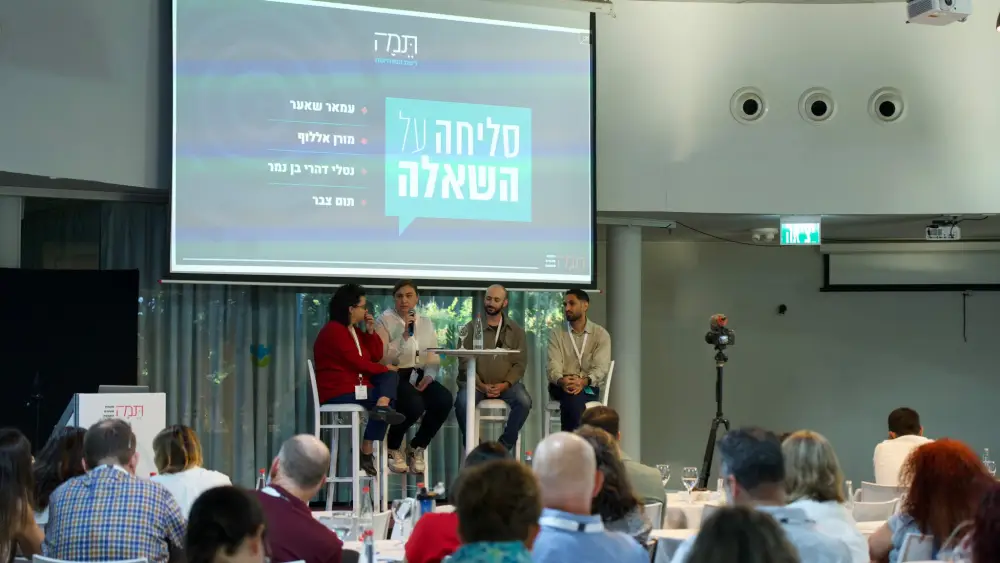
Young voices
One of the event’s central moments was a conversation between young Jewish and Arab leaders from the network, including Ammar Shaar, Tom Tzabar, Natalie Dehary and Moran Allouf.
The participants discussed how the events of the past year had shaped their identities, fears and visions for the future, while reexamining concepts such as partnership, “total victory,” hope and responsibility.
For the organizers, the youth conversation reflected one of the central findings of the report: Many young Israelis are less interested in repeating the ideological formulas of previous generations and more interested in asking what kind of country they will inherit.
The conference featured an “Ideas Marketplace,” showcasing 15 initiatives that emerged from the network’s working groups.
Among them were a video and content series making the issue of the conflict accessible to Haredi audiences through a Torah-based and pragmatic lens; a traditional Mizrahi policy framework titled “Speaking Middle East,” proposing an alternative regional approach rooted in cultural and geographic belonging; and a trilingual digital platform for protected Jewish-Arab dialogue that seeks not to blur disagreements but to grow through them.
TEMA said the initiatives illustrate the organization’s broader mission: turning difficult conversations into practical action.
The report’s authors describe the document as “provisions for the road ahead”—not a final statement of what each group believes, but a snapshot of an evolving process. Their premise, they say, is simple but demanding: Before Israel can develop a shared strategy for the conflict outside its borders, it must better understand the conflicts, fears and hopes within its own society.