


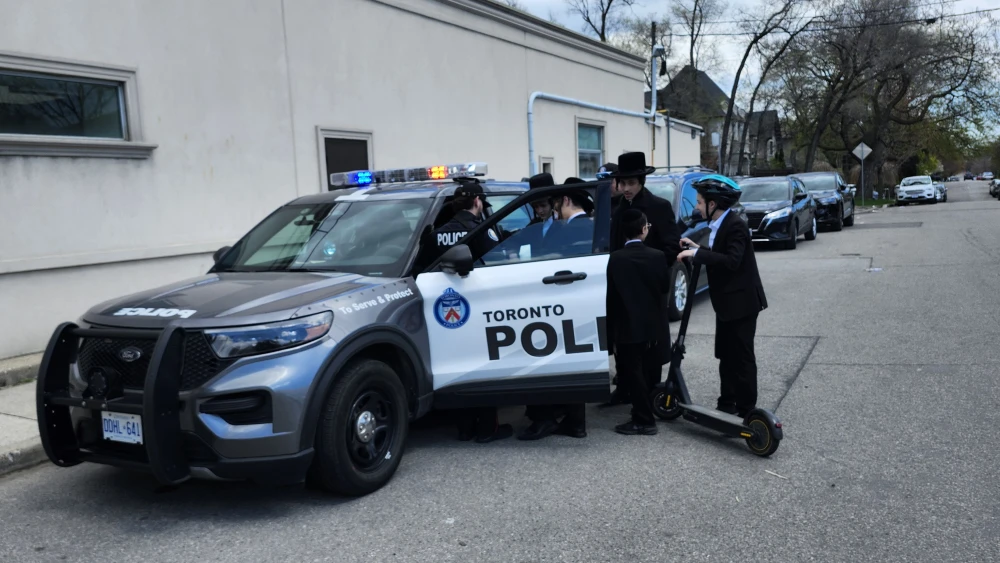
Days after the Toronto Police Service said that it arrested two more people suspected of displaying antisemitic signs at a March 15 demonstration, the Ontario government said that it plans to address what authorities and community advocates say is a weak point in responding to hate: moving bias cases through the courts.
The provincial government created the country’s first specialized unit to prosecute hate crimes and assigned experienced crown prosecutors to work on hate speech and hate-motivated offenses across the province.
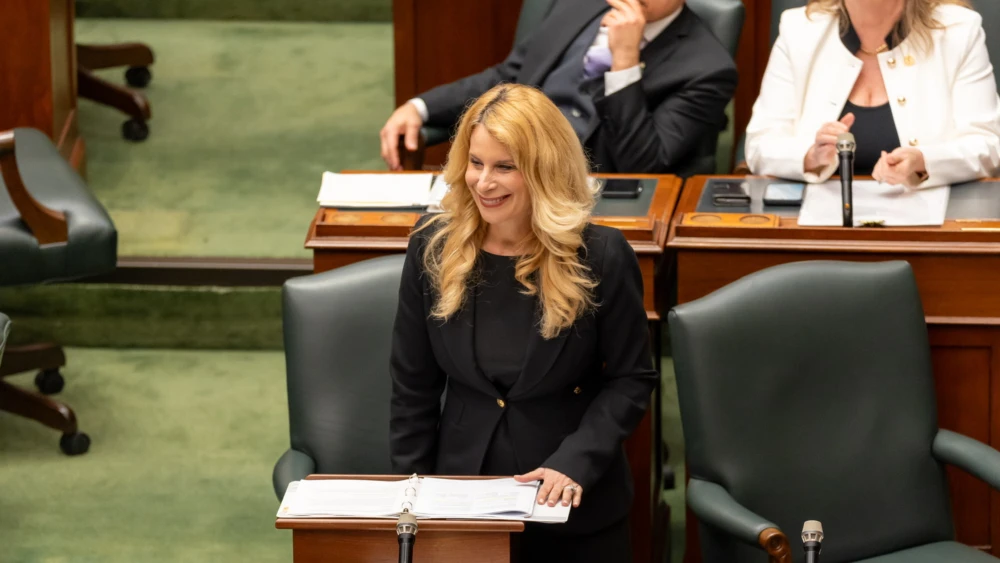
“We saw a gap in the system, and we fixed the gap,” Michelle Cooper, a Progressive Conservative provincial parliamentarian who represents the riding, or district, of Eglinton-Lawrence, told JNS.
“It’s not just someone working off the side of their desk,” she said, of the expertise of the hate crime prosecutors.
The new provincial initiative is the result of a motion that Cooper introduced, which received unanimous support in Parliament on April 16, she said. She told JNS that the province has already hired prosecutors in each of the six Ontario regions and that they will work with police departments before and after they bring charges.
While police officers and detectives investigate, “they’ll have the evidence, and then they can work with the crown to make sure they have everything before they are charging someone with this crime,” Cooper told JNS.
“Sometimes some of these take a little bit longer, because it is complex,” she said.
In 2025, about 82% of religiously motivated hate crimes in Toronto targeted Jews, compared to 14% that were anti-Muslim, according to annual hate crime statistics that the Toronto Police Service released in May.
The Centre for Israel and Jewish Affairs, the advocacy arm of the Jewish Federations of Canada-UIA, stated at the time that Jews make up 3% of Toronto’s residents and that 35% of all reported hate crimes in the city targeted Jews.
“A Jewish Torontonian is now 14 times more likely to experience a hate incident than any other resident of Toronto,” CIJA said in May.
In Ontario, hate crime cases have been dropped when prosecutors have lacked specialized expertise to weigh the right legal balance between bias intent and protected speech, according to Cooper.
She and Doug Downey, Ontario attorney general, visited the hate crimes unit at the Toronto Police Service last year.
In her role as a provincial parliamentarian “and also a Jewish person in the community and having a large Jewish community constituent base here in Eglinton-Lawrence, I wanted to understand the why,” she told JNS. “What is going on?”
Cooper said the police department’s hate crimes unit expanded after Oct. 7 to operate with full-time, dedicated investigators with relevant expertise.
“We can’t prevent people from committing crimes,” she told JNS. “For me, it’s about holding people accountable.”
The way to hold people accountable is by building stronger case law via prosecutions that overcome the legal hurdles inherent in hate-crime cases.
A crown prosecutor, who tried a case in Windsor, Ontario, secured a conviction due to the prosecutor’s relevant expertise, she said.
It is important for prosecutors and police to work together from soup to nuts, so that investigators know what evidence to seek, so that it could be available at trial. Then, Cooper told JNS, prosecutors will “have everything before they are charging someone with this crime.”
The Toronto, Peel and York regional police departments and the Police Association of Ontario have supported the new plan, according to Cooper. Jewish groups have also backed it.
“This is an important step toward protecting targeted communities, including Jewish Canadians,” stated Simon Wolle, CEO of B’nai Brith Canada.
Cooper hopes to see documentation of the program’s success in the next year or two, and she thinks the government should share that data publicly.
“Obviously, we’d wanna see that the needle’s moved on this,” she told JNS.



