This Yom Kippur, Chaim Neria intends to bring copies of two manuscripts, which the National Library of Israel recently acquired, to synagogue with him to study and to “deepen my knowledge” during the High Holiday.
“Taking to shul different mahzors and holding them side by side with your mahzor always helps to reflect on the nusach and see unique nusachim, renewing your experience,” Neria, curator of the library’s Haim and Hanna Solomon Judaica collection, told JNS. (A nusach is an approach to prayer endemic to a particular geographic area and culture, such as Ashkenaz or Sephardi.)
In recent days, the library announced its acquisition of a 14th-century mahzor for Yom Kippur from the Crimean peninsula and of two out of three parts of a 15th-century mahzor from Lisbon, Portugal.
Neria confirmed that the 14th-century manuscript is one that Kedem Auction House in Jerusalem sold on May 6, but he would not say that it was bought for the amount listed on the Kedem site: $13,750, including buyer’s premium. The listed sales price was on the lower end of the auction house’s estimate of $10,000 to $20,000.
“That is the mahzor; however, the library does not disclose information about prices,” Neria told JNS. “Regardless of price or what is important or trendy in the current market, we, as custodians of national memory, have different ways to estimate items that are invaluable to Jewish history.”
The curator also confirmed that the 15th-century manuscript is one that Kedem withdrew from a sale “due to the historical value of the item,” and which the auction house says was “purchased by the National Library of Israel with the assistance of Kedem Auctions.” Kedem listed an estimate of $150,000 to $200,000.
JNS asked whether it was bought for an amount within the range, or whether an entity needs to pay more to buy something outright and have it taken out of the sale. “The library does not comment on prices,” Neria said.

‘Vessels of time’
The curator told JNS that in a “screen-saturated age,” the library’s new acquisitions offer
“a lesson in how culture endures.”
“These books aren’t only carriers of words. They are vessels of time, touch and community,” he said. “They reveal the Jewish year not as an app or a feed but as something literally held together by thread and parchment, calibrated by generations who turned those pages on the eve of festivals and fasts.”
The fact that the two mahzors have endured “is a lesson in resilience and responsibility,” according to Neria. “Both the Lisbon mahzor—a survivor of expulsion and upheaval—and the Crimean mahzor, from an area of vibrant, diverse Jewish life at a Black Sea crossroads, carry the marks of dispersion and return.”
But admiring the physical beauty and importance of centuries-old books on parchment doesn’t mean that one must be a Luddite who attacks machines.
“The computer screen is not an enemy,” Neria told JNS. “We will digitize and share these volumes online to allow access to a global audience, but the aura of the original—its marginal notes, thumb-worn corners and traces of past readers’ voices—can only be fully grasped through the object itself.”
He added that viewers experiencing the mahzors on the computer can be a “doorway” to seeing the books in person at the library, which “once encountered, may change how they look at every screen thereafter.”
Unique prayers
The 14th-century mahzor for Yom Kippur from the Crimean peninsula, which the Krauss Family Charitable Trust purchased for the library, includes piyutim, liturgical hymns that are chanted on holidays, including the High Holidays, that don’t appear in any other known texts, according to the National Library of Israel.
A seemingly unique prayer found in the mahzor for consoling mourners refers to comforting the “heart of mourners.” JNS asked Neria if that unusual phrasing derived from a reference in Isaiah 40:1-2 to “comforting” and speaking “upon the heart” of Jerusalem. “It is relatively rare, but you can find it in one formulation of birkat avelim,” the prayer for mourners, in the responsa of the ninth-century rabbi Natronai ben Hilai, he said. (The curator also referred JNS to a reference to God as the “healer of broken hearts,” in Psalms 147:3.)
The library stated in a release that the mahzor contains “many” previously unknown piyutim. JNS asked how many is “many.”
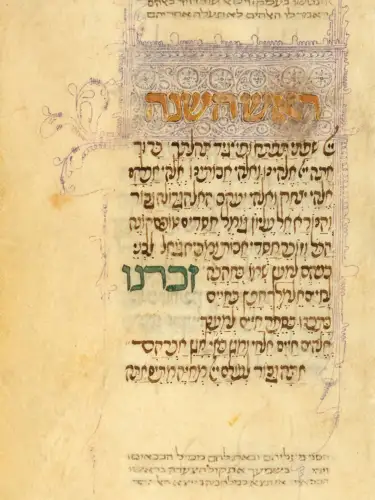
“We don’t know yet,” Neria said. “That will be the work for scholars to research and discover. Further research is definitely needed.”
There is also a need for scholars to study the manuscript, which includes prayers for Yom Kippur morning, afternoon and evening, more to ascertain its significance, according to Neria.
The curator told JNS that the Kaffa rite is one from the port city of Kaffa on the Black Sea. “It started as a Greek colony in the first century, and its earliest tradition stems from the Romaniote tradition practiced by Judeo-Greek Jews,” he said. “However, as a port city, it housed many different Jewish communities: Rabbanites, Karaites,
Khazarians, Genoese, Sephardi, Ashkenazi.”
There were so many kinds of Jews in Kaffa that Rabbi Moses ben Jacob of Kiev, the city’s spiritual leader, opted to create a prayer book of the Kaffa rite in the late 15th or early 16th century, according to Neria. The mahzor that the library acquired predates that standardized mahzor “and is predominantly in the Romaniote tradition,” he said.
Only some 3,000 Crimean Jews survived the Holocaust, and although there are small communities of Krymchak Jews, Neria isn’t aware of the Kaffa rite being practiced today. “It was never put into print form and therefore fell out of use centuries ago,” he told JNS.
In a press release, Neria called the mahzor “an irreplaceable piece of Jewish history that enriches our understanding of medieval Jewish prayer, poetry and community life” and said that the prayer for mourners in the manuscript could be adopted today “as we pray for the return of the hostages and for a time of peace.”
‘Rich book culture’
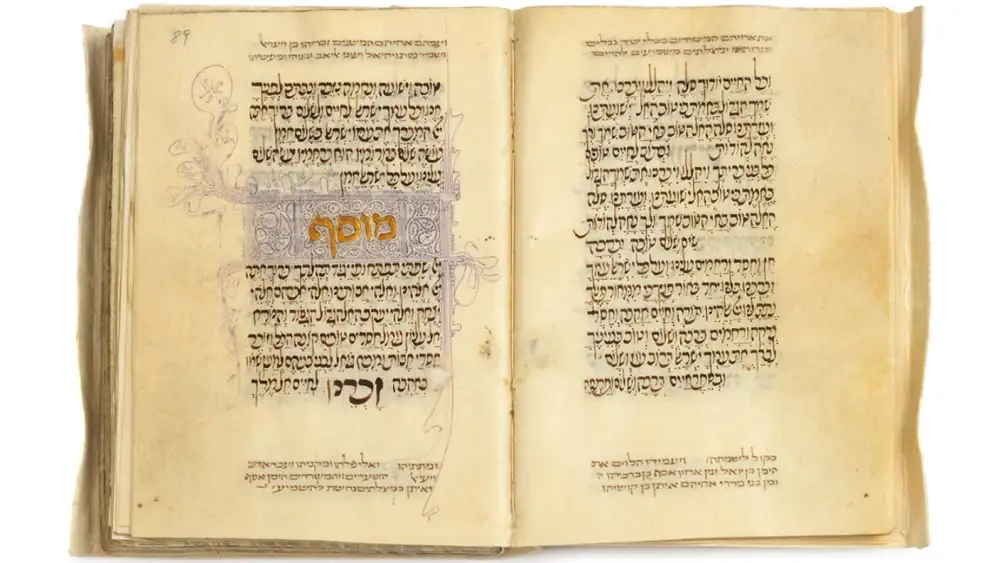
The Lisbon mahzor, which the Haim and Hanna Solomon Judaica Foundation and Zukier Family bought for the library, was split into three parts at some point. The library says it is now “reunited” in Jerusalem.
The Aleppo community gifted one volume of the manuscript—with Shabbat prayers—and the Aleppo Codex to then Israeli president Yitzhak Ben-Zvi in 1957, and it was placed in the Yad Ben-Zvi archives. “The whereabouts of the other two volumes was unknown until they recently came up for auction,” the library said. “These have now been acquired by the library that will digitally reunite the Lisbon mahzor and make it available online.”
JNS asked Neria what the significance is of a manuscript having a “reunion” online. “You can find all three volumes now on our website, which is something that was unavailable to scholars before,” he said.
The “reunited” manuscript contains prayers and poems for the High Holidays, Passover, Shavuot and Sukkot, as well as other holidays, in the Sephardic rite, according to the library. It was made during a period in which Jews were expelled from Spain in 1492, and some moved to Portugal. The latter expelled Jews, or forced them to convert, in 1496.
“It appears that even in their most difficult moments, the Portuguese Jewish community did not give up its books,” Neria stated in a press release. “They took these cultural treasures along to their next destination.”
“They had a rich book culture,” he told JNS. “The famous Lisbon school of scribes produced at least 30 beautiful manuscripts that we know of.”