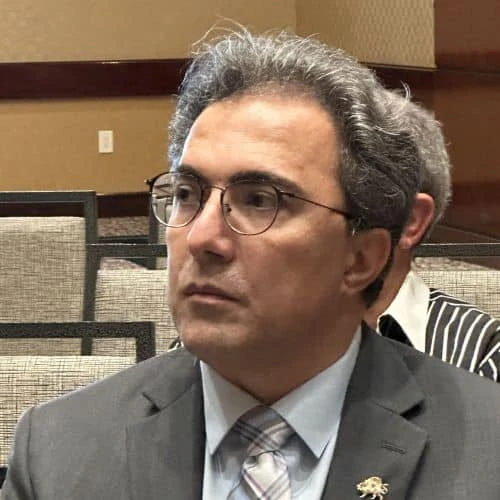
Paul Goldenberg, a criminal justice and global security expert from New Jersey, has devoted the last 30 years of his life to protecting Jewish and other vulnerable communities.
His career has had a cinematic theme to it. After starting out as a police officer, he went deep undercover for five years working as a criminal entrepreneur of multiple businesses and a widely known gun runner, which allowed him to infiltrate organized gang networks. He also headed the investigation of a notorious crime family, whose story “The Sopranos” TV series was based on, and advised the cast of the show.
He told JNS he couldn’t even reveal his profession to his own mother, who thought he was a drug dealer after seeing photos of him driving a Corvette with long hair, flashy gold jewelry and a skintight T-shirt.
When Goldenberg emerged from his undercover life in the 1990s, he was appointed State Chief of the New Jersey Attorney General’s Office, where he led hate crimes and domestic terrorism investigations.

In 2004, he founded the Secure Community Network (SCN), North America’s largest security organization dedicated to keeping the Jewish community safe through intelligence and law-enforcement liaisons. That same year, he led special policing operations across 12 European nations for the Organization for Security and Co-operation in Europe (OSCE), the world’s largest regional security organization.
He was named “Most Influential Person in Homeland Security” last year and in 2021. As a sworn member of the U.S. Department of Homeland Security Secretary’s Homeland Security Council, he headed the Targeted Violence Against Religious Communities and Countering Foreign Influence national security task forces.
On June 19, he was honored by the International Association of Campus Law Enforcement Administrators (IACLEA), the world’s only campus police association, with the Special Ambassador Award for his launch of innovative programs to enhance campus safety.

As chief adviser for policy and international policing at Rutgers University’s Miller Center on Policing and Community Resilience, Goldenberg developed training courses for a new program, Navigating Through Campus Conflict: National Leadership Training to Prevent Hate Crime, Violence & Intimidation. Initiated by IACLEA and the Global Consortium of Law Enforcement Training Executives, the program’s goal is to unify students, faculty, administrators and on-campus security personnel with police throughout the United States and Canada.
“Our vision is to establish a world-class, distinct police foundation focused on Holocaust education, genocide prevention and the essential role of civilian policing in safeguarding democracy, especially in today’s volatile environment,” he said, noting they plan to create a transnational hub for law-enforcement professionals to help them to protect vulnerable communities.
‘How personal it is to them’
Next year, the program plans to bring law-enforcement officers to Israel to study the impact of the Hamas-led terrorist attacks in southern Israel on Oct. 7, 2023, on local policing and public safety strategy. In turn, Israeli police will travel to the United States to share best practices in counterterrorism, demonstrating how they have adapted to serve not only as community protectors but also as frontline responders in the fight against organized terrorism.

Referencing Oct. 7, he stated, “Israeli Police showed their heroism again and again, not only by acting as peace officers, but also as the first line of defense and as protectors of civilians who fought bravely and valiantly.”
In 2015, Jeffrey Mottley, a retired lieutenant colonel and the commander of the New Jersey State Police Homeland Security Branch, went to Israel as part of an executive law-enforcement mission organized by Goldenberg. He was struck by the immediacy with which Israeli police normalized the aftermath of an emergency. “You always want to show that the government and law enforcement have things under control, and build that sense of confidence with the local jurisdictions,” he said.
Mottley said he realized “from a historical perspective why security is so important to the Jewish community … how personal it is to them.”
During the 1990s and early 2000s, Goldenberg brought SWAT members from the New Jersey State Police to Israel, where they received on-the-ground training by Yamam, Israel’s national counter-terrorism unit. He pointed out that “Israel is a canary in a mine, and what happens there ultimately makes its way here to the U.S. Israelis have been very good with their training methodologies.”
Since 2001, he has organized more than 15 police missions to Israel and is in discussions with Israeli police about establishing more programs with police associations in the United States and Europe.
Throughout his career, Goldenberg has fostered a close-knit alliance between the Jewish community, Israel and the police. He was in France when there was an onslaught of antisemitic attacks and encouraged French Jews to forge close relationships with local police while he worked with Israeli, American, Canadian and European intelligence to help secure Diaspora communities.

‘It was such a powerful trip ’
As chair of the International Police Delegation to the 2025 International March of the Living, he helped organize a trip for law-enforcement leaders from the United States, Europe, the United Kingdom and Africa to the Auschwitz concentration camp site for Yom Hashoah. It was the largest law-enforcement delegation to participate in a March of the Living event since its inception 35 years ago.
“It’s the first time in history that the world’s police marched alongside Jewish and Israeli constituents,” Goldenberg noted.
More than 10,000 people, including Holocaust survivors and their families, heads of state and government officials, marched in solidarity from Auschwitz to Birkenau for an emotional experience that brought life to a death site.
The trip was part of a police training program called “Operationalizing Never Again: The Role of Law Enforcement in the Holocaust and Contemporary Genocide,” developed by Goldenberg and his team. It was launched this year by Rutgers University’s Miller Center, the University of Virginia’s Center for Public Safety and Justice, and the Global Consortium for Law Enforcement Training Executives.
The program provides law-enforcement leaders with tools to combat antisemitism, bias and human-rights violations, analyzing events that led to the Holocaust and the role of police in society.

Col. Patrick J. Callahan, superintendent of the New Jersey State Police and a close friend of Mottley, has participated in March of the Living events organized by Goldenberg for the past three years. He called the experience “life-changing,” and said that after he went the first year, “I struggled when I got home. ... It took me about a week, but I almost had PTSD. It was such a powerful trip.”
After Oct. 7, Callahan said three Jewish troopers and a Muslim trooper marched together from Auschwitz to Birkenau on the second trip. “The magnitude of the inhumanity is what everyone seemed to settle on,” he remembered.
He relayed how heartbreaking it was to hear Holocaust survivors in their 90s speak about the children and grandchildren they lost on Oct. 7.
Law-enforcement officers from across the globe received standing ovations for their service at the Kraków Opera. “It’s gotten bigger each year,” Callahan said. “There were 64 of us in this delegation. We all marched in uniform, and people from all over the world came and thanked us for being there and being a part of telling the stories.”
A video about the program, “Operationalizing Never Again,” warns that when police “become pawns of oppression or tools of tyrants, the foundation of democracy begins to erode. History has shown us the consequences are catastrophic.”