


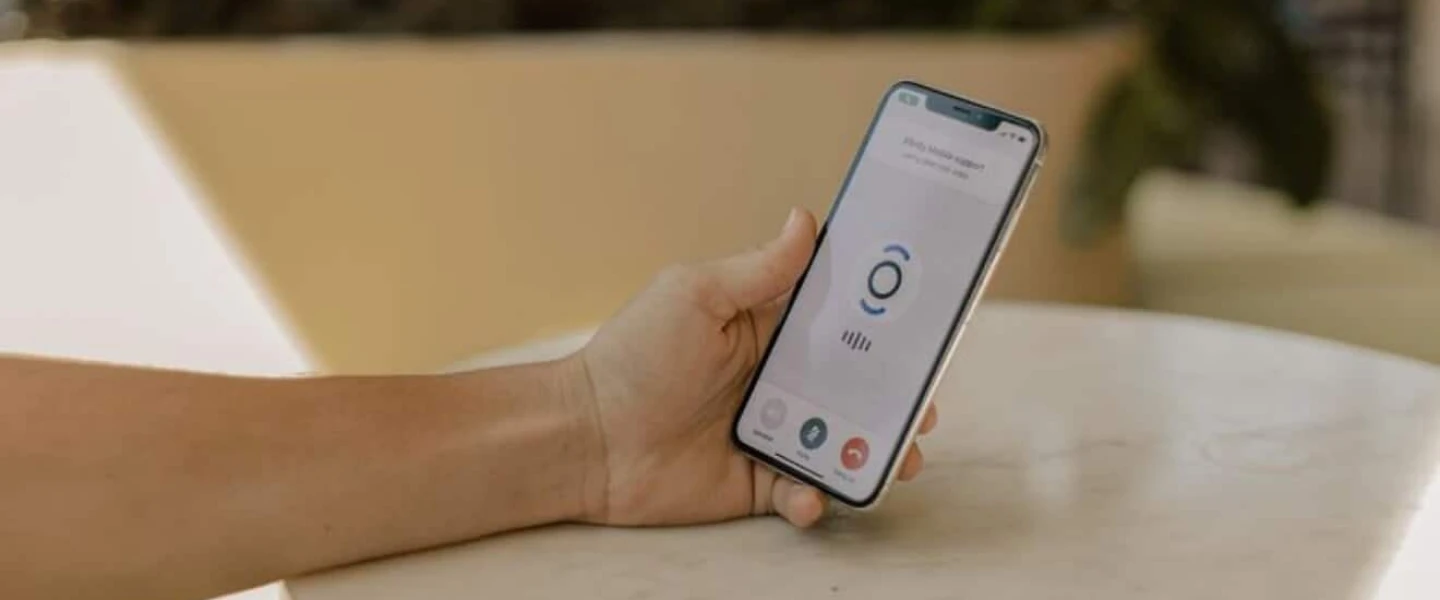
Imagine having a comfortable telephone conversation with a deaf or hard-of-hearing person. A new AI-powered app produced by an American-Israeli startup has made that possible for countless people.
True to its name, Nagish—Hebrew for “accessible”—has removed the communication barriers plaguing members of the deaf community by converting text-to-speech and speech-to-text in real time.
As its website explains, the AI-based app is “fast, private and accurate.” No third party is necessary.
The idea was conceived in 2019, when co-founder Tomer Aharoni, a 33-year-old Israeli engineer, was a student at Columbia University.
“One day, while sitting in class, I got a phone call and couldn’t answer because I was in class,” he told JNS in a recent interview. “I started thinking: How can you have a phone conversation in a situation where you cannot hear or speak?
“After class, I shared this thought with Alon Ezer, my co-founder—also an engineer—and his immediate reaction was: How do deaf people communicate?”
“That’s when we learned that deaf people did not make phone calls,” Aharoni said. “They were declining calls. They were asking someone else to answer. They just couldn’t have a private conversation.”
That was when they decided to do something about it and build a proof of concept.
“Back then, it was very hard-coded. You could only call a single phone number. The interface was a Telegram chatbot, but we wanted to create something that showed what we can do if we have more time, and it worked quite well,” Aharoni said.
“We went with it to a hackathon at Columbia. Google was there. They loved the idea, and they wanted to write a case study about us.”
The study evolved into an ad for Google Cloud. Then Google invited Aharoni and Ezer to speak at its annual cloud conference in San Francisco, which is attended by about 50,000 people each year.
“All of that happened while we were students,” Aharoni said.
He was on the verge of accepting full-time employment at Bloomberg as a software engineer, and Ezer was working as an engineer at a startup that was since acquired.
“And suddenly, we had this side project that was gaining more and more traction,” Aharoni added. “First Google and then users wanted to try it.”
It was becoming increasingly time-consuming, he recalled. People submitted feature requests, required support for bugs and more.

Doing good in the world
“We started playing with the idea (of launching a company),” Aharoni said. “We were, like, ‘What are we going to do with this?’ We weren’t sure if there was a viable business opportunity, but we also wanted to do good in the world.”
Their decision was influenced by the realization that without doing well, it would be impossible to “do good.”
“If the company doesn’t succeed and cannot self-sustain, there’s really no way to make an impact. Yes, maybe we could change the lives of five or 10 people, or even 20 people, but to change the lives of the 40 million deaf and hard-of-hearing Americans, we would need funding. We would need either a business model or someone willing to invest a large amount of money.
“Long story short, we found out that the U.S. government, namely the FCC [Federal Communications Commission], had a $2 billion fund— specifically to make communication accessible for people with hearing loss. Historically, that fund paid human operators. The stenographers, captioners and interpreters are all paid by the government.”
The duo then decided to try becoming the first AI-powered provider to get certification from the FCC.
Everyone they discussed it with advised them not to go ahead with the idea, saying it would take at least 10 years, and even then, there was little chance they would get the certification.
Nevertheless, they decided to go for it, and within three-and-a-half years, they were certified by the U.S. government.
“We got a second certification a year later. We became profitable and have built a very sustainable business since then,” Aharoni said.
Nagish was officially launched in 2021.
Ezer, 32, is now an American citizen based in Florida. The company has offices in New York and Tel Aviv, and Aharoni divides his time between the two cities.
Hundreds of thousands of people—mostly in America—use the app daily, Aharoni said.
Translating sign language into real-time

About six months ago, in a multi-million-dollar deal, Aharoni and Ezer acquired Sign.mt, a company in Zurich that developed AI-based technology for real-time sign language recognition and translation.
Its Israeli founder, Amit Moryossef, has a Ph.D. from Bar-Ilan University in Computer Science, focusing on sign-language processing and completed his post-doctorate in Zurich. He is now the head of research at Nagish.
Nagish benefits not only the deaf community, which was first demonstrated in Israel following the Hamas attacks on Oct. 7, 2023.
“After Oct. 7, we also made it available in Israel,” Aharoni said. “I was in the U.S. when it happened. I was watching the news and saw all the people calling from their bomb shelters—whispering because they couldn’t speak—and we realized this app can be lifesaving. So, overnight, we made it available in Israel. Hundreds of people signed up. Today, we have a couple of thousand people in Israel using the service.
“In Israel, we don’t monetize. We just offer it as a service for the community. It’s completely free. Luckily, I’m not aware of any case today of someone using it in Israel for emergency purposes unless the person is deaf or hard of hearing. But that was the trigger that made us open it for Israelis as well.”
In the United States, the service is marketed quite aggressively. There are limitations to the extent that the service can be promoted outside of America, including Israel, because it is certified by the U.S. government, Aharoni said.
“But as long as people need it, we’ll keep the access open,” he added. “You can simply go to the App Store and download it. It’s completely free and you can start using it immediately.”


