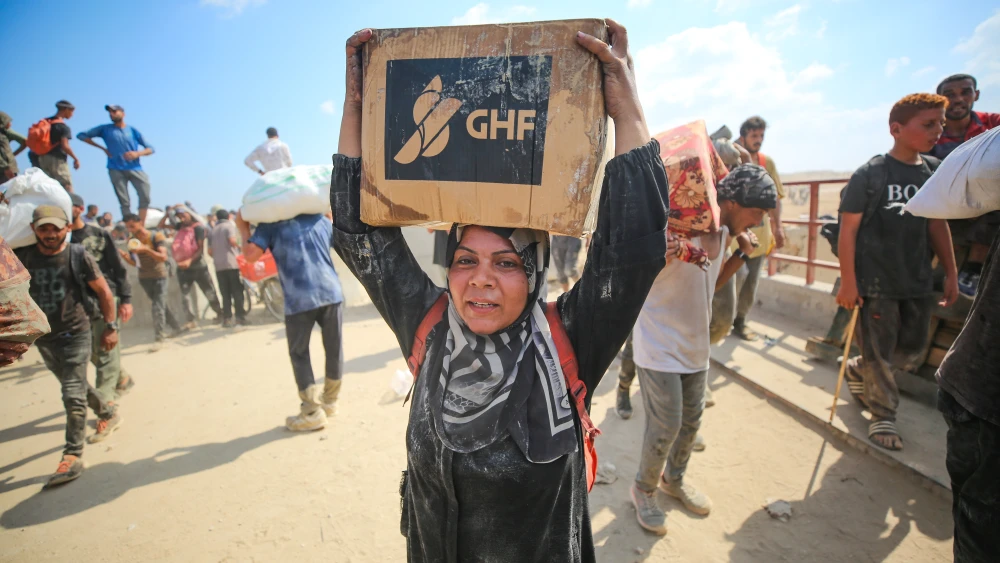
The U.S.-backed Gaza Humanitarian Foundation, which the U.S. Department of State has said it will fund with a $30 million grant, is “chaotic” and “it is not pretty, but it works,” a senior Trump administration official told JNS on background.
The foundation, a U.S. nonprofit that the United Nations and other Israel critics have decried since its launch on May 27, says it has delivered nearly 110 million meals in the two months and change since its operation began. The foundation responds to Israeli and U.S. concerns about Hamas siphoning off much of the aid that the United Nations and other groups have sought to deliver to Gazan civilians.
“About 7% of non-GHF trucks make it without being looted, stolen, self-diverted or ‘self-distributed by armed individuals,’” the senior U.S. official said, borrowing a euphemistic phrase which the United Nations uses.
In that same period, since the foundation launched, “100% of the GHF trucks have made it through to the secure distribution sites and 100% of that food has been distributed to people who are coming to get it,” the senior U.S. official told JNS.
Nearly 89% of aid trucks that the United Nations collected inside Gaza between May 19 and Aug. 5 were looted, according to the global body’s data.
Critics of the foundation say that its distribution methods defy humanitarian principles, and there are allegations—which the Jewish state denies completely—that Israeli troops fire upon aid seekers. Israel says that Hamas terrorists hide among aid seekers and stir up trouble.
Hamas has reportedly insisted in ceasefire negotiations that the foundation be dismantled and that the United Nations serve again as the primary facilitator of aid delivery in the enclave. The global body has also said it alone can deliver aid properly in the Strip.
The senior U.S. official blasted the United Nations for refusing to partner with the foundation.
“Why would the U.N. not participate? What is the harm in trying to deliver food in a rational way?” the senior official said.
“If you look at the U.N.’s most recent argument, they refuse to work with GHF, because it’s aligned with Israeli security,” the senior U.S. official said.
Israeli troops guard areas outside the perimeter of distribution sites. Private U.S. contractors protect the sites.
The United Nations has refused to deliver aid, “because there’s no alignment with security,” the U.S. official told JNS. “You can’t have it both ways.”
U.S. President Donald Trump stated in late July that his administration had allocated $60 million earlier that month for food aid to the Gazans. It wasn’t immediately clear to which entity Washington directed that funding.
The U.S. State Department announced in early July that it had approved a $30 million grant for the foundation the previous month, but as of July 26, the funds had yet to be disbursed.
Steve Witkoff, U.S. special envoy for peace missions, toured a foundation distribution site near Rafah on Friday and reportedly relayed his findings to Trump earlier this week.
“GHF is not the holistic solution. GHF is a part of something that can possibly help to promote better opportunity for Gazans in Gaza,” the senior U.S. official told JNS.
“Anybody who thinks that this is going to be the solution is wrong,” the official said. “Anybody who thinks that this can’t be part of the solution is equally disillusioned, and I would say is more fundamentally wrong.”
The senior U.S. official pushed back on claims that the United Nations and other humanitarian groups had a system in place that worked.
“I think that anybody who wants to look at Gaza and says what happened between 2006 to Oct. 6 worked—I don’t know how you define ‘worked,’” the senior official said. (Hamas increased its power in Gaza starting in 2006.)
The senior U.S. official likened the control that Hamas and some international groups exert in Gaza to “mafia ownership.”
“Billions and billions of dollars have been poured into Gaza for decades, and the result of that is what?” the senior official said. “The demand for everybody to go back to what it was. What was the great success of all of this aid?”
Gaza’s gross domestic product on Oct. 6, 2023—the day before the Hamas-led terrorist attacks in southern Israel on Oct. 7—was less than $4,000 per capita, according to the senior official.
“Strip away the humanitarian aid component of it. It’s less than $800,” the senior U.S. official told JNS. “So more than 75% of the GDP of Gaza was dedicated by aid dollars.”
The senior official said that Gazans, who receive aid from the foundation, say that “this is the first aid that was given as charity that they received without any strings attached—not since Oct. 8, 2023, but since 2006.”
“This was the first time that they were able to show up to a place, get what was donated to them and bring it back and to be able to have access to it,” the senior U.S. official told JNS.