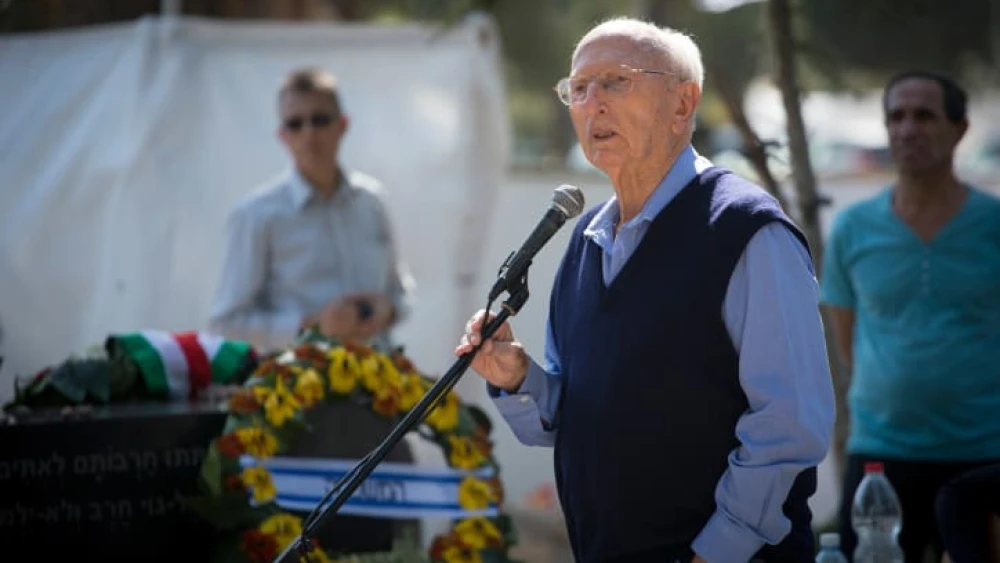
Zvi Zamir, the fourth director of Israel’s Mossad national intelligence agency, died in Tel Aviv on Jan. 2. He was 98 years old.
Born Zvicka Zarzevsky in 1925 in Lodz, Poland, Zamir immigrated to Israel when he was just 7 months old.
Zamir met in London in October 1973 with the Egyptian agent Ashraf Marwan, the adviser to Egyptian President Anwar Sadat and son-in-law of President Gamal Abdel Nasser who was known as “The Angel” and who warned of an impending attack ahead of the Yom Kippur War.
The Agranat Commission of Inquiry investigating the failures of the war praised the Mossad for its work in collecting and passing on intelligence.

Zamir served as a commander in the Haganah’s Palmach strike force and the Israel Defense Forces during the 1948-49 War of Independence.
In 1946, the British police arrested him; he spent 10 months in the Latrun detention camp. During the War of Independence, he established and led the Palmach’s Sixth Battalion, responsible for securing the convoys to Jerusalem.
After lengthy service in the military, during which he commanded the Givati Brigade and later the Southern Command, he became the IDF’s attaché in London.
In 1968, then-Prime Minister Levi Eshkol appointed Zamir as the fourth director of the Mossad, a position he held until 1974.
His tenure was characterized by extensive action, especially in the fight against Palestinian terrorism around the world and the conventional military threat to the State of Israel, which peaked with the outbreak of the Yom Kippur War.
Under Zamir’s command, the Mossad led daring intelligence-gathering and counterterrorism operations, including against the leaders of the Black September terrorist organization responsible for the 1972 murder of 11 Israeli Olympic sportsmen in Munich.
“The Mossad family bows its head at the passing of a modest man who was imbued with values and who believed in the personal responsibility of the agency’s commanders and employees, in their various professions, as well as in its integrity and striving for contact,” the Prime Minister’s Office, which oversees the intelligence agency, said in a statement.
“He was a model and inspiration of a brave and involved commander with integrity, whose heart and words were in synch, and who was always concerned about the good of the country and its security. May his memory be blessed,” the PMO said.
Zamir met his wife, Rina (née Sadovsky), during their service in the Palmach. She died in 2019. They had three children.