Palestinian Authority and Hamas representatives have left Egypt without signing an expected agreement on joint management of the Gaza Strip after the war with Israel, multiple sources reported on Tuesday night.
Earlier on Tuesday, negotiators from both sides told AFP that Hamas and the P.A.'s ruling Fatah Party were close to creating a committee of up to 15 “nonpartisan” Palestinians who would administer the enclave. The officials claimed the plan would follow a truce deal with Jerusalem.
The draft agreement, a copy of which was seen by the press agency, states that the committee would administer the Gaza side of the Rafah Crossing with Egypt.
However, senior P.A. official Jibril Rajoub was quoted as telling reporters in Ramallah on Tuesday that he did not favor any agreement to create separate political systems in the Gaza Strip, Judea and Samaria.
“What committee is this? It is wrong to even discuss this issue,” said Rajoub. “We want one government, one security apparatus and one unified policy. Any discussion or effort outside of this framework is a mistake.”
Meanwhile, a Palestinian source familiar with the talks told Sky News Arabia on Tuesday evening that “there are still obstacles to signing the agreement, including the ‘security file’ and the crossings of Gaza.”
The source claimed that Hamas is trying to ensure that members of both its civil and military apparatus would continue to receive salaries after the P.A.-led committee assumed control of the coastal enclave.
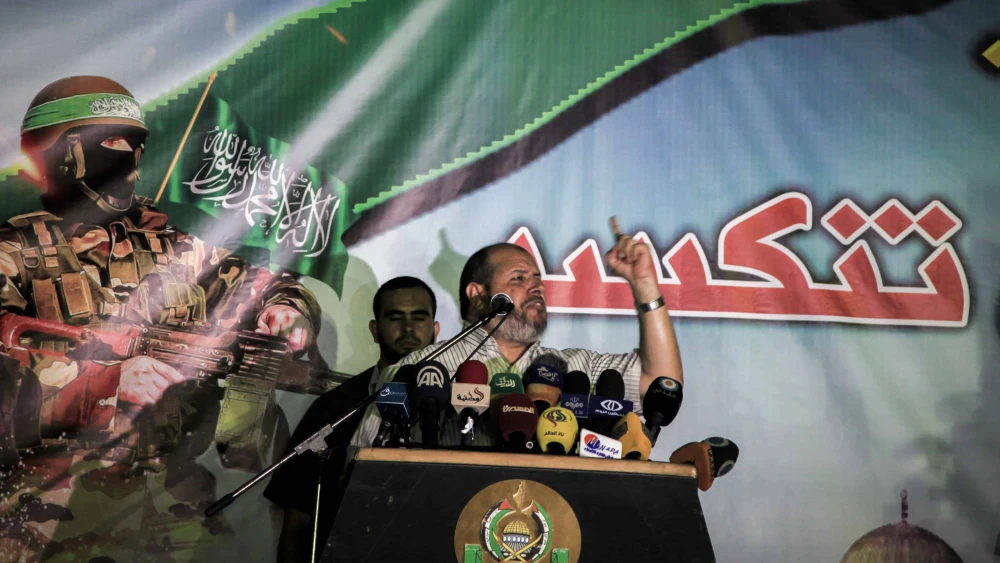
The delegations, led by Turkey-based Hamas official Khalil al-Hayya and Fatah Central Committee member Azzam al-Ahmad, reportedly left to formulate their responses to the Egyptian draft.
An Egyptian source had previously claimed that Hamas was willing to accept that it would not be the sole ruler in Gaza, in light of Cairo’s demand that P.A. control be restored to advance a possible two-state solution.
On Sept. 25, P.A. Prime Minister Mohammad Mustafa announced that Fatah had agreed to sit down with Hamas in Egypt. Mustafa said the discussion would focus on forging initial deals “to arrange the situation” in Gaza. He expressed his “readiness to administer the Gaza Strip the day after the war without excluding anyone,” local media reported.
In July, Hamas and Fatah announced a unity deal following talks in Beijing. The declaration was approved by 14 terrorist factions that took part in negotiations hosted by Wang Yi, the Chinese foreign minister.
“Today, we sign an agreement, and we say that the path to completing this journey is national unity,” Hamas official Musa Abu Marzouk said at the time. “We are committed to national unity, and we call for it.”
The U.S. State Department, which has been pushing for P.A. control over the Strip after the war, has rejected a government that includes Hamas.
“Hamas has long been a terrorist organization. They have the blood of innocent civilians—both Israeli and Palestinian—on their hands,” State Department Spokesman Matthew Miller told reporters in Washington in July. “There can’t be a role for a terrorist organization.”
Secretary of State Antony Blinken has insisted that an “effective and revitalized Palestinian Authority” should govern Gaza—a move that Israel rejects because of Ramallah’s overt support for terrorism.
Jerusalem vehemently rejects Hamas and P.A. rule over the Strip, with Israeli Prime Minister Benjamin Netanyahu favoring a transfer of control to local bodies not considered hostile to the Jewish state.
Netanyahu said during an interview that aired on May 9 that Israel is seeking to establish a rule “by Gazans who are not committed to our destruction, possibly with the aid of the United Arab Emirates, Saudi Arabia and other countries that I think want to see stability and peace.”
According to recent polls of Palestinian public opinion, 89% of Palestinians support establishing a government that includes or is led by Hamas. Only 8.5% said they favor an authority that is controlled exclusively by the Fatah faction.