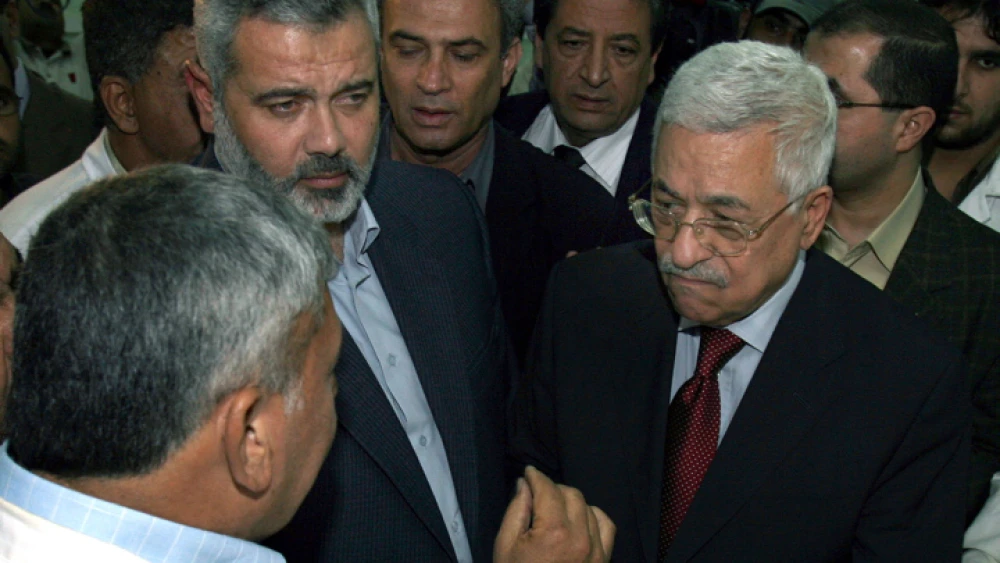
Senior Hamas terrorist Musa Abu Marzouk announced on Tuesday the signing of a Palestinian unity agreement that includes Mahmoud Abbas’s Fatah faction, which rules areas of Judea and Samaria.
“Today, we sign an agreement, and we say that the path to completing this journey is national unity. We are committed to national unity, and we call for it,” said Abu Marzouk.
The “Beijing declaration” was signed by 14 Palestinian factions that took part in negotiations hosted by Chinese Foreign Minister Wang Yi.
Fatah, based in Ramallah, and Hamas have been split since 2007 following the latter’s violent takeover of Gaza. There have been many failed attempts to bring the two factions together.
Israeli Foreign Minister Israel Katz said in a statement on Tuesday that “instead of rejecting terrorism, Mahmoud Abbas embraces the murderers and rapists of Hamas, revealing his true face.
“In reality, this won’t happen because Hamas’s rule will be crushed, and Abbas will be watching Gaza from afar. Israel’s security will remain solely in Israel’s hands,” Jerusalem’s top diplomat added.
In February, Abbas traveled to Doha to discuss ways to incorporate Hamas into a P.A.-led government for Judea, Samaria and Gaza.
The same month, sources in Ramallah told Sky News Arabia that Hamas had approved a three-phase plan leading to “complete reconciliation [with Fatah]” and the Gaza-based terror group joining the Palestine Liberation Organization, which controls the Palestinian Authority, under a “unified Palestinian-Arab vision.”
Also in February, Fatah and Hamas officials converged on Moscow for a two-day “national dialogue” on forming a unity government under the auspices of the Russian Foreign Ministry. Other rounds of talks were held in the past in Egypt, Turkey and Algeria.
The Islamist group reportedly also gave its blessing to P.A. chief Abbas’s proposal to establish a “government of technocrats” whose primary purpose would be the reconstruction of Gaza after the war prompted by Hamas’s murder of some 1,200 people in Israel on Oct. 7.
Hamas is an “essential part of the Palestinian political mosaic,” then-P.A. Prime Minister Mohammad Shtayyeh told world leaders gathered in Qatar in December.
“We want a situation in which Palestinians are united. ... I think it is time that Hamas call the Palestinian president and tell him we’re all united behind you, and you are the legitimate authority of the Palestinian people and we are ready to engage,” Shtayyeh stated at the Doha Forum.
Amid the unity talks, Shtayyeh submitted the collective resignation of his government last month. Abbas then appointed Fatah loyalist Mohammad Mustafa to fill the prime minister’s role.
U.S. Secretary of State Antony Blinken has insisted that an “effective and revitalized Palestinian Authority” should ultimately govern Gaza.
During a Jan. 10 meeting in Ramallah, Blinken pressed Abbas on “administrative reforms, which, if implemented, would benefit the Palestinian people.” Sky News Arabia described the tête-à-tête as “tense” and marked by “arguments.”
The Biden administration wants the P.A. to assume control of the Strip after Israel’s war against Hamas ends, a move that Jerusalem rejects because of Ramallah’s overt support for terrorism.
On Jan. 27, Abbas’s spokesman Nabil Abu Rudeineh told Al Arabiya that the P.A. is prepared to hand over the reins to Hamas if it won a general election. Ramallah is “prepared to hold general elections, and if Hamas wins, the president will hand over the Authority,” he said.
The U.S. State Department has refused to rule out Hamas retaining power in Gaza or even joining a P.A.-led governing body that would also have jurisdiction in Judea and Samaria.
According to recent polls, 89% of Palestinians support establishing a government that includes or is led by Hamas. Only around 8.5% said they favor one controlled exclusively by Fatah.
Israeli Prime Minister Benjamin Netanyahu has repeatedly emphasized his opposition to the P.A. taking over Gaza in a post-Hamas world.
“There will not be any element that educates for terrorism, finances terrorism and dispatches terrorism” in the Strip, said Netanyahu.
“I will not allow us to replace Hamastan with Fatahstan, that we replace Khan Yunis with Jenin,” he continued. “I will not allow the State of Israel to repeat the fateful mistake of Oslo, which brought to the heart of our country and to Gaza the most extreme elements in the Arab world, which are committed to the destruction of the State of Israel and who educate their children to this end.”