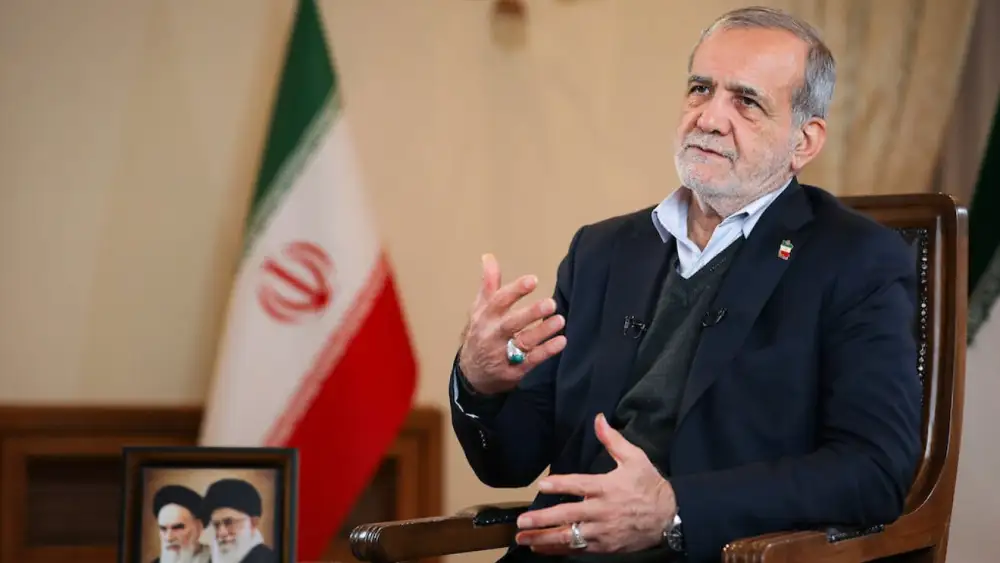
A top Iranian official appeared to threaten preemptive action against Israel on Monday, as Tehran and other Iranian cities saw protest rallies over a crippling financial crisis and soaring annual inflation rate of 42%.
Ali Shamkhani, a political adviser and representative of Iran’s Supreme Leader Ali Khamenei in the Defense Council, issued the threat on X, using indirect language in a post written in Hebrew on his account.
It appeared shortly after U.S. President Donald Trump said his country would “knock the hell out of” Iran’s government if it attempted to rebuild nuclear sites targeted by the U.S. and Israel in June. Trump made the comment during a press conference he gave in Florida, alongside visiting Israeli Prime Minister Benjamin Netanyahu.
“Under Iran’s defense doctrine, some responses are determined even before the threats reach the implementation stage,” the text on Shamkhani’s account read. “Iran’s missile and defense capabilities are uncontrollable and do not require authorization. Any aggression will be met with a severe, immediate, and unexpected response.”
In parallel, Iran’s leadership is facing rare expressions of internal dissent over the country’s spiraling economic crisis, which has left the national currency at an all-time low of 1.4 million rials against a single U.S. dollar.
The head of Iran’s central bank, Mohammad Reza Farzin, resigned on Monday, local news media reported. Iran’s former economy minister Abdolnaser Hemmati was appointed to replace Farzin.
The crisis has unfolded amid Trump’s “maximum pressure” campaign, which leverages sanctions and other measures to secure a new deal on Iran’s nuclear program following the joint Israeli and American strike on that program’s key sites in June.
Commenting on the protests by thousands of people in Iranian cities, Pezeshkian wrote on X: “The livelihood of the people is my daily concern,” adding that the government planned to “reform the monetary and banking system and preserve the purchasing power of the people.”
The interior minister was instructed to “hear the legitimate demands of the protesters through dialogue with their representatives,” Pezeshkian added.
Iran has seen repeated waves of popular protests since 2009 over a host of issues, including the religious oppression practiced by its theocratic rulers.
In December 2024, hundreds of people staged a vocal protest at Tehran’s iconic Grand Bazaar, declaring a strike at a place that had served as a focus of the protests of the 1979 Islamic Revolution.
The current regime, then led by Ayatollah Ruhollah Khomeini, was installed there after it toppled Shah Mohammad Reza Pahlavi. The rial’s value was 820,500 per dollar on the unofficial market back then.
Iran is also plagued by a five-year drought that has reportedly depleted underground reserves and ravaged the country’s agricultural sector.
Security forces have repressed previous protest waves with deadly force and arrests. Videos shared online on Monday showed security forces firing tear gas to disperse some of the protests in Tehran and at least two other cities.
An X account whose handle is Mossad Farsi, which was opened in June and which has more than 50,000 followers, featured a Farsi text post on Monday that i24 News reported had encouraged Iranians to protest against their regime, assuring them, “We are with you in the field as well,” as per the television channel’s translation.
In previous checks, JNS was not able to verify an official Mossad affiliation with the account. Netanyahu and other Israeli officials have repeatedly called on Iranians to overthrow the mullah regime and assured Iranians of Israel’s friendship toward their nation, with which Israel had close cooperation before 1979.
The 12-day war in June between Israel and Iran, in which the U.S. used heavy bombers to target nuclear sites, followed a war between Israel and Hamas, which triggered the war on Oct. 7, 2023, by invading Israel.
Israel bombed military targets across Iran and assassinated dozens of top officers and nuclear scientists in a campaign that is said to have left the Islamic Republic with limited to nonexistent aerial defenses. The Israel Air Force gradually moved on to targeting government buildings and regime symbols as the war progressed.
Iran fired thousands of missiles into Israel, killing some 30 people and causing thousands to temporarily relocate, but hitting few crucial military and infrastructure targets.
Hamas and Hezbollah were Iran’s main proxies in its campaign against Israel, widely understood to serve as deterrents against Israel thanks to the terrorists’ possession of Iranian ballistic weapons and funding. Hezbollah accepted a ceasefire deal with Israel in November 2024 and Hamas agreed to one in October 2025.
Analysts believe Hezbollah, whose entire upper echelon was killed, along with that of Hamas, was severely weakened before it agreed to pull back from southern Lebanon. Hamas’s ability to target Israel has reportedly been eliminated, outside limited attacks on some of the thousands of Israel has deployed in the Gaza Strip to dismantle the terrorist group.
In December 2024, the pro-Iranian regime of Bashar Assad in Syria fell, in what observers said was largely a result of the Iranian axis’ weakening during the war.
Iran has denied having any plans to obtain nuclear arms, despite a vast body of evidence suggesting otherwise. Many experts believe that the determination of the radical Mullah regime to develop this weapon was likely only strengthened by its losses in the war.