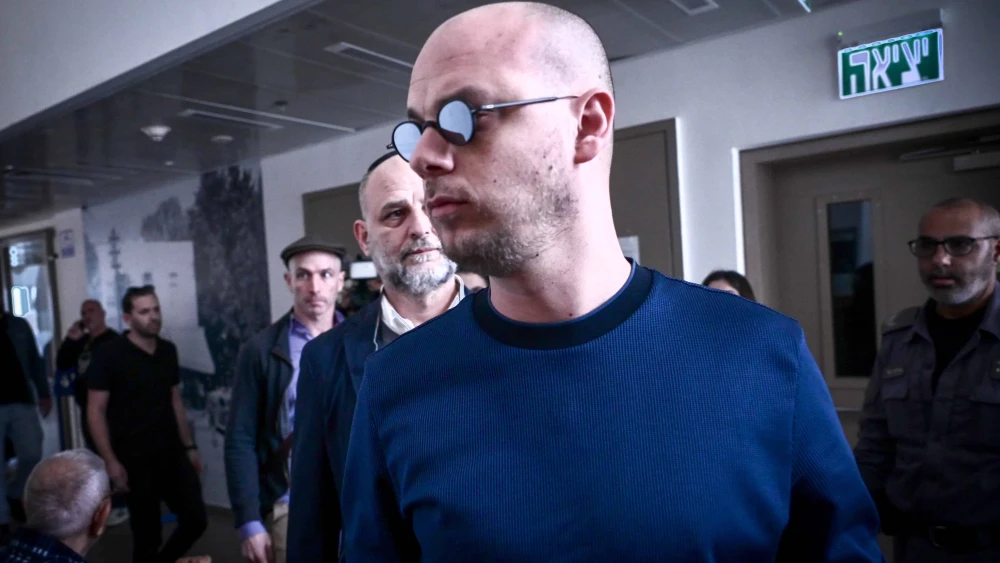
Eliezer Feldstein, the main suspect in the secret document leak scandal, gave a three-hour interview, aired over three nights this week on Israel’s Channel 11, in which he implicated Israeli Prime Minister Benjamin Netanyahu in the affair.
“He knew everything,” Feldstein told Omri Assenheim, host of the program “It Will be Good,” speaking of the prime minister. “He’s the one who in the end stood behind the leak to the Bild newspaper.”
The “secret documents affair” involves the passing of a classified document from the IDF Military Intelligence Directorate to Feldstein, who worked as a communications adviser for the prime minister.
The document, obtained from the computer of a mid-level Hamas commander, outlined the Hamas strategy for a hostages-for-ceasefire deal. According to the document, Hamas didn’t want a deal.
The document, provided by Feldstein to Bild, became the basis of a Sept. 6, 2024, story in the German newspaper, which reported that Hamas’s goal in hostage talks was to buy time to rebuild its military capabilities, “exhaust” Israel’s military, and “exert psychological pressure” on the hostages’ families, who would, in turn, pressure the Israeli government.
The document bolstered the narrative of the prime minister that only military pressure would free the hostages.
The leaked document came at an opportune time for Netanyahu, who faced increased public pressure after the bodies of six hostages were discovered in a tunnel complex in the Gaza Strip on Aug. 31, 2024. They were murdered at point-blank range by their Hamas captors.
Feldstein said the discovery of the murdered Israelis contradicted Netanyahu’s message that “military pressure brings back hostages,” showing instead the opposite, that “military pressure kills hostages.”
Netanyahu referred to the Bild story in a Sept. 8 Cabinet meeting, saying it revealed that Hamas planned “to tear us apart from within,” but “the great majority of Israel’s citizens are not falling into this Hamas trap.”
Opponents of the prime minister’s strategy, including hostages’ families calling for an end to the war to free the captives, accused Netanyahu of purposely leaking the document to torpedo a hostages’ deal so he could continue to pursue his war aims.
Netanyahu’s office said the document’s release didn’t compromise the effort to free the hostages but helped it by exposing Hamas’s methods of applying psychological pressure, blaming Israel for the failure of talks “when everyone knows—as has been confirmed repeatedly by U.S. officials—that Hamas is preventing the deal.”
Meanwhile, the Information Security Department in the Military Intelligence Directorate opened an investigation to discover how the document leaked. They said the release of the document could compromise Israeli methods of intelligence collection.
The investigation led to the Oct. 27, 2024, arrest of Feldstein. On Nov. 21, 2024, he was indicted on charges of endangering national security by passing leaked military documents. A second suspect, Aaron Rosenfeld, an NCO in the Military Intelligence Directorate, who passed the document to Feldstein, was also indicted.
Feldstein told Channel 11’s Assenheim that his direct supervisor, Jonathan Urich, strategic adviser to the prime minister, sent him a message that “The boss [Netanyahu] is satisfied.”
Feldstein then said he had a conference call with Netanyahu and Urich. Netanyahu told Feldstein the publication was very important and thanked him.
Feldstein said he did everything with the knowledge of Urich. “He knew everything that I knew. Where the document came from, what was its source,” Feldstein said.
“I have no doubt that Urich updated the prime minister,” he added. “But you don’t have proof?” asked Assenheim. “No,” Feldstein said.
Netanyahu’s office has denied the premier initiated the leak, saying he learned of the document from the media. On Nov. 22, Netanyahu posted a video online defending Feldstein.
“I know Eli Feldstein. He is a patriotic Israeli, a passionate Zionist. … There is no way in the world that he would have done anything deliberately to compromise the security of the state,” the prime minister said.
Netanyahu accused Israel’s security services of selective enforcement, pointing to numerous leaks that had not been investigated at that time, including a video from the Sde Teiman detention facility claiming to show IDF soldiers as war criminals.
The prime minister also questioned why he hadn’t been given the document. “This document should have been on my desk, I should have been making decisions based on this material, and I certainly should not have been excluded from it. And this is not the first time that I have been denied vital information,” he said.
While Feldstein was largely critical of the prime minister during the interview, he found common ground on this occasion.
“You’re dealing with the most sensitive issue in the world—the hostages. … So tell me, shouldn’t we not have every document, every letter, every note, every paper, every little thing that touches on the most sacred topic. … Bring it to the Cabinet,” Feldstein said.
Qatargate
Feldstein also finds himself involved in another scandal involving the Prime Minister’s Office, dubbed “Qatargate.”
Two Netanyahu advisers, Urich and Israel “Srulik” Einhorn, were reportedly hired by Qatar through their PR company Perception to improve the country’s image.
A recent i24 investigation found that Feldstein coordinated with Einhorn to promote pro-Qatari narratives and portray the Gulf state in a positive light in Israeli media. They portrayed Qatar as playing “a central role in regional negotiations,” and others, such as Egypt, as “unreliable or self-interested.”
On Monday, following the i24 investigation, former Prime Minister Naftali Bennett sharply attacked the incumbent: “Netanyahu’s office betrayed the State of Israel and IDF soldiers during wartime and acted on behalf of Qatar for monetary gain, and Netanyahu himself is covering it up,” he said.
Minister of Diaspora Affairs and Combating Antisemitism Amichai Chikli also called for a full investigation. Speaking to radio station Kan Reshet Bet on Wednesday, Chikli said, “There is no way to defend this thing. It is shocking.”
Further compromising Feldstein is the fact that his salary was not paid by the Prime Minister’s Office but rather through a businessman by the name of Gil Berger, who it turned out received the money from Jay Footlik, a U.S.-based Qatari lobbyist.
Feldstein said he had no knowledge of where his salary came from and never asked. He portrayed himself as the victim. “In hindsight, I have good reason to think that they used me to serve interests that weren’t also necessarily the interests of the prime minister.”
In March, Urich and Feldstein were arrested by Israeli police on suspicion of contact with a foreign agent, money laundering, bribery, fraud and breach of trust. They were released on April 22 to house arrest.
Einhorn has not yet been questioned as he resides in Serbia.

Netanyahu, questioned by police on March 31 about Qatargate, accused law enforcement officials of seeking to overthrow his government. “I understood that there was a political investigation here, but I did not know to what extent. … I said, ‘Show me material, show me something,’ but they had nothing to show.”
The Prime Minister’s Office issued a statement to the program “It Will be Good,” denying all the accusations Feldstein made against it.
“This is a long series of false and recycled claims, all of which rely on the testimony of a person with clear personal interests, who is trying to deflect responsibility from himself by systematically defaming the prime minister and his entourage. The prime minister never gave an order to leak classified information to Feldstein, neither directly nor indirectly. He did not approve the circumvention of censorship, did not manage or know any external payroll mechanism, and was not a party to any illegal move,” the statement said.
“The content of the conversations with Feldstein attributed to the prime minister is completely fabricated. The prime minister rejects any attempt to attribute extraneous motives, improper considerations or illegal actions to him. Referring to Jonathan Urich, the court has already ruled that ‘Qatar-fake’ is a libel where there is no offense and, in fact, it turned out that it was invented and used for personal and political defamation,” the statement continued.
Netanyahu likely referred to a November decision by the Central District Court in Lod rejecting an appeal by the police asking to prevent Urich from returning to work for the Likud Party. However, Urich is still prevented from working directly with Netanyahu and his staff.
In November, Israeli police said it had completed its investigation into Qatargate and in 60 days would transfer the file to the State Attorney’s Office, which would decide whether to pursue prosecution against suspects in the Prime Minister’s Office.