


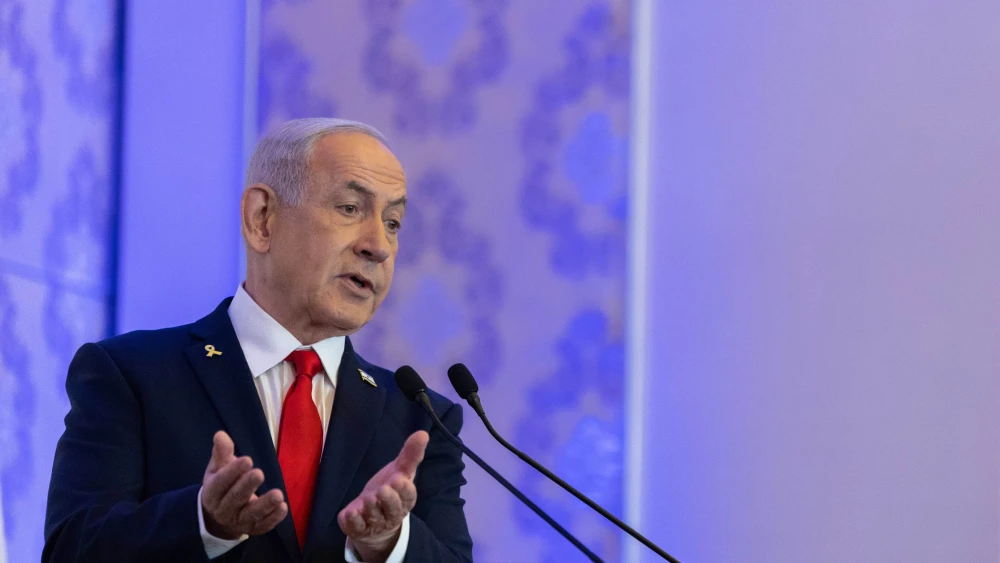
Israeli Prime Minister Benjamin Netanyahu warned on Monday that the Jewish state increasingly needs to become self-reliant amid ongoing attempts to sanction the government’s ability to import weapons.
“Israel is in a sort of isolation,” Netanyahu said, speaking at the annual conference of the Finance Ministry’s Accountant General in Jerusalem.
“We will increasingly need to adapt to an economy with autarkic characteristics,” he continued, using the term for economic self-sufficiency. “I am a believer in the free market, but we may find ourselves in a situation where our arms industries are blocked.”
According to Netanyahu, Jerusalem has no choice but to morph into “Athens and super-Sparta,” because in the coming years, the Jewish state will continue to “have to deal with these attempts to isolate us.”
The premier argued that mass Muslim migration to Europe has created a “significant and vocal minority” that bends E.U. governments on issues related to the Gaza Strip, and claimed that this influence was fueling sanctions and limiting Jerusalem’s ability to import weapons parts.
In addition, “enemy states, including Qatar, have invested vast sums to influence global discourse through social networks,” Netanyahu stated.
According to Amit Segal, a reporter for Israel’s Channel 12, the remarks were prompted by ongoing disagreements between Netanyahu and Israeli Finance Minister Bezalel Smotrich regarding the defense budget.
The reporter said that Netanyahu sought to convince the Finance Ministry’s senior officials that they needed to agree with his vision, including a plan to move defense infrastructure underground.
After leading indices on the Tel Aviv Stock Exchange switched from gains to losses on Monday, Netanyahu’s office issued a clarification.
“To all the doom-and-gloom forecasters about the economy: in the end, the stock market in Israel is the strongest in the world,” said Netanyahu.
“The shekel has strengthened, the deficit has shrunk despite the war, and foreign investment in R&D is the highest in the world after the United States. Investing in Israel is the smart thing to do,” he added.
“However, what we will continue to do is increase investments in weapons production so we won’t be dependent on weak Western European leaders who cave to the extreme Muslim minorities in their countries—and that is exactly what we are doing,” Netanyahu stated.
The Bank of Israel held its benchmark interest rate steady in July at 4.5% for the 12th consecutive meeting, citing moderate economic recovery amid ongoing domestic and global uncertainty.
The economy grew at a 3.7% annualized rate in the first quarter, nearing its long-term growth trend, while annual inflation over 12 months fell to 3.1%, slightly above the upper limit of the Bank of Israel’s target range.
Since the end of May, the shekel strengthened significantly, appreciating by approximately 7.3% against the U.S. dollar and 3.8% against the euro.
Addressing a delegation of some 250 U.S. state legislators after leaving the Finance Ministry on Monday afternoon, Netanyahu said there was an “active effort” ongoing to erode Israel’s ties with the United States.
These efforts are “orchestrated by the same forces that supported Iran,” he continued, accusing China and Qatar of spearheading attacks on the Jewish state’s very legitimacy in the United States and on social media.
“We can break this siege, and we will,” the prime minister vowed.


