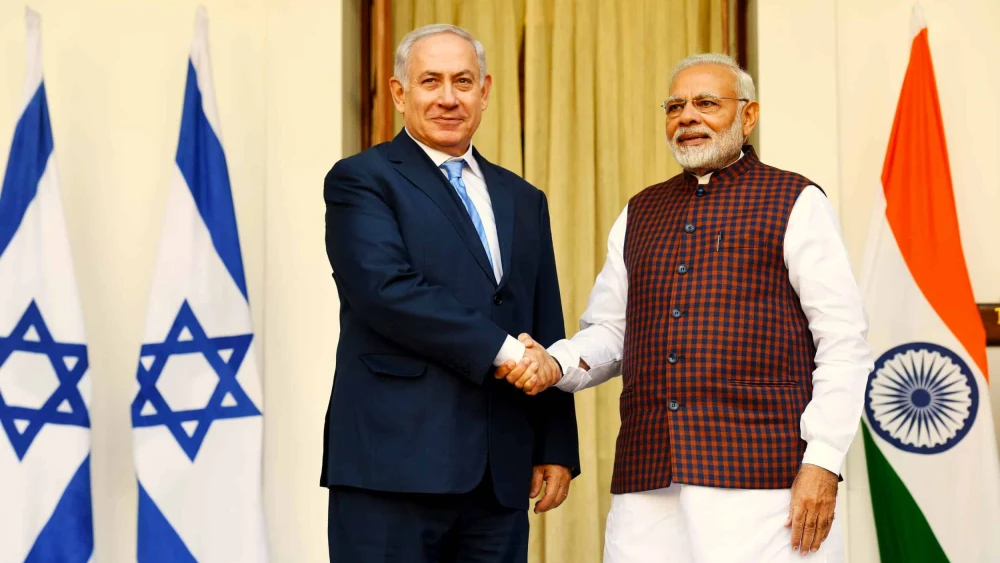
Israeli Prime Minister Benjamin Netanyahu said on Sunday that a planned visit by his Indian counterpart this week was part of a broader vision to build alliances to counter both Shi’ite and Sunni Muslim radicalism.
Speaking at the start of the weekly Cabinet meeting in Jerusalem, the premier said Israel would seek to deepen economic, diplomatic and security cooperation with New Delhi, while expanding partnerships with Mediterranean, African, Asian and moderate Arab countries.
Netanyahu hinted at new Asian partner nations “that I won’t detail at the moment,” saying he would present them “in an organized manner.”
According to the long-time Jewish leader, “The intention is to create an axis of nations that see eye-to-eye regarding the reality, challenges and goals against the radical axes—both the radical Shi’ite axis, which we have struck very hard, as well as the emerging radical Sunni axis.
“All of these nations share a different perception, and our cooperation can yield great results and, of course, ensure our resilience and our future,” the prime minister added.
Netanyahu noted that Indian Prime Minister Narendra Modi would be visiting Jerusalem on Wednesday, where he is scheduled to address Knesset lawmakers, hold an innovation event and visit Israel’s Yad Vashem national Holocaust memorial alongside the premier.
Netanyahu noted he was “personal friends” with his Indian counterpart, explaining: “We speak frequently on the phone and visit one another. I have visited India, and Modi has visited here.”
“The fabric of this relationship has grown tighter,” Netanyahu said. “He is coming here so we can tighten it further through a series of decisions related to strengthening the cooperation between our governments and countries, including economic, diplomatic and security cooperation.”
Netanyahu in a speech to Knesset lawmakers late last year warned of new emerging threats, in what was reportedly a veiled reference to Turkey and Qatar’s expanding regional influence following Iran’s weakening in the June 2025 war between Israel and Tehran.
In response to Ankara’s growing hostility toward the Jewish state during the war on Hamas that started on Oct. 7, 2023, Jerusalem has sought closer alliances with nearby nations like Cyprus and Greece.
Ties between India and Israel have been steadily improving since Modi’s election in 2014. The premier has transformed the country’s stance from Cold War-era alignment with the Arab world to a more pro-Israel one.
Under Modi, India and Israel have significantly deepened their strategic, economic, and defense ties, a cooperation driven by the two countries’ shared security concerns and tech collaboration. Bilateral trade has surged, more than doubling to a record-breaking $5 billion in 2024.