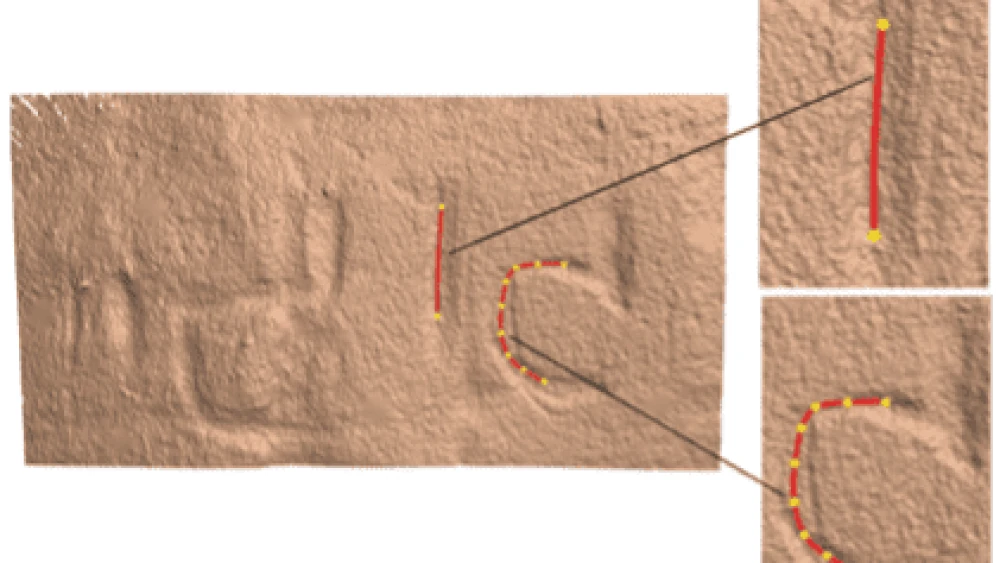
Researchers at the Hebrew University of Jerusalem have developed software, called ArchCUT3-D, to extract and analyze ancient engravings that could lead to a better understanding of the engravers’ background and skills.
The software extracts thin, three-dimensional slices of man-made engravings, and uses micromorphological incision recognition to closely examine size, shape and color for precision analysis.
In the study, published in “Nature Humanities and Social Sciences Communications,” researchers scanned two ancient engravings (Ibex and Chariot), as well as contemporary graffiti (Gigi) from Timna Park (Site 25) in the Arava Desert near Eilat, Israel. The findings show that engravings were created using distinct techniques, stroking and “peeling,” enabling researchers to potentially distinguish an engraver’s level of skill and previous experience.
The team hopes their findings will lead to further research and inspire interdisciplinary collaborations to unravel the mysteries surrounding these ancient artworks.
“Our research provides a fresh perspective on ancient rock engravings by delving into the intricacies of their production processes,” said professor Leore Grosman, head of the Hebrew University Computational Archaeology Laboratory. “By unlocking the technological secrets behind these engravings, we gain valuable insights into the craftsmanship, artistic expression and cultural context of our ancestors─even the background of each engraver.”
The research team also included Lena Dubinsky, a doctoral candidate at the Hebrew University of Jerusalem’s Institute of Archaeology, and Marcelo David, a researcher and lecturer at the university’s Computational Archaeology Laboratory.
The software can be downloaded for free here.