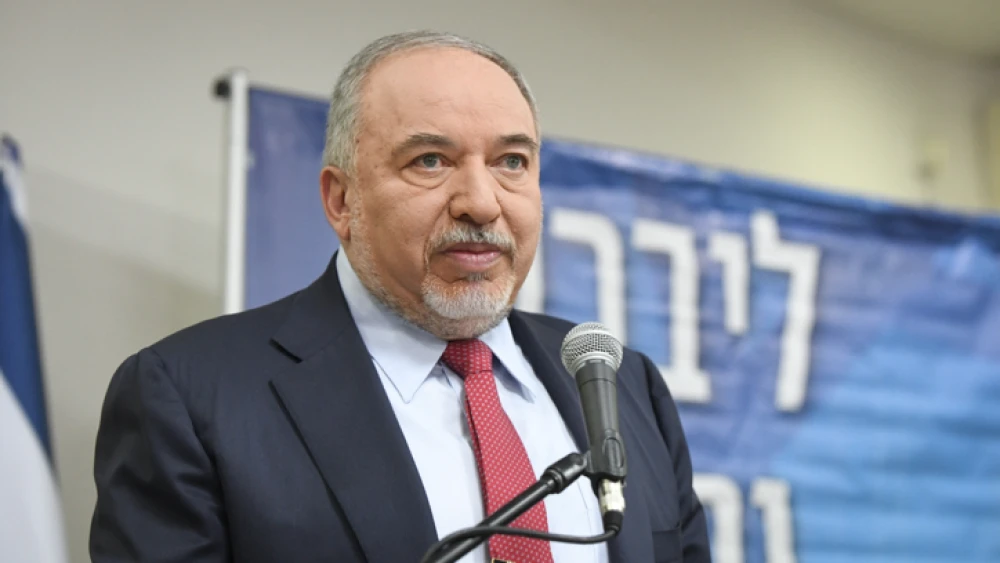
The second Knesset election of 2019 is getting off on the wrong foot for Prime Minister Benjamin Netanyahu and the rest of the right-wing camp, who have a real chance of being voted out of power. A poll conducted by the Maagar Mohot Institute for Israel Hayom shows that without Yisrael Beytenu leader Avigdor Lieberman, the right will win only 56 seats, five seats short of the minimum 61 needed to form a governing coalition.
However, there was also good news for the right-wing parties: According to the poll, all of them—with the exception of Moshe Feiglin’s Zehut Party—are expected to make it past the minimum electoral threshold of 3.25 percent.
The poll, conducted among a representative sample of 507 adult Israelis with a margin of error of 4.3 percent, also indicated that whether the parties to the Right of the Likud or the parties on the Left manage to join forces and run as a “mega-bloc,” Lieberman will remain in a position to tip the scales.
Netanyahu’s Likud Party was predicted to win 31 seats, with the center-left Blue and White Party close on its heels at 30 seats. Labor, under newly elected leader and veteran legislator Amir Peretz, was predicted to win eight seats, with the same number predicted for the United Right.
United Torah Judaism was predicted to win seven seats—the same number projected for the secularist Lieberman. Six seats were predicted for both Shas and Meretz, under new party leader Nitzan Horowitz.
Four seats each were predicted for former prime minister, defense minister, and IDF chief of staff Ehud Barak’s new party and for the New Right under former Education Minister Naftali Bennett.
The poll predicted nine seats for the Joint Arab List.
When asked who they thought was best qualified to serve as prime minister, 35 percent of respondents picked Netanyahu. Less than one-quarter (22 percent) of respondents picked Blue and White leader Benny Gantz, and 12 percent said Barak was the best candidate for prime minister.
The poll also looked into the viability of various joint lists and party mergers. According to the results, if Labor MK Itzik Shmuli or Stav Shafir had been elected head of Labor and as a result, Labor had run on a joint list with Barak’s party and Meretz, the resulting left-wing list would have won 19 seats. However, that appears unlikely to happen with Peretz as Labor leader. If that scenario had come to pass, the left-wing list would have chipped away at Blue and White, leaving Gantz’s party with only 26 seats.
On the other side of the political map, if Habayit Hayehudi, the National Union, Otzma Yehudit, the New Right and Zehut were to run together, the resulting right-wing list would scoop up no less than 19 seats, the poll showed. In that case, the list would take some seats away from the Likud, leaving Netanyahu’s party with 25 seats, and the right-wing bloc would still be unable to form a coalition without Lieberman.
This article first appeared on Israel Hayom.