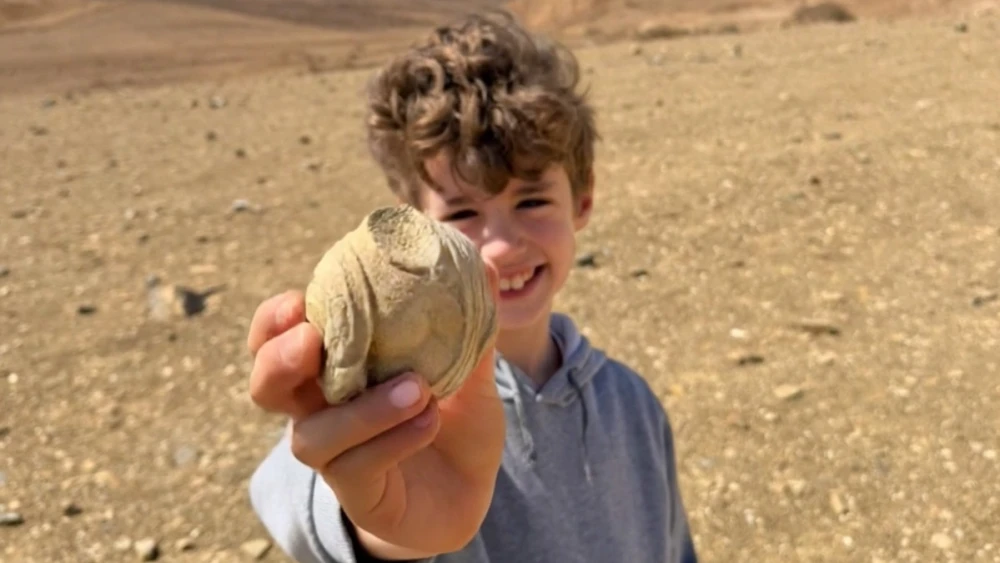
An 8-year-old Israeli boy discovered a rare 1,700-year-old statuette fragment dating to the Roman period while hiking with his family in the Ramon Crater in the Negev Desert, the Israel Antiquities Authority announced on Monday.
“I was looking for special things on the ground that I could show in class,” said Dor Wolynitz of Rehovot. “Suddenly, I noticed an interesting stone with stripes lying on the ground and picked it up. It seemed unusual, so I showed it to Akiva, an archaeologist and my dad’s friend who was with us on our trip.”
The fragment, measuring about six by six centimeters, depicts part of a human figure draped in flowing folds of fabric resembling a cloak. Archaeologists date it to approximately 1,700 years ago. Although the fragment lacks identifying marks, Goldenhersh said archaeologists believe it may depict the Roman god Jupiter or Zeus-Dushara, a Nabatean deity associated with Zeus.
“At first I thought it was a fossil,” said Akiva Goldenhersh, a supervisor in the Israel Antiquities Authority’s Antiquities Theft Prevention Unit. “But then I noticed the sculpted folds of the garment, and I was very excited.”
The artifact was examined in Israel Antiquities Authority laboratories by geologist Nimrod Wieler, who determined it was made of phosphorite, a mineral common in the Negev.
“Being made of local material reasonably indicates the statuette was made in Israel and not imported,” said Goldenhersh.
According to Goldenhersh, the artistic style and clothing point to a Roman-period origin. The figure appears wrapped in a himation, a heavy outer garment common in classical Greek and Roman dress.
“The manner of sculpting the folds and the choice of such a delicate material indicate a very high level of skill on the part of the artist,” he said.
“This tiny find reflects the combination of local traditions with influences from the classical world,” Goldenhersh added.
The Ramon Crater lay along the ancient Spice Route linking southern Arabia and the Far East with Mediterranean ports.
During the Nabatean and Roman periods, caravans transported frankincense, myrrh, spices and other luxury goods across the Negev along this major trade artery. Most archaeological remains in the region date from the third century BCE to the fourth century CE, when the Nabateans — whose capital was Petra — developed an extensive desert trade network.
Archaeologists have uncovered caravan stations, forts, water systems and agricultural installations in the area, evidence of the intensive human activity that once flourished in the harsh desert environment.
Dor and his family turned the artifact over to the IAA’s National Treasures Department. The agency presented the boy with a certificate recognizing his actions.
“Every archaeological find is part of our shared heritage in this land,” Goldenhersh said. “Handing it over to the National Treasures allows us to study it, preserve it and make the knowledge accessible to the public.”
Israeli Heritage Minister Rabbi Amichai Eliyahu praised the discovery and the family’s response.
“On a family trip of reservists, a curious child discovered a piece of our past,” said Eliyahu. “I congratulate Dor for his vigilance and responsibility. Thanks to him, the find will be preserved and will help tell the story of the people and cultures that passed through here thousands of years ago.”
The authority awarded Dor a certificate after the family turned the artifact over for preservation and study.
Originally published by TPS.