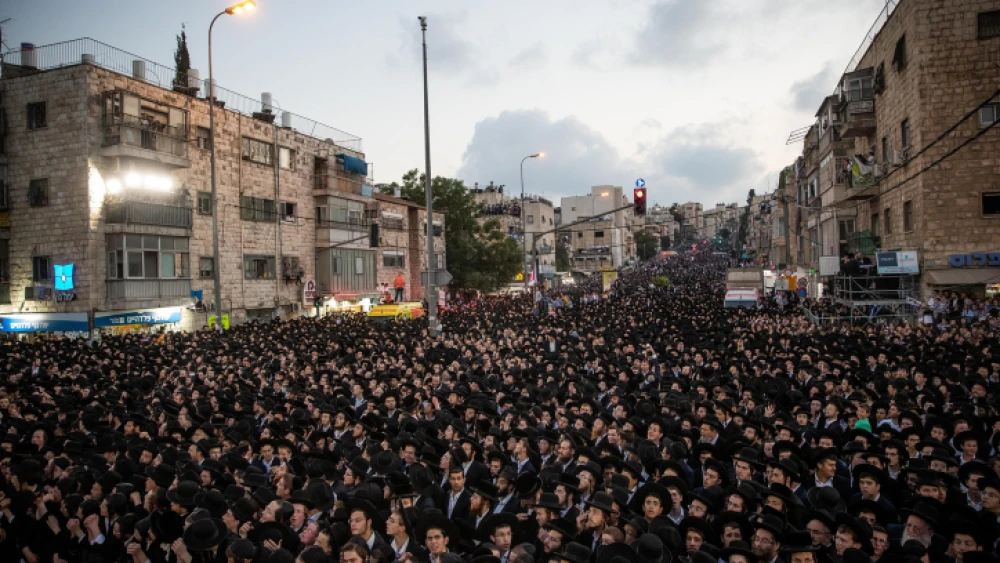
An estimated 50,000 ultra-Orthodox Israelis converged on Jerusalem’s Bar-Ilan intersection on Sunday for a United Torah Judaism Party election rally.
Top religious leaders urged them to get out and vote, while UTJ leader Deputy Health Yaakov Litzman warned that Tuesday’s election is part of a struggle “over our right to be ultra-Orthodox, to observe the commandments, to lead a life of Torah and faith.”
UTJ MK Moshe Gafni compared Blue and White No. 2 Yair Lapid and Yisrael Beiteinu leader Avigdor Lieberman, who have run on a secularist, and in some cases, anti-Orthodox platform, with the Jewish people’s biblical arch-nemesis, Amalek, according to a report in The Times of Israel.
The event was also attended by the head of the Gur Hassidic movement, Rabbi Yaakov Aryeh Alter and Rabbi Chaim Kanievsky, one of the preeminent leaders of the ultra-Orthodox community.
Lieberman and Lapid have both called to force the ultra-Orthodox to serve in the Israeli military and said they would form coalitions without the religious parties.
The ultra-Orthodox community railed last month against Lapid over a satirical campaign video portraying ultra-Orthodox politicians as corrupt and extortionist.