


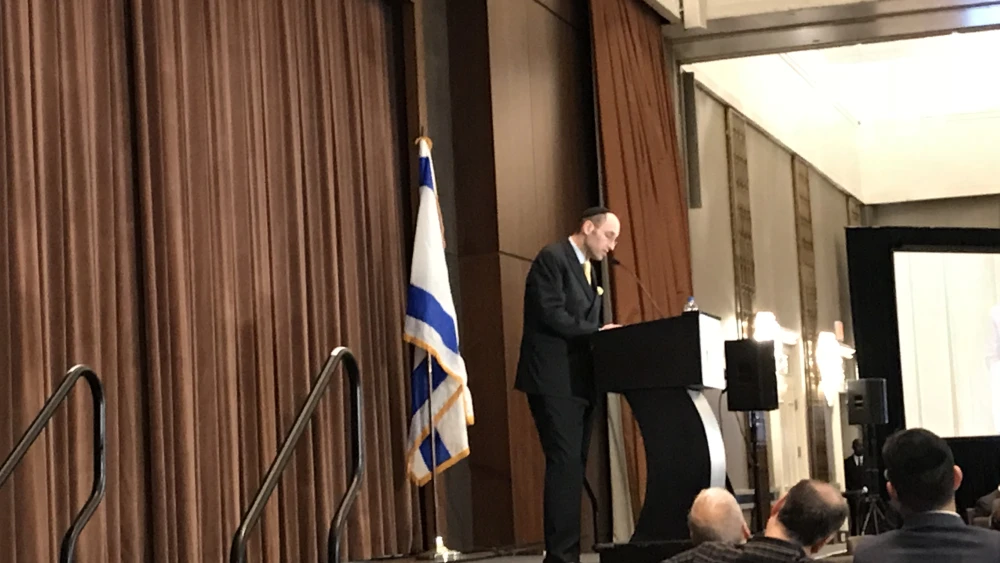
To promote Judaism and conservatism in the context of American life and ideals and Zionism, the Jewish Leadership Conference (JLC) held its second annual conference in New York on Oct. 28.
“We believe conservative ideas because they make America better,” said Jonathan Silver, JLC executive director, in his introductory speech.
“Along with political leaders and rabbis, journalists and commentators, educators and activists, we came together in the belief that now is the time for American Jews to articulate and advance a new agenda: in defense of religious freedom, in favor of school choice, allied with Israel in a dangerous world, tough-minded in the global fight against anti-Semitism, and supportive of the traditional family,” JLC said about its event last year.
Additionally, thoughts and prayers were given throughout the conference to the family and friends of the 11 Jewish worshippers shot and killed by a gunman during Shabbat-morning services at the Tree of Life*Or L’Simcha Synagogue in Pittsburgh.
“Thankfully, attacks like this in America are rare,” said Silver.
Prominent American-Israeli journalist Caroline Glick talked about the rise in anti-Semitism in the United States and worldwide, citing four kinds of anti-Semitism: Nazi anti-Semitism/white supremacy; jihadism; that encouraged by figures such as Nation of Islam Louis Farrakhan and Women’s March leader Linda Sarsour, whom Glick called “very powerful”; and anti-Zionism, which Glick said is not widely understood as anti-Semitism.
In her well-received speech, Glick focused mostly on the last category. She said that anti-Zionism is anti-Semitic because it targets Israel, as it is the largest Jewish community in the world.
She also noted how the anti-Zionist BDS movement ostracizes Jews, especially on college campuses. In particular, she mentioned recent cases at the University of Michigan, as well as a boycott of two New York University pro-Israel groups by 53 student organizations, in addition to a few other cases as examples.
Glick added that BDS targets not Israel, but American Jews. Her message to the bigots: “You are the haters of Abraham, Isaac and Jacob.”
.@CarolineGlick speaking at #JewishLeadershipConference, talking about dangers of anti-Semitism pic.twitter.com/kju1oiSAYw — Jackson Richman (@jacksonrichman) October 28, 2018
Notable names and speakers
Other speakers included Rabbi Meir Soloveichik, the great-nephew of 20th-century leader of American Jewry Rabbi Joseph B. Soloveitchik; and Israeli Minister of Justice Ayelet Shaked, who reportedly spoke with U.S. Attorney General Jeff Sessions following the Pittsburgh synagogue attack.
Washington Free Beacon co-founder and editor-in-chief Matthew Continetti, Weekly Standard founding editor Bill Kristol and National Review editor Rich Lowry conducted a discussion about the legacy of the late intellectual and writer Charles Krauthammer, who passed away from cancer in June.
The Tikvah Fund, which was a major participant in the conference, announced a scholarship in Krauthammer’s memory. The organization also spoke of an initiative to translate the former psychiatrist’s writings into Hebrew.
Former Jewish Agency head Natan Sharansky—former longtime refusenik and leader of the fight to release Soviet Jewry, who spent eight years in gulag—was awarded the inaugural Tikvah Prize for his heroism as a Jewish statesman and more.
Breakout sessions at the conference featured, but were not limited to, Elliott Abrams, who served as a foreign-policy adviser under U.S. Presidents Ronald Reagan and George W. Bush; Harvard University professor Ruth Wisse; New York University professor and free-speech advocate Jonathan Haidt; Israeli philosopher and author Yoram Hazony; and Middle East scholar Martin Kramer.



