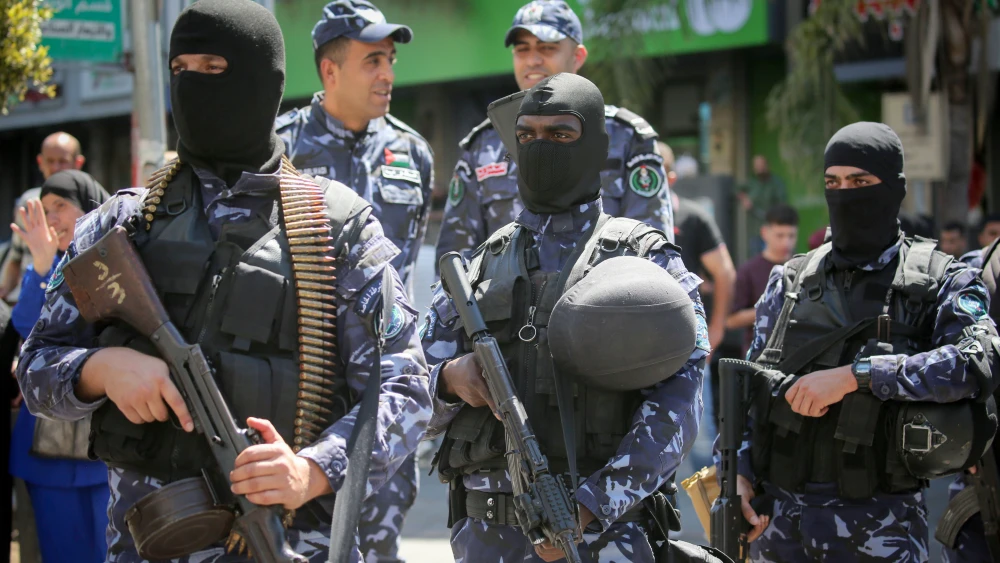
An Israeli reserve soldier in civilian clothes was beaten, disarmed and abducted by Palestinian Authority police on Sunday night after they set up an illegal roadblock in Area C of Judea and Samaria, according to his attorney. The officers reportedly handcuffed the soldier, took his weapon and drove him into Area A near Ramallah before eventually transferring him to the Israel Defense Forces.
Under the Oslo Accords, Area C is under Israeli municipal and security control, while Area A is under full Palestinian Authority control.
The soldier, who was carrying his personal weapon, was traveling on Sunday night from the Gush Talmonim bloc in the Binyamin region of Samaria toward Route 443 when he encountered a police vehicle blocking the road near the P.A. town of Beitunia.
According to an account provided by his attorney, Chaim Bleicher of the Honenu legal-aid organization, the soldier approached the roadblock to determine whether it was an Israeli security force. He then discovered that the officers were Palestinian Authority police.
The officers reportedly surrounded his vehicle and called additional P.A. police to the scene. They attempted to take his weapon, but the soldier refused to surrender it.
The P.A. officers then pepper-sprayed him in the face and beat him before taking his weapon. They subsequently pulled him from the car, handcuffed him and placed him in a Palestinian police vehicle.
According to the soldier’s account, he was driven toward Ramallah, in Area A, and held for approximately an hour before being taken to the outskirts of the city and transferred to IDF forces.
According to Bleicher he suffered bruising and other injuries, as well as irritation and burns to his face from the pepper spray.
Bleicher subsequently sent a letter to Israeli Defense Minister Israel Katz and IDF Central Command chief Maj. Gen. Avi Bluth demanding the arrest of the Palestinian police officers involved.
“This is an extremely serious incident,” Bleicher wrote. “Armed Palestinian police officers entered Area C in violation of the law, endangered the security of the area, and assaulted and abducted an Israeli citizen.”
“This represents a serious and dangerous attack both on the individual soldier and on the sovereignty of the IDF and the security forces,” he continued. “We are requesting, on behalf of the victim, that arrests of the Palestinian police officers who attacked and beat him be carried out as soon as possible.”
Bleicher told JNS that he had not yet received a response to the letter.
Civil Administration retracts initial account
The incident initially drew controversy after Israel’s Civil Administration issued a statement suggesting that the Israeli had entered Area A and had been driving in a dangerous area.
The Civil Administration later corrected the account, explaining to JNS: “Further to the statement issued last night (Sunday night), we would like to clarify that, due to an error in the initial report received by the Civil Administration, the statement included incorrect information, and we regret the error.”
“The Israeli resident mentioned in the statement did not enter Area A, but was in Area C in close proximity to it,” the Civil Administration said. “The incident is being reviewed in order to draw the necessary lessons.”
The correction came after the Binyamin Regional Council sharply criticized the Civil Administration for its initial response.
The council said the administration had “chosen to point an accusing finger at the Israeli resident,” claiming that he had been driving in a dangerous area, “rather than seriously addressing the unauthorized activity of P.A. police in Area C.”
“The security authorities must fulfill their responsibility and secure the roads that were built to serve Israeli communities,” the council said.
Binyamin Regional Council head and Yesha Council chairman Yisrael Ganz added: “The serious incident last night proves once again that the Oslo Accords have long since become an empty piece of paper.” It was “unacceptable,” he continued, that P.A. police “operate in violation of the agreements in Area C, stop a reserve soldier and take his weapon, while the State of Israel blames the Israeli who was driving on the road.”
“It is time to recognize reality, cancel the Oslo Accords, and allow settlement and free movement in the open areas throughout Binyamin, Judea and Samaria,” Ganz added. “At the same time, I call on decision-makers to act immediately to open a safe and secured route between the Dolev–Talmonim bloc and Route 443.”
Honenu called for the Palestinian police officers involved in the attack to be arrested as soon as possible and urged the IDF to secure the road to ensure continued Jewish movement along the route. The organization also called on the military to prevent armed Palestinian forces from entering territory under Israeli security responsibility.