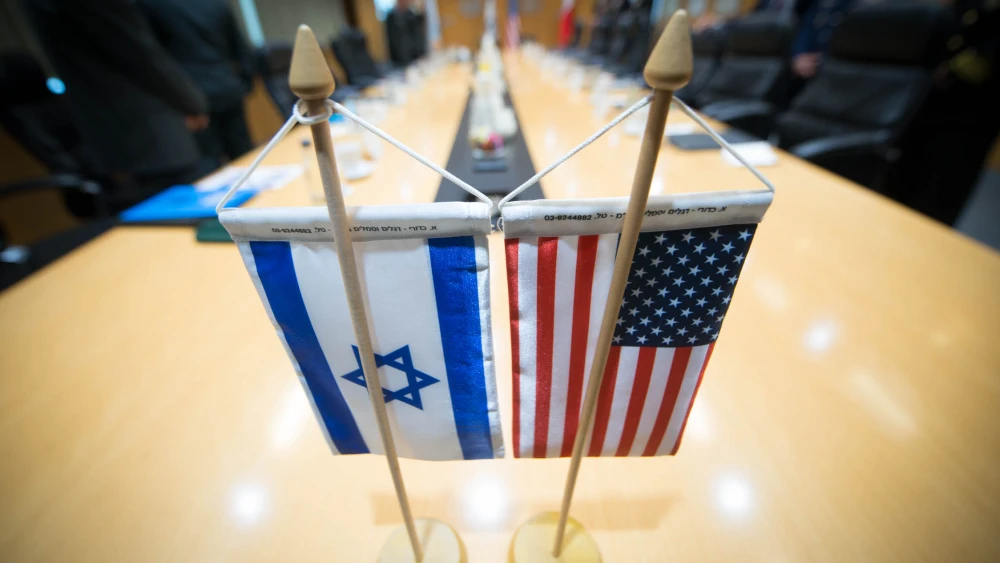
Rep. Mike Rogers (R-Ala.) is pushing back on claims that a provision in the fiscal year 2027 National Defense Authorization Act would cede control of U.S. military operations to Israel.
“Israel is far and away the best ally the United States has in the Middle East, and our cooperative programs with them strengthen our national security by giving our warfighters access to cutting-edge technologies,” Rogers, chairman of the House Armed Services Committee, wrote.
Rogers said Section 224 of the House committee’s NDAA draft, titled the “United States-Israel Defense Technology Cooperation Initiative,” does not create new Defense Department programs or transfer authority over U.S. forces.
“It simply adds transparency and improves efficiency by designating a single official to coordinate existing initiatives,” Rogers said. “In no way does it give away command and control of our military operations, personnel or equipment.”
The provision would require the secretary of defense to designate an executive agent to coordinate U.S.-Israeli defense technology cooperation, including joint research, development, testing, evaluation, integration and industrial partnerships. The measure also calls for identifying jointly developed or Israeli-origin technologies that could be integrated into U.S. military systems.
Rogers called claims that it would place the U.S. military under Israeli control “categorically false and misleading.”
“Misinformation in relation to Israel and our close partnership with them has always run rampant, and bad actors are all too happy to stoke these flames when given the opportunity,” he wrote.
Rep. Ro Khanna (D-Calif.) stated on June 1 that he is working with Rep. Thomas Massie (R-Ky.) to introduce an amendment striking Section 224 from the defense bill. Khanna has argued that the provision would deepen military integration between the two countries, describing it as a “fusion” of the U.S. and Israeli militaries.
The dispute comes as the House Armed Services Committee prepares to mark up the fiscal 2027 NDAA on June 4.
The Republican Jewish Coalition commended Rogers for “setting the record straight.”
“Section 224 strengthens American national security by deepening defense-tech cooperation with our closest ally in the Middle East,” the group stated. “The bad-faith claims about ‘ceding control’ are categorically false. The U.S.-Israel alliance makes both nations safer, stronger and more secure.”
AIPAC also thanked the congressman for “prioritizing initiatives that help make America safer and stronger.”
“Further partnering with our democratic ally Israel on defense issues helps give our troops a strategic advantage and helps modernize our military,” the organization stated.